Sunday Oct 04, 2026
Sunday Oct 04, 2026
Wednesday, 3 June 2026 00:22 - - {{hitsCtrl.values.hits}}
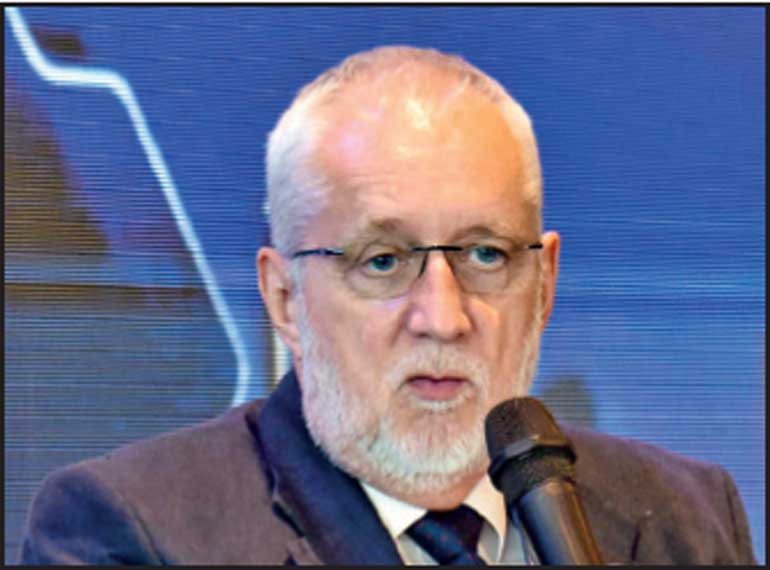
Delegation of the EU to Sri Lanka and the Maldives Head of Cooperation
Dr. Johann H.Hesse
The European Union (EU) last week urged Sri Lanka to develop a robust pipeline of investment-ready infrastructure projects and leverage innovative financing mechanisms to attract global capital, positioning its Global Gateway initiative as a high-quality and transparent model for funding strategic developments.
Addressing the Sri Lankan-German Business Forum 2026, Delegation of the EU to Sri Lanka and the Maldives Head of Cooperation Dr. Johann Hesse said Sri Lanka’s infrastructure ambitions, particularly in the maritime sector, would depend not only on funding availability but also on project preparation, governance standards, and regulatory certainty.
“Ports are not just infrastructure. They are a country’s gateway to the world,” he said.
He pointed out that the key challenge facing developing economies was no longer whether to invest in infrastructure, but how to finance it sustainably while supporting long-term economic transformation.
Against this backdrop, Dr. Hesse promoted the EU’s Global Gateway as a framework that combines infrastructure development with green and digital transitions.
The Global Gateway is the EU’s strategy to invest in sustainable and trusted connections that work for people and the planet. Originally targeting € 300 billion in investments, the EU expanded its objective to € 400 billion by 2027.
“Global Gateway is based on high standards rather than short-term gains. It is based on fair and transparent terms rather than hidden conditionality. It is also based on long-term, mutually beneficial partnerships that respect sovereignty and development priorities,” he said.
The remarks come as Sri Lanka pursues major port expansion projects, logistics hubs, and connectivity infrastructure requiring billions of dollars in investment over the coming years.
Unlike traditional development financing models that rely heavily on public funding, Dr. Hesse said the Global Gateway strategy seeks to use limited public resources to mobilise substantially larger volumes of private and commercial capital. “This is not just a pot of public money,” he said.
One of the key tools available under the initiative is blended finance, which combines grants with loans, equity investments, and development finance from European institutions.
According to Dr. Hesse, relatively small grant contributions can significantly improve the viability of infrastructure projects by supporting climate-resilient designs, environmental safeguards, digital systems, and last-mile connectivity.
A second pillar is the use of guarantees and risk-sharing mechanisms to reduce political, regulatory, and credit risks associated with large-scale infrastructure investments.
“Through our investment instruments, we can provide guarantees that reduce the risks for large infrastructure investments,” he said.
However, Dr. Hesse stressed that one of the biggest obstacles to attracting investment was often not the lack of capital but the shortage of well-prepared, bankable projects.
“We see in many countries that it is not money alone that is the critical factor. It is the lack of very well-prepared bankable projects,” he said.
As a result, project preparation has become a major focus of the Global Gateway approach, encompassing feasibility studies, risk assessments, environmental impact analyses, and investment structuring.
The objective, he said, is to create conditions that enable private investors to participate confidently in infrastructure projects.
“There is capital available, but it is actively looking for bankable, well-governed infrastructure projects,” Dr. Hesse noted.
To unlock greater investment flows, he outlined three priorities for Sri Lanka.
“First, the country must develop a robust pipeline of investable projects capable of attracting international financiers. Second, it should make greater use of blended finance and guarantee mechanisms to crowd in private sector investment. Third, infrastructure investments should be integrated with broader economic objectives such as digitalisation, sustainability, and green growth,” he explained.
Dr. Hesse described this integrated model as the EU’s “360-degree approach,” whereby major infrastructure projects become catalysts for wider economic transformation via technology transfer, digital systems, environmental improvements, and institutional development.
He also emphasised that financing alone would not determine investment success. “We need predictability. We need transparency. We need clarity,” he said.
Dr. Hesse said investors require stable regulatory frameworks, transparent procurement systems, clear national priorities, and strong institutions before committing long-term capital.
This links infrastructure financing directly to policy reform and governance improvements, he added.
“Global Gateway is not only about money. It is also about policy dialogue, reforms, capacity building, and working together with ministries, regulators, port authorities, and other stakeholders,” he said.
Dr. Hesse reaffirmed the EU’s interest in supporting sustainable infrastructure development in Sri Lanka, particularly in sectors such as ports, logistics, connectivity, and green infrastructure.
“Global Gateway is a high-quality, reliable, and sustainable choice that we wish Sri Lanka to consider. A partnership that supports Sri Lanka’s sovereignty and green transition,” he said.



