Tuesday Oct 27, 2026
Tuesday Oct 27, 2026
Friday, 24 July 2026 00:24 - - {{hitsCtrl.values.hits}}
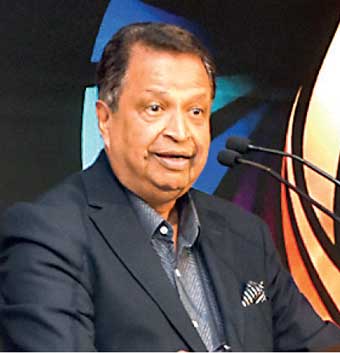 |
| Nepal Chaudhary Group Chairman and President Dr. Binod Chaudhary – Pic by Shehan Gunasekara |
By Charumini de Silva
Nepal’s billionaire industrialist Dr. Binod Chaudhary on Wednesday said boards that focus solely on compliance and risk management risk holding companies back, while those that successfully combine sound governance with entrepreneurial ambition will be best positioned to build globally competitive businesses.
Delivering a keynote address on ‘Beyond Borders, Beyond Limits: How Directors Can Build Global Ambition from Small Markets’ at the Sri Lanka Corporate Director Summit 2026, organised by the Sri Lanka Institute of Directors (SLID), Dr. Chaudhary said the forum’s main theme, ‘Future-Ready Sri Lankan Directors,’ reflects the evolving role of corporate boards in emerging economies.
“The role of a director cannot be limited to compliance, control, and risk management alone. Those responsibilities remain essential, but the future belongs to boards that can successfully combine good governance with ambition,” he said.
Drawing on his own business journey, Dr. Chaudhary opined that boards must complement entrepreneurial vision rather than constrain it.
Recalling his decision to invest in the former Hotel Samudra in Sri Lanka in 2000 during the height of the civil conflict, he said many considered the move irrational.
“Even people close to me questioned whether I had lost my mind,” he said, adding that he viewed the investment as a key opportunity to partner with the Taj Group.
Acknowledging that boards have a duty to oversee governance and manage risk, he warned against allowing excessive caution to undermine growth opportunities. “Entrepreneurs bring ambition. Boards provide discipline. The two should complement each other, not work against each other,” he said.
Using the global expansion of the Wai Wai instant noodle brand as an example, Dr. Chaudhary said businesses from smaller economies should never allow limited domestic markets to define their ambitions.
Despite advice from industry leaders in Thailand that Nepal was too small to support an international brand, he said the company built Wai Wai with global markets in mind. He said today, the brand is sold in over 100 countries, with annual sales of around 3 billion packets, representing around 3% of the global instant noodle market.
“When you come from a small country, people tell you your market is too small, your capital is limited, and your institutions are still developing. Much of that may be true, but none of those reasons should become excuses,” he stressed.
“The first transformation must happen inside the boardroom. If the board thinks small, the company will remain small,” he pointed out.
Dr. Chaudhary also highlighted his group’s recent partnership with John Keells to distribute BYD electric vehicles in Sri Lanka, describing it as an example of calculated risk-taking.
“Although the Chaudhary Group had limited experience in the automobile industry apart from introducing Suzuki to Nepal more than four decades ago, the venture exceeded expectations within its first year. The success prompted BYD to invite the group to represent the brand across multiple international markets,” he said.
Under the dynamic leadership of his son, Nirvana Chaudhary, he noted that the company expanded its BYD operations into 25 countries within a year, including the UK, the Balkans, Kosovo, and Albania, with plans to enter Sweden, Norway, and Denmark.
“Our answer was simple. Perhaps we did not yet possess everything required. But we had the determination to build those capabilities. We had the courage to take the next step,” he said.
However, Dr. Chaudhary stressed that ambition should always be balanced with prudent governance.
“You cannot destroy a business that has taken three generations and over 140 years to build,” he cautioned.
Dr. Chaudhary also outlined five qualities he believes every future-ready director should possess.
He urged boards to adopt a global mindset, strengthen institutions while embracing artificial intelligence (AI) and innovation, demonstrate the courage to take calculated risks, focus on building trusted brands rather than simply manufacturing products, and remain rooted in their national identity.
“The strongest global companies remain proud of where they come from,” he said, referring to his latest book, ‘Made in Nepal.’
Dr. Chaudhary also commended Sri Lanka’s institutional and educational foundations, asserting that the country possesses significant advantages over many emerging economies.
“I have always believed that Sri Lankan businesses are, in many ways, more fortunate than Nepali businesses,” he said, citing the country’s strategic location, education system, and institutional framework as key strengths.
Clarifying his remarks, Dr. Chaudhary said he was not celebrating colonialism but recognising the value of institutions and governance systems that continue to support Sri Lanka’s economic development.
He commended the SLID for promoting stronger corporate governance and noted that he has encouraged business leaders in Nepal to explore establishing a similar Institute of Directors in partnership with Sri Lanka.
“I believe there is much we can learn from one another,” he said.




