Friday Aug 07, 2026
Friday Aug 07, 2026
Monday, 8 December 2025 04:48 - - {{hitsCtrl.values.hits}}
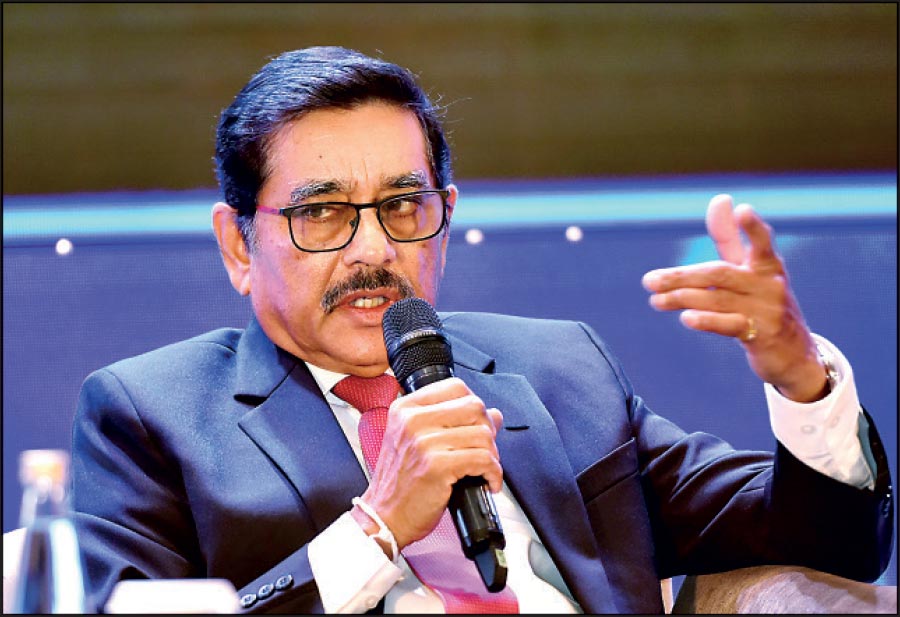
CBSL Governor Dr. P. Nandalal Weerasinghe – Pic by Ruwan Walpola
Central Bank of Sri Lanka (CBSL) Governor Dr. Nandalal Weerasinghe has warned that Sri Lanka cannot afford to forget the reform agenda that underpins the country’s stabilisation, even as post-Ditwah reconstruction demands immediate Government attention.
Speaking at the Sri Lanka Economic and Investment Summit organised by The Ceylon Chamber of Commerce, he said the country’s foundation for growth remains fragile and depends on discipline in macroeconomic management and the timely implementation of structural reforms.
“The stability that we have basically achieved is a foundation for growth,” he said. “When going forward, we need to ensure we maintain monetary stability, fiscal stability, and also external stability. That is important, and also financial stability. So, when going forward, for us to move into a higher growth path, we should not weaken the foundation for stability.”
He warned that the reform trajectory must not be derailed by the disaster response. “We should not forget that we need to focus on this area,” he said. “All these short-term shocks we can absorb. I am sure the fiscal space is there. We can manage that. I am not too concerned about that.”
Dr. Weerasinghe said the Central Bank expects supply chain disruptions from the cyclone to cause only a brief increase in inflation.
“We might see a small uptick in inflation as a result of these supply chain disruptions,” he said. “I think this is something we do not have to worry about. But that could reflect, given the real inflation environment. This 2 percent inflation going up to 3 percent will not be a surprise, given the short-term impact.”
He said inflation should revert once bottlenecks clear. “Over a period of time, once supply chain issues are addressed, I would say we will come back to the normal inflation trajectory,” he said. “We will maintain stability going forward, as we have been doing so far under the framework.”
He also said the cyclone will not produce a major balance of payments shock. “External impact, I do not see as a significant impact from this event,” he said. “What we see is an immediate impact that will be more cyclical.”
Reviewing global risks, he said earlier concerns over US tariff policy had eased. “We had a lot of concerns at that point. Now we can see that it has been softening in terms of its impact on Sri Lanka as well as other markets,” he said. “Compared to where we were, that issue, I think, to a certain extent is again stabilising in my view.”
He noted that political developments and energy prices remain uncertainties, though Sri Lanka’s rising reliance on renewable energy mitigates exposure to global price swings. Domestically, he said pent-up demand for agricultural imports had temporarily pushed the current account into a small deficit, but this was normalising.
“Now we can see that this is also settling down,” he said. “As a result, we saw some pressure on the external side last month. Now it is gradually settling down.”
The CBSL Governor downplayed the impact of global interest rate changes. “I do not see that as a significant impact on our balance of payments side,” he said. “We do not have much exposure to these kinds of global interest rates.”
However, he cautioned that disruptions in supply chains could present modest challenges for exporters. “This impact could be a small shock in terms of supply chain disruption, especially for our suppliers here,” Dr. Weerasinghe said. “That we will have to manage.”
On medium-term growth, Dr. Weerasinghe said Sri Lanka must convert consumption-led demand into investment. Sovereign rating improvements, trade reforms and productivity gains are essential conditions, he said. “I think we are hoping that there will be an improvement in this rating,” he said.
“Facilitation through reforms, making the business environment easier through some of the reforms already included in the World Bank budget support programme, those are very important reforms.”
He highlighted reducing non-tariff barriers, labour productivity reforms and stronger regional integration as priorities.
“We need to have important reforms implemented to improve the productivity of labour and also reduce the barriers to trade and have access to regional markets,” he said. “The Government has made a decision to link up with RCEP. This is a very important link-up for supply chains in the region for us to have much more open trade.”
He closed by reiterating that stability must be actively maintained. “We will maintain stability going forward, as we have been doing so far under the framework,” he said.




