Thursday Oct 15, 2026
Thursday Oct 15, 2026
Thursday, 15 October 2026 04:26 - - {{hitsCtrl.values.hits}}
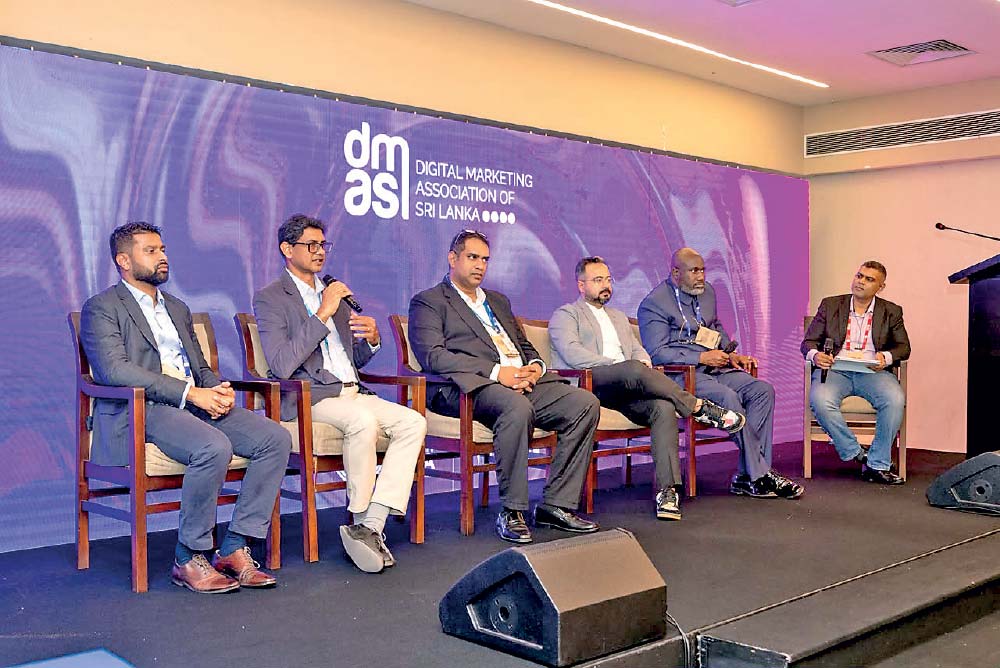
From right: DMASL Executive Committee Member and Commercial Bank of Ceylon MarTech and Digital Strategy Lead Shanaka Rathnayake (Moderator), eTranzact Ghana CEO and Board Member Dr. John Obeng Apea, Visa CMO and Head of Marketing – India and South Asia Gaurav Ramdev, PayMedia Founder/CEO Kanishka Weeramunda, HNB Chief Innovation Officer Chandima Cooray, and Equity Group Holdings Group Director – International Trade Relations and CWEIC Hub Director – East and Central Africa A.Q. Hamza
By Safna Malik
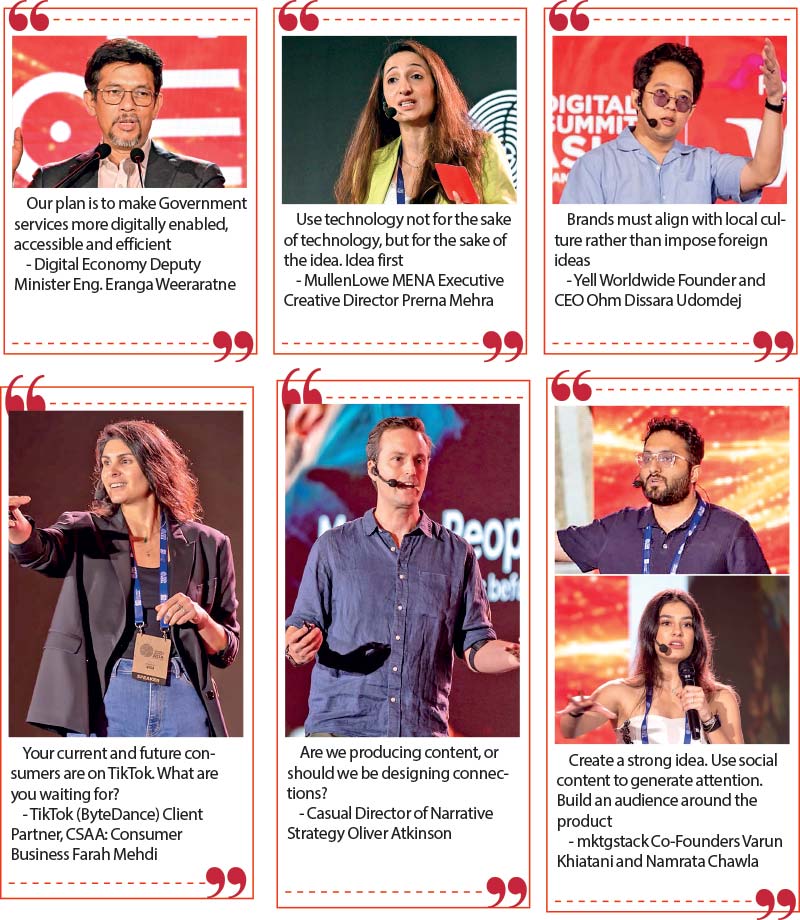
A strong global digital presence can help Sri Lankan businesses enter overseas markets and lift foreign-exchange earnings, Digital Economy Deputy Minister Eng. Eranga Weeraratne said. Addressing Digital Summit Asia Sri Lanka 2026, organised by the Digital Marketers Association of Sri Lanka (DMASL), in Colombo, he said the Government would focus on five key areas, including digitalising public services and traditional sectors, developing digital skills, promoting cashless payments, expanding the digital industry and achieving $ 5 billion in digital exports by 2030 as part of Sri Lanka’s digital transformation plan.
Accessing or developing technology is not the greatest challenge; Sri Lanka has the resources and talent to do so. “The difficult part is changing human behaviour,” he said. Although QR and digital-payment options are widely available, many consumers continue to withdraw cash before making purchases.
Taking LankaQR as an example, Weeraratne said that, despite being available for more than five years, QR-based payments have yet to achieve widespread adoption. The Government’s objective is to make LankaQR the first choice for consumers and merchants alike.
Changing this will require a major shift in transaction habits, with digital payments becoming the first choice over cash. Effective marketing is needed to communicate the convenience and advantages of digital payments.
In today’s connected world, he said, geography matters less than a country’s capabilities, creativity and the trust it earns for the work it delivers. Meanwhile, entrepreneurs are launching new businesses, supported by a broader community seeking to position Sri Lanka as Asia’s Epicentre for digital marketing, creativity, technology, innovation and business.
MullenLowe MENA Executive Creative Director Prerna Mehra opened the learning sessions with her keynote, “You’re in a toxAic relationship,” setting the tone for a presentation that placed AI in a human context.
She said people often treat AI like a vending machine: insert a prompt, press a button and expect brilliance. But when results disappoint, the response is often simply: “I don’t like it,” “make it better,” “make it human,” or “try again.”
AI does not require politeness or validation; it requires clarity. Mehra outlined common red flags in this relationship: vague briefs, missing context, changing instructions, feedback that dismisses output without proper guidance, and letting AI decide which option is best when that decision and responsibility must remain human.
Without this clarity, AI can accelerate creative work but risk producing “AI slop”: generic, repetitive and emotionally empty content that can reduce brand quality and push audiences away.
To counter this, give AI clear direction, relevant background, brand language and success criteria, specific feedback, updated briefs when needed, and human judgement. She said AI should be treated as a tool for developing ideas, not as a replacement for thinking.
In a session titled “From local to global: Expanding your local business worldwide,” Yell Worldwide Founder and Chief Executive Ohm Dissara Udomdej said the digital economy has made international expansion more accessible for regional businesses.
Cultural context, he said, is a form of currency: understanding how people think, what they value and what feels familiar determines whether a brand can earn relevance in a new market. AI can translate words, but not culture; effective communication still depends on human judgement, tone, humour and local references.
For Sri Lanka, he said the country’s unique culture offers a strong base for global expansion. Every market has its own “creative dialect,” and even regional differences within one country matter. Brands must align with local culture rather than impose foreign ideas.
Businesses should define their brand, purpose and values, then adapt their storytelling for international audiences while protecting their identity and respecting local cultures. AI should remain a supporting tool, he added; with the right partners and cultural understanding, local businesses can connect with the world.
In the session “From watch it to want it: The TikTok effect,’’ TikTok (ByteDance) Client Partner, CSAA: Consumer Business, Farah Mehdi, outlined how TikTok has evolved from an entertainment platform into a demand-generation engine that moves users from watching to wanting to buying.
With over two billion monthly users globally and 8.6 million in Sri Lanka, where TikTok logs 38 billion views and 37 million video creations monthly, the platform offers unmatched reach and participation. 63% of users are comfortable seeing creators in brand campaigns, and such exposure significantly lifts product research and purchase intent. Mehdi advised businesses to run consistent campaigns that reach at least half the target audience, deliver two or more exposures per week over four weeks, and measure outcomes, positioning TikTok not just as an awareness channel but as a lever for demand creation and sales growth.
Under the session, “Making people care: What your brain does before you decide,’’ Casual Director of Narrative Strategy, Oliver Atkinson, argued that most advertising fails because it never gets registered in the brain. Ads pass through like radio signals on an untuned channel. In an age of endless AI content, the scarcity is no longer creativity. It is connection and care.
Atkinson explained that about 95% of decisions happen below conscious awareness. The rational mind acts as a press office, giving reasons for decisions the subconscious has already made.
Speaking about brain behaviour, he said resonance gets past the brain’s filter when a message feels relatable. Immersion keeps attention long enough to drive action. Creating interest is necessary, but action is the goal. The aim is to make people buy, remember, or change.
In this AI world, the advantage will not go to whoever produces the most content. It will go to whoever makes people feel connected, and the question remains whether we should produce content or should be designing connections.
mktgstack co-founders Varun Khiatani and Namrata Chawla, during their session Stop Answering Briefs, Start Answering Consumers, said brands and agencies must understand the real consumer and business problem before building a solution.
Khiatani said marketers need to get closer to people instead of relying only on screens, reports and trends. “If you remain a laptop creator, you will not only become less creative; you will also become less informed,” he said, warning that briefs can otherwise reflect a company’s message rather than consumer needs.
Briefs often prescribe solutions before defining the problem, Chawla said. “Why do we put the solution inside the brief before we have properly examined the question?” She added that ROI cannot be a universal metric, because each marketing activity should be judged by the business problem and behaviour it aims to change.
Chawla stressed that a campaign idea alone is not enough. “If the idea is strong but nobody sees it, it may not solve the business problem.” Khiatani added that shareable content can turn attention into distribution: “Create a strong idea. Use social content to generate attention. Build an audience around the product.” Their key takeaway from the session was, “We do not answer briefs. We answer the right questions, and we answer consumers.”
Moderated by DMASL Executive Committee Member and Commercial Bank of Ceylon PLC Martech and Digital Strategy Lead Shanaka Rathnayaka, the panel discussion, Payments Are Getting Smarter: What Does That Mean For The Customer Relationship, brought together PayMedia Ltd. Founder and CEO Kanishka Weeramunda, eTranzact Ghana Ltd. CEO and Board Member Dr. John Obeng Apea, Visa CMO and Head of Marketing, India and South Asia Gaurav Ramdev, HNB Chief Innovation Officer Chandima Cooray, and Equity Group Holdings Group Director for International Trade Relations and Commonwealth Enterprise and Investment Council (CWEIC) Hub Director for East and Central Africa AQ Hamza to explore how technology is reshaping trust, choice and accountability in financial services.
Invisible payments, visible choice
Weeramunda said payments are becoming more embedded and less visible, but customers must still consciously choose the brands they trust. He argued that businesses cannot leave these decisions entirely to automation. “The opportunity lies in making our brand the one customer deliberately choose, rather than leaving the decision to an automated system,” he said.
Automation needs accountability
Apea argued that the real test of a digital financial relationship begins when an algorithm rejects a customer or a payment is declined. While automation can expand access to credit and services, institutions must explain negative decisions, offer alternatives and treat customers fairly. Without clear communication, he warned, people may lose confidence in digital systems and return to cash.
He added that this is particularly important for small businesses, which often lack the resources to manage complex payment systems. “Trust and confidence are essential,” Apea said, stressing that providers must explain decisions and support merchants after problems arise.
Removing merchant friction
Cooray noted that many small merchants still depend on manual CEFT transfers, requiring customers to enter account details, select the right bank and complete several error-prone steps. He argued that digital banking should remove such friction by allowing businesses to accept card payments directly through a mobile app.
Using the HNB Mobile App and its HNB Accept capability as an example, Cooray said mobile-led payment acceptance can remove the need for separate POS hardware, reduce input errors, speed up transactions and give merchants more control over payments.
Payments are part of a journey
Ramdev said payments are no longer a standalone interaction but part of a wider customer journey across online and offline channels. He illustrated this with an AI assistant that could guide a customer from recipe recommendations to ingredient purchases, checkout, delivery and cooking instructions.
“In that type of experience, the payment is only one part of the journey,” Ramdev said. He argued that brands must remain useful and relevant throughout the experience, rather than appearing only at the point of transaction.
When payments fail
Pointing payment failures as a crucial moment related to customer relationships. Ramdev said providers must take responsibility, clearly explain errors and communicate transparently about a customer’s money. “A payment failure is not only a technical incident. It is also a brand moment,” he said.
Apea agreed that speed without explanation is not enough. Customers need to know what happened, who is accountable and when the issue will be resolved. He argued that properly managed failures can build loyalty, while poor communication can quickly weaken trust.
The human layer matters
Apea emphasised that digital systems can deliver speed and scale but cannot fully replace empathy and judgement. “Particularly in financial services, a customer may need more than an automated message,” he said.
He called for a hybrid model in which algorithms enable faster decisions while human support provides fairness, inclusion and accountability, especially when customers are rejected, confused or lack confidence in digital services.
Sri Lanka’s cross-border opportunity
Hamza said emerging-market digital ecosystems must look beyond their regions to grow. South Asian technology and digital frameworks, he argued, could serve markets in East Africa and across Commonwealth networks.
He urged Sri Lankan agencies and tech firms to develop solutions for shared emerging-market needs, including fintech, localised e-commerce and data-driven consumer insights. The challenge, he noted, is less about technical ability than navigating compliance, payment gateways and local regulations.
Trade organisations can help home-grown firms access institutional buyers and corporate networks, he added. Drawing on Equity Group’s experience in Africa, Hamza called for smoother cross-border trade channels to help regional talent and technology services scale.
The panel’s collective message was that smarter payments must remain inclusive, reliable and human-centred. Trust will depend on how well brands support customers through moments of choice, help and crisis and whether people feel understood and included throughout the journey.
The first day also featured breakout sessions led by international speakers, including Senator We Run Ads Founder Ovais Ahamed on, “The thinking performance marketer: The way to be relevant in the AI age.” Swiggy AVP Marketing and Creative Head Prateek on, “Why so serious? Humour in advertising communication.” Voxy Media Southeast Asia Business Head Naved Qureshi on the topic, “From creator activity to creator infrastructure: Why brands need an operating system, not another influencer campaign.”
The summit continued into its second day, with Ramdev returning to deliver the opening keynote, “Before brands, there was trust,” extending the discussion on customer relationships and trust.
DMASL vice-presidents and summit co-chairs Gayathri Seneviratne and Shalendra Mendis described Digital Summit Asia Sri Lanka 2026 as an industry milestone and regional opportunity. Formerly known as Digital Summit Sri Lanka, the summit was renamed to position Sri Lanka as the Epicentre of Asia’s digital marketing, creative and innovation industries.
Powered by Visa, the two-day summit featured thought leadership, interactive and breakout sessions, and a first-of-its-kind Night Summit. Its full-day agenda connected Sri Lankan professionals with international and regional expertise while creating greater visibility and opportunities for local talent. Businesses also had the opportunity to engage with speakers, partners and delegates, exchange ideas, build relationships and take practical insights back to their organisations.
They said Sri Lanka’s digital industry must unite to compete globally. “When an industry comes together like this, we have an opportunity together as a community. We can take on anyone in the world if we align in the right ways.” For brands and agencies, global growth will depend on collaboration, shared learning and a stronger collective presence beyond Sri Lanka.
- Pix by Lasantha Kumara and Ruwan Walpola




