Friday Oct 02, 2026
Friday Oct 02, 2026
Tuesday, 21 April 2026 01:50 - - {{hitsCtrl.values.hits}}
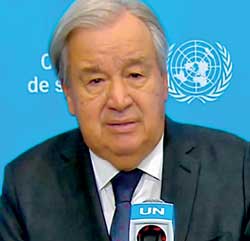 |
| UN Secretary-General António Guterres |
Developing countries took a major step to rebalance the global financial system on 15 April, launching the first-ever Borrowers’ Platform during the International Monetary Fund (IMF)-World Bank Spring Meetings, with UN Trade and Development (UNCTAD) serving as its Secretariat.
The platform brings together finance ministers and central bank governors from developing countries to strengthen debt management capacity, enhance coordination, and amplify their collective voice in global debt discussions.
UN Secretary-General António Guterres described the initiative as “a breakthrough in global financing; a platform in which borrowing countries sit together, learn from each other and speak with a collective voice.”
UNCTAD, which will serve as the Secretariat, is a leading authority on developing country debt, combining independent analysis with direct support for countries in managing their debt through the Debt Management and Financial Analysis System (DMFAS) debt management program – today present in 60 countries.
Rising debt pressures drive urgency for collective action
The launch came against a backdrop of mounting debt challenges across the developing world.
External debt reached $ 11.7 trillion in 2024, while debt service costs rose to approximately $920 billion.
Today, 54 countries – home to 3.4 billion people – spend more on debt servicing than on health or education, highlighting the scale of the challenge.
These pressures have constrained public investment, limiting countries’ ability to finance growth, strengthen resilience and achieve sustainable development.
Against this backdrop, cooperation among borrowers has emerged as a natural and necessary response to shared challenges.
Closing a gap in the international financial architecture
While creditor coordination mechanisms have long been established, borrowing countries have lacked a dedicated platform to exchange experiences, share information, and build technical capacity.
The Borrowers’ Platform was designed to address this imbalance. First outlined in the Sevilla Commitment adopted at the Fourth International Conference on Financing for Development in July 2025, the initiative creates a permanent space for collaboration among developing countries.
Through peer learning, technical support and knowledge sharing, the platform aims to strengthen debt management practices and improve coordination on sovereign debt issues.
Broad political backing from across the developing world
The launch brought together representatives from 30 countries, including Prime Ministers, 16 Ministers, and Central Bank Governors, underscoring strong political momentum behind the initiative.
Countries of all sizes and regions were represented – from major economies such as India and South Africa to small and vulnerable States such as the Maldives – reflecting the shared nature of debt challenges across the developing world.
Led by a working group including Egypt (Chair) and Pakistan (Vice Chair), alongside Colombia, Honduras, Maldives, Nepal, and Zambia, the platform will now move from launch to implementation. Member States agreed to expand participation, establish interim governance arrangements, and define a work program leading to the IMF-World Bank Annual Meetings in October 2026.
By improving transparency, strengthening capacity, and fostering cooperation, the Borrowers’ Platform is expected to contribute to more sustainable financing outcomes. Over time, it may also send a positive signal to markets by enhancing debt sustainability practices and reducing uncertainty for investors – helping ensure that rising debt burdens do not derail development prospects.



