Sunday Sep 20, 2026
Sunday Sep 20, 2026
Monday, 22 December 2025 05:54 - - {{hitsCtrl.values.hits}}
|
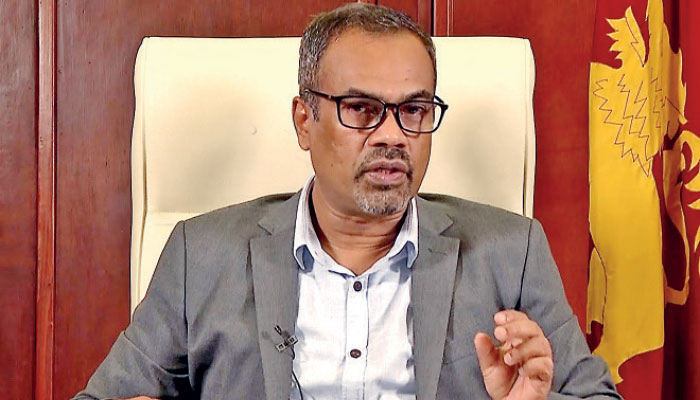
Finance and Planning Deputy Minister Dr. Anil Jayantha Fernando
|
Finance and Planning Deputy Minister Dr. Anil Jayantha Fernando said the International Monetary Fund’s (IMF) approval of $ 206 million under the Rapid Financing Instrument (RFI) on Friday provides the country with critical and low-cost emergency funding at a time when the country is focused on recovery and stabilisation.
In a video message released by the Finance Ministry on Saturday, he expressed appreciation to the IMF and its Mission Chief for Sri Lanka Evan Papageorgiou for the swift assistance, stressing that the facility is designed to minimise the impact of shocks on the balance of payments (BOP) during emergencies.
“We appreciate the immediate relief assistance extended by the IMF,” Dr. Fernando said, noting that the RFI is a standard instrument available to IMF member countries facing urgent external financing needs.
Dr. Fernando asserted that the IMF-backed RFI, together with domestic relief measures, is intended to protect recovery momentum and prevent misinformation from undermining confidence at a critical juncture for the economy.
The Deputy Minister pointed out that the interest rate attached to the RFI is exceptionally low and transparent. He explained that the rate is linked to the IMF’s Special Drawing Rights (SDR) framework, which is reviewed weekly.
“The basic rate of charge is determined weekly, but for the week 15 to 21 December is 3.274%, i.e. the SDR interest rate plus a fixed margin, which is a standard for every member,” he said.
Dr. Fernando stressed that the rate around 3.27% to 3.28% is significantly lower than market borrowing costs. “This number is already very low,” he said, adding that surcharges apply only after a specified period and are based on the level of access relative to a country’s IMF quota. “The surcharges are level-based and may rise up to 200 basis points (bps) in some cases, but only after a period of time,” he said.
He noted that RFI financing typically carries a repayment period of three to five years, underscoring that it is well-suited for emergency situations. “In an emergency, we can obtain these funds to minimise the impact on the BOP,” Dr. Fernando said.
The Deputy Minister said the decision to seek the RFI was made following recommendations from the Public Finance Department, as part of a broader effort to rebuild and stabilise the country’s economy.
“We are in the process of recovering our economy and we intend to further stabilise the economy. We act on the necessity of rebuilding Sri Lanka,” he said.
Dr. Fernando also outlined domestic relief measures introduced alongside IMF financing.
In line with a circular issued by the Central Bank of Sri Lanka (CBSL), all licenced banks have agreed to grant distressed businesses extensions of between three and six months on existing loan repayment schedules, without imposing additional interest or fees.
“The relief is aimed at providing immediate cash flow support to enterprises whose operations were disrupted by flooding and infrastructure damage,” he added.
According to him, the decision has already been communicated to bank branches countrywide and affected businesses have been advised to formally request the concession from their respective banks.
Beyond temporary repayment relief, he said banks have also agreed on a common mechanism to address borrower difficulties more systematically. This includes the provision of low-interest concessional loans recommended by the CBSL.
“Guidelines for these facilities have been issued to ensure uniform implementation across the banking system and to prevent delays in assistance reaching those in need,” Dr. Fernando said.