Tuesday Oct 13, 2026
Tuesday Oct 13, 2026
Tuesday, 13 October 2026 02:57 - - {{hitsCtrl.values.hits}}
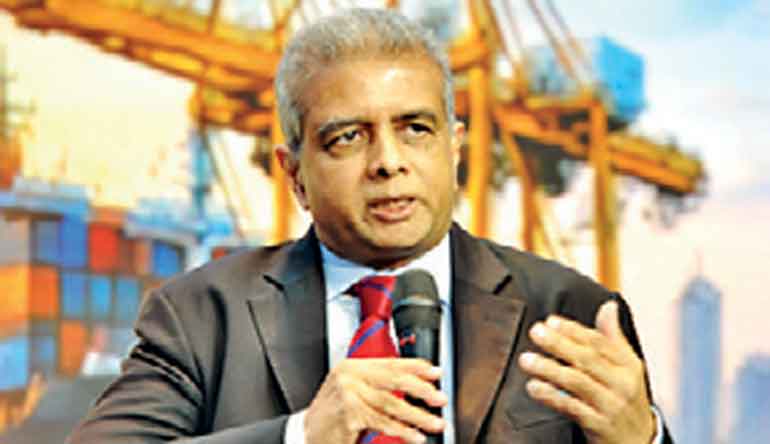
President’s Chief Adviser on Digital Economy Dr. Hans Wijayasuriya – Pic by Lasantha Kumara
Sri Lanka’s shortage of data centre and cloud capacity is to some extent a market failure, as clear demand from banks and other users has yet to draw private supply, forcing the Government to invest in a sector it should not need to, the President’s top digital adviser said yesterday.
“The Government really does not need to do it, but it will,” President’s Chief Adviser on Digital Economy Dr. Hans Wijayasuriya said during a conversation on digital transformation at the Sri Lanka Economic and Investment Summit (SLEIS) 2026, moderated by The Ceylon Chamber of Commerce (CCC) Secretary General and CEO Shiran Fernando.
Demand was already evident, he said. “I think it is very clear that there is demand now. The banks are crying out for sovereign, resident cloud infrastructure.”
That demand must be matched by supply from the private sector and data centre operators, Dr. Wijayasuriya said, arguing that the gap persisted only because investors had yet to act on the supply-demand equation.
“There are sufficient demand signals out there for supply to be created. I sincerely believe that,” he said. “The private sector can take this ball and run.”
The key barrier to resolve was the price of energy for data centres, he said. The Digital Economy Ministry is working with the Board of Investment (BOI) on an investment and incentive framework for the sector. While the Government will make some investments, its main role is to create an enabling environment for private investors, both local and new foreign direct investment (FDI), to enter the data centre, Artificial Intelligence (AI), and cloud market.
Sri Lanka’s total data centre capacity stands at around 5 megawatts (MW), against Malaysia’s 1.5 gigawatts. The country needs 25-50 MW of cloud capacity with built-in AI capability in the short term to enable AI across industries and services in both the private and public sectors, a level at which Dr. Wijayasuriya said Sri Lanka’s global competitiveness would be solid.
He cautioned, however, against unchecked expansion. Sri Lanka would take a conservative approach, targeting 25 MW in the short term given environmental concerns, and would not go as far as some regional neighbours. Malaysia had scaled up to 1,500 MW from around 5 MW in 2021, but is now pulling back after realising that data centres not serving domestic demand were effectively buying energy and selling it.
“Basically, it is an energy export. We must be very clear on the economics of that energy export and the next best use of the next megawatt generated in your country,” he said.
“We are taking a calibrated approach to ensure that our industries are legitimately competitive and that we generate sufficient export revenues from data infrastructure, while being energy sensitive and environmentally sensitive in the process,” Dr. Wijayasuriya added.




