Sunday Sep 13, 2026
Sunday Sep 13, 2026
Thursday, 26 February 2026 03:43 - - {{hitsCtrl.values.hits}}
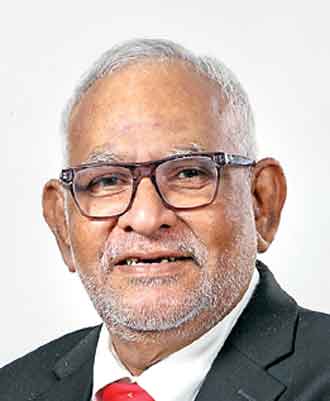
Chairman J. Durairatnam

Director/CEO Thimal Perera
 Record performance and strategic expansion key highlights
Group Core Business PAT of Rs. 11.2 b
Group Total CAR of 15.989%
Group Net Fee and Commission Income up by 48% to Rs. 7.3 b
Loan Book up by Rs. 120 b to Rs. 516 b
Bank PAT at Rs. 16 b including disposal gain from Acuity Partners
DFCC Bank yesterday said it has delivered a record financial performance for the year ended 31 December 2025, reinforcing the strength of its strategy, the discipline of its execution, and the resilience of its balance sheet. Profit After Tax (PAT) from continuing operations increased by 32%, supported by sustained expansion in the loan portfolio and deposit base, disciplined asset-liability management, and strong cost governance.
Total assets expanded by 22% to Rs. 857 billion, while the loan portfolio grew by 31%, reflecting calibrated credit expansion aligned with national recovery priorities. Funding optimisation and prudent liquidity management continued to underpin performance, reinforcing long-term value creation for shareholders and customers.
In a statement, DFCC said, during the year, market interest rates stabilised at lower levels, with the Central Bank of Sri Lanka (CBSL) maintaining an accommodative stance for part of the year to support liquidity and credit flows. Despite economic disruptions following Cyclone Ditwah in late 2025, early indicators of recovery emerged, with reconstruction activity expected to support credit demand going forward.
A defining strategic milestone was the signing of a binding Business Sale Agreement with Standard Chartered Bank PLC, to acquire the Wealth and Retail Banking operations of Standard Chartered Bank, Sri Lanka. This transaction strengthens DFCC Bank’s retail and wealth franchise, expands its customer base, and accelerates scale across key growth segments.
The bank also successfully issued Sri Lanka’s first listed and rated Blue Bond, a Rs. 3 billion transaction that was significantly oversubscribed. This landmark issuance reflects strong investor confidence and reinforces DFCC Bank’s leadership in sustainable and thematic finance.
During its 70th anniversary year, the bank introduced a suite of special Fixed Deposit products to reward longstanding customers and deepen relationships, underscoring its enduring commitment to service and trust.
Looking ahead, DFCC Bank remains firmly committed to upholding Environmental, Social, and Governance (ESG) principles. Sustainability is embedded within the bank’s operating model, ensuring that growth remains inclusive, responsible, and aligned with the long-term well-being of communities and stakeholders. The bank continues to enhance climate- and sustainability-related financial disclosures in line with SLFRS S1 and S2, strengthening transparency and decision-useful reporting for investors and capital providers.
In 2025, DFCC Bank PLC reported a Profit Before Tax (PBT) of Rs. 15,582 million and a PAT of Rs. 11,060 million from continuing operations, representing a 32% increase over the previous year’s PAT of Rs. 8,353 million. Including the gain arising from the disposal of its stake in Acuity Partners Ltd., subsequently renamed HNB Investment Bank Ltd., total PAT for the year increased to Rs. 16,028 million.
Earnings Per Share (EPS) from continuing operations rose by 30% to Rs. 25.30, while EPS including the disposal gain stood at Rs. 36.66, reflecting sustained earnings momentum.
At Group level, for the year ended 31 December 2025, PBT was Rs. 15,953 million and PAT was Rs. 11,231 million from continuing operations, compared to Rs. 13,820 million and Rs. 8,554 million, respectively, in 2024. Group EPS from continuing operations rose by 30%, increasing to Rs. 25.31 in 2025, from Rs. 19.51 in the previous year.
The bank’s Return on Assets (ROA) before tax from continuing operations maintained at 2%, while Return on Equity (ROE) after tax from continuing operations stood at 11.55% for 2025, compared to 10.99% in 2024.
The bank’s total tax expenses, including Value Added Tax (VAT), Social Security Contribution Levy (SSCL) on financial services, and Income Tax, amounted to Rs. 10,751 million for the year ended 31 December 2025. Consequently, the bank’s tax expense as a percentage of operating profit including the gain on disposal of the Acuity stake stood at 41% for the year. Interest income increased by 6% during the year, while interest expenses were effectively contained, reflecting disciplined margin management in a lower-rate environment. A loan portfolio expansion of 31% supported this performance, with a strategic focus on quality asset growth.
Net Interest Income (NII) increased by 10% to Rs. 30,953 million, driven by effective loan book growth and funding cost optimisation. The Current Accounts Savings Accounts (CASA) portfolio grew by 20%, with the CASA ratio at 24.49% as at 31 December 2025, reflecting a stronger funding mix of deposits and improved cost efficiency.
Net Interest Margin (NIM) moderated from 4.18% in December 2024 to 3.96% by December 2025, primarily due to competitive pressures and prevailing market dynamics.
Strategic focus on remittances, trade-related commissions, and card-based services supported strong growth in non-funded income. Credit card portfolio expansion contributed meaningfully to performance.
While related fee expenses increased in line with customer acquisition and portfolio growth, the net impact remained positive. Net fee and commission income increased by 48% to Rs. 7,313 million, compared to Rs. 4,929 million in 2024.
The Stage 3 impaired loan ratio improved to 4.55% as at 31 December 2025, from 5.63% a year earlier, supported by recoveries and portfolio expansion.
Impairment provisions were prudently calibrated to reflect model updates and risk buffers across higher-risk customer bases, including customers who were affected by Cyclone Ditwah and requesting relief under the temporary debt relief schemes. Consequently, impairment charges increased by 6% to Rs. 4,926 million, compared to Rs. 4,648 million in 2024.
Technology and digital transformation remained a strategic priority, with ongoing upgrades to its IT infrastructure aimed at enhancing multi-channel service delivery and operational efficiency. In parallel, the bank increased its investment in marketing and promotional activities to strengthen brand visibility, deepen customer engagement, and support product growth. These forward-looking initiatives are expected to deliver long-term value by building brand equity, expanding market reach, accelerating customer acquisition, and strengthening DFCC Bank’s competitive position in a dynamic financial landscape.
As a result of these strategic investments, operating expenses increased to Rs. 18,808 million for the year ended 31 December 2025, compared to Rs. 16,805 million in 2024. The bank continues to prioritise cost optimisation to ensure sustainable growth and operational resilience.
Changes in the fair value of investments in equity and fixed-income securities (Treasury Bills and Bonds), along with movements in hedging reserves, are recorded through other comprehensive income. The application of hedge accounting minimised the impact of exchange rate fluctuations on the bank’s profitability.
A fair value gain of Rs. 9,721 million was recorded on equity securities outstanding as of 31 December 2025, primarily driven by the increase in the share price of Commercial Bank of Ceylon PLC. Treasury Bill and Bond valuations contributed a further gain of Rs. 1,059 million.
DFCC Bank delivered strong balance sheet growth despite ongoing economic challenges and sector-specific pressures. Total assets expanded by Rs. 153 billion, a 22% increase since December 2024. The bank’s net loan portfolio also increased by Rs. 120 billion to reach Rs. 516 billion, representing a robust 31% growth from RS. 395 billion as at 31 December 2024. This performance reflects the successful execution of DFCC Bank’s strategic growth priorities and renewed confidence amid improving economic conditions, reinforcing the bank’s vital role in driving credit expansion and supporting national economic recovery.
The bank’s total liabilities increased by Rs. 130 billion, reflecting a 21% growth from December 2024. The deposit base expanded by 21%, rising by Rs. 100 billion to Rs. 565 billion, up from Rs. 465 billion as of 31 December 2024, resulting in an improved loan-to-deposit ratio of 99.80%.
Additionally, the CASA ratio stood at 24.49% as of 31 December 2025. The bank effectively contained funding costs by utilising medium to long-term concessionary credit lines, which supported the expansion of the lending portfolio and provided much-needed concessionary funding to customers. Factoring in these concessionary term borrowings, the CASA ratio further improved to 29.74%, while the loan-to-deposit ratio improved to 92.85% as of 31 December 2025.
As at 31 December 2025, total equity increased by Rs. 23 billion, supported by a PAT of Rs. 16.03 billion and fair value gains across the bank’s securities portfolios.
In alignment with the bank’s growth strategy and the improving economic environment, the net loan portfolio grew by 31%. Leveraging the strengthened equity base, the bank effectively absorbed the additional capital requirements associated with portfolio growth. The Tier 1 Capital Ratio was maintained at 13.550%, while the Total Capital Ratio stood at 15.933%, compared to 12.402% and 15.759%, respectively, as at December 2024.
The Bank’s Net Stable Funding Ratio (NSFR) stood at 122.64%, and the Liquidity Coverage Ratio (LCR) – All Currency stood at 184.06%, both comfortably exceeding regulatory minimums.
The bank’s dividend policy seeks to maximise shareholder wealth while ensuring adequate capital for expansion, supported by its islandwide presence and investments in technology. Accordingly, the Board of Directors has approved a final dividend of Rs. 7.50 per share, comprising Rs. 2.50 per share in cash and Rs. 5 as a scrip dividend for the year ended 31 December 2025, balancing shareholder returns with long-term business plans. Consequently, the dividend payout ratio for the year is 32% of the distributable profit.
Director/CEO Thimal Perera said: “DFCC Bank concluded 2025 with record financial performance, strengthened capital, and decisive strategic progress – achievements made possible by the trust placed in us and the discipline with which our teams executed throughout the year.
“For the year ended 31 December 2025, the bank recorded a PAT of Rs. 11,060 million from continuing operations, reflecting a 32% increase over the previous year’s Rs. 8,353 million. Including the gain arising from the strategic divestment of our 50% stake in Acuity Partners Ltd., total reported PAT increased to Rs. 16,028 million. It is important to clearly distinguish between these figures. The underlying performance of Rs. 11,060 million reflects the strength of our core banking operations, while the additional gain strengthened our capital base and enhanced strategic flexibility for future growth.
“Total assets expanded by 22% to Rs. 857 billion, supported by a 31% increase in the loan portfolio. Our Total Capital Adequacy Ratio (CAR) stood at 15.933%, and both the NSFR and LCR remained comfortably above regulatory thresholds – reaffirming the resilience of our balance sheet and our prudent approach to risk management.
“2025 was also marked by significant strategic milestones. The signing of the binding Business Sale Agreement to acquire the Wealth and Retail Banking operations of Standard Chartered Bank in Sri Lanka represents a transformative step in strengthening our retail and wealth franchise. During the year, we also successfully issued Sri Lanka’s first listed and rated Blue Bond – a Rs. 3 billion transaction that was significantly oversubscribed – reinforcing our leadership in sustainable finance and responsible capital mobilisation.
“As we commemorated our 70th year of service, our focus remained firmly on relevance and responsibility. Our MSME, retail, and remittance propositions continued to expand financial access, while disciplined cost management and funding optimisation supported stable earnings growth. Sustainability is not an adjunct to our strategy; it is embedded within our operating model, governance framework, and disclosure practices.
“Our commitment extends beyond financial performance. Through our Ride for Life cycling initiative, we continued to raise national awareness on mental health, recognising that economic resilience must be matched by social well-being. Our leopard conservation campaign further underscored our responsibility towards environmental stewardship and biodiversity protection – reflecting our belief that responsible banking must consider the long-term health of the ecosystems within which we operate.
“During the year, the bank was honoured to receive several recognitions that reflect the strength of our people and our brand. We were certified as a Great Place to Work and ranked fourth in the AICPA and CIMA Top 20 Employers in Sri Lanka. We were also named Best Bank in MSME Acceleration at the ICC Emerging Asia Banking Awards 2025. In addition, DFCC Bank was ranked 27th among Sri Lanka’s Most Valuable and Strongest Brands by Brand Finance and received recognition at SLIM Digis 2.5 for Best Use of AI Technologies and Best SEO/SEM Campaign. We view these acknowledgements not as endpoints but as encouragement to continue raising standards across every dimension of our work.
“These outcomes would not have been possible without the confidence of our customers, the commitment and professionalism of our employees, the guidance of our regulators, and the support of our Board, shareholders, and investors. We remain deeply grateful for the trust placed in DFCC Bank. It is this trust that obliges us to remain transparent, prudent, and forward-looking in every decision we take.”
“As we move ahead, our capital is strong, our strategy is clear, and our responsibility remains unchanged. DFCC Bank will continue to pursue disciplined growth, responsible innovation, and sustainable value creation - building on over seven decades of service to Sri Lanka with humility and conviction,” added Perera.




