Tuesday Sep 15, 2026
Tuesday Sep 15, 2026
Tuesday, 27 January 2026 03:11 - - {{hitsCtrl.values.hits}}
 |
 |
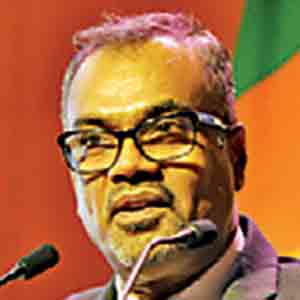
| Finance Deputy Minister Dr. Anil Jayantha Fernando | Sri Lanka Customs Director General Seevali Arukgoda |
Sri Lanka Customs officials must be rewarded through a fairer and more credible incentive system if the Government is serious about reducing corruption risks and sustaining reform, Finance Deputy Minister Dr. Anil Jayantha Fernando said yesterday, acknowledging that existing mechanisms remain weak and uneven.
Addressing an event at Sri Lanka Customs to mark International Customs Day, Dr. Fernando said officers had surpassed revenue targets despite what he described as “a working environment [that] is not conducive,” and deserved recognition for delivering results under significant constraints.
“It is a fact that there are some mechanisms to give you rewards, but those mechanisms have their own weaknesses,” he said. “As a result, when some sectors of officials are rewarded, that negatively affects the other sector.”
Referring to what he termed “coercive ranks,” Dr. Fernando said gaps in incentives and authority created space for bribery and allegations of misconduct. “Always that window is open for perpetrators to bribe because of these coercive ranks,” he said, adding that the gap could “only be reduced by increasing your rewards in a very acceptable and vibrant manner.”
While noting that fiscal constraints persisted, he said discussions were under way on improving salaries and benefits at Customs and other enforcement agencies. “We will be doing these things in the future, but we need some more time,” he said, pointing to the need for “sustainable and inclusive economic growth” to support such reforms.
Dr. Fernando also stressed that Customs’ mandate extended well beyond revenue collection to border security, public health, food safety, and environmental protection—functions that often go unnoticed. “If there’s a delay, the accusation comes in,” he said. “But people do not see how much pain is taken by Customs officers to release goods within a short period of time.”
He cited vigilance against dangerous and illicit items as evidence that Customs’ role “goes beyond revenue collection,” adding: “Our vigilance is highly commended, especially in drugs and other things.”
The comments come as Sri Lanka Customs reports record revenue performance alongside renewed reform momentum.
Sri Lanka Customs Director General Seevali Arukgoda said the Department had concluded “the most successful year in its institutional history,” combining revenue growth with trade facilitation and social protection.
In 2025, Customs collected Rs. 2,257 billion, surpassing the national target of Rs. 2,231 billion and recording the highest-ever collection. Revenue from general cargo rose by 18%, while direct enforcement contributions reached Rs. 32 billion, reflecting a 10% year-on-year (YoY) increase.
Arukgoda said reforms were being advanced with the support of development partners, including the International Monetary Fund (IMF) and the World Bank, to strengthen institutional integrity and operational efficiency. A recent Memorandum of Understanding (MoU) with the Inland Revenue Department (IRD) on data-sharing and parallel audits is expected to deter undervaluation and overvaluation through coordinated enforcement.
Progress has also been made in trade facilitation through expanded digitalisation, the introduction of applications such as “Track My CusDec” and “Motor Vehicle Verification,” and the extension of the Authorised Economic Operator program to include micro, small and medium-sized enterprises (MSMEs). Advance rulings covering tariff classification, valuation, and rules of origin have also been expanded in line with Trade Facilitation Agreement commitments.
For 2026, Sri Lanka Customs has been assigned a revenue target of Rs. 2,207 billion, which Arukgoda said the Department was confident of achieving. The primary strategic focus this year is the full digitalisation of remaining manual procedures to reduce face-to-face interactions and improve transparency.
Plans are also under way to establish a cargo examination yard at Kerawalapitiya by 2027, which would reduce physical examinations from 40% to 10%, easing congestion and supporting trade growth.
Other initiatives planned for 2026 include pre-arrival clearance, paperless cargo clearance, automated risk management, electronic cargo tracking, and an electronic bidding system for goods disposal. Customs also released the Time Release Study 2025, conducted under World Customs Organisation (WCO) guidelines, to identify bottlenecks and support evidence-based reform.
A new Code of Ethics and Conduct, developed with guidance from the IMF, World Bank, WCO, United Nations Development Programme (UNDP), the Presidential Secretariat, and Commission to Investigate Allegations of Bribery or Corruption (CIABOC), will be issued this week as a binding departmental order.
The reform agenda mirrors concerns raised in the IMF’s 2023 Governance Diagnostic Assessment, which found Sri Lanka’s revenue administration structurally vulnerable to corruption due to fragmented institutions, weak oversight, and wide discretionary powers. The report noted that Customs, the IRD, and Excise largely operate in silos, with corruption risks highest at points of direct interaction such as valuation, classification, concessions, and refund processing.
“Exposure to corruption in customs and tax administration is substantial,” the IMF said, citing weak performance monitoring, seniority-based promotions, flawed incentive structures, and leadership instability.
While digitisation—such as ASYCUDA at Customs—has reduced risks where implemented, the IMF warned that pervasive manual processes and weak data-sharing continue to undermine revenue integrity.
Against that backdrop, Dr. Fernando said reforms would succeed only if institutional incentives were addressed alongside systems. “We hope that with the development of the platform, we would be able to achieve this in the medium term,” he said, assuring Customs officials of continued Government support.
– Pix by Lasantha Kumara
Customs Time Release Study 2025 shows steady gains, flags need for deeper reforms
Sri Lanka Customs recorded steady improvements in cargo clearance performance in 2025, but structural and procedural bottlenecks continue to constrain efficiency, according to the Time Release Study (TRS) 2025 released yesterday in conjunction with International Customs Day.
The study, the third national TRS following earlier exercises in 2014 and 2018, provides an updated benchmark of border clearance performance after a seven-year gap marked by the Easter Sunday attacks, the COVID-19 pandemic, and the economic downturn in 2023.
Endorsed by the World Customs Organisation, the TRS measures the time taken for goods to be cleared at the border and identifies procedural delays affecting legitimate trade. The publication of release-time indicators also supports Sri Lanka’s commitments under the World Trade Organisation’s (WTO) Trade Facilitation Agreement.
Based on transaction-level data extracted from the Automated System for Customs Data and terminal-operator records, the TRS 2025 placed greater emphasis on median release times to reflect routine clearance performance more accurately.
For seaport imports, the median release time declined to 51 hours and 32 minutes in 2025 from 54 hours and 19 minutes a year earlier, while the average release time improved by 7.6% to 76 hours and 43 minutes, indicating a reduction in extreme delay cases.
The study confirmed that Authorised Economic Operator (AEO) consignments continued to clear significantly faster than non-AEO cargo, reflecting the impact of risk-based controls. Structural differences between cargo types persisted, with Full Container Load imports clearing substantially faster than Less than Container Load cargo.
Air cargo imports recorded faster routine clearance than sea cargo, but the study highlighted substantial delays before Customs processing, driven mainly by the timing of declaration submission rather than Customs controls.
Overall, the TRS 2025 points to incremental gains in clearance efficiency, while highlighting the need for deeper reforms, including expanded pre-arrival processing, better coordination among border agencies, and further scaling of risk-based facilitation measures.




