Tuesday Sep 15, 2026
Tuesday Sep 15, 2026
Wednesday, 14 January 2026 06:02 - - {{hitsCtrl.values.hits}}
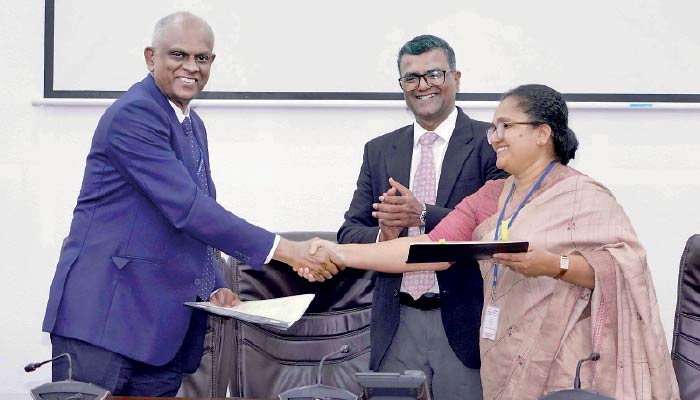
Customs Director General Seevali Arukgoda (left) and IRD Commissioner General Rukdevi Fernando exchanging the MoU. Treasury Secretary Dr. Harshana Suriyapperuma looks on
The Finance Ministry yesterday said that Sri Lanka Customs and the Inland Revenue Department have signed a Memorandum of Understanding to conduct joint investigations into under-valuation of imports and related tax evasion, as part of broader Government efforts to strengthen revenue administration.
The MoU was signed at the Ministry of Finance on 13 January in the presence of Treasury Secretary Dr. Harshana Suriyapperuma.
According to the Finance Ministry, operational reviews by Sri Lanka Customs have identified that under-valuation of imported goods has resulted in tax revenue losses to the Government. Authorities have also uncovered instances where certain businesses import goods through third parties on a temporary basis to evade taxes, including liabilities payable to the Inland Revenue Department.
The agreement establishes a joint mechanism enabling Sri Lanka Customs and the Inland Revenue Department to jointly investigate and audit declarations made by importers and the trading community to both institutions.
The MoU follows proposals submitted by a team of senior officials from both Departments aimed at strengthening coordinated enforcement and information-sharing.
The initiative is being implemented under the coordination of the Revenue Administration Reform and Modernisation Office attached to the Presidential Secretariat, which has appointed operational committees to identify reforms to improve the efficiency and effectiveness of Sri Lanka Customs, the Inland Revenue Department and the Excise Department. The Office’s mandate includes supporting Government measures to increase State tax revenue.
Sri Lanka Customs recorded the highest-ever revenue in 2025, surpassing the target of Rs. 2,115 billion and generating an additional surplus of about Rs. 300 billion. The Inland Revenue Department collected a record Rs. 2,203 billion in revenue in 2025, the highest in its 93-year history, exceeding the annual target by Rs. 33 billion.
Sri Lanka’s revenue administration is structurally vulnerable to corruption due to fragmented institutions, weak oversight, and extensive discretionary powers, according to the IMF’s 2023 Governance Diagnostic Assessment.
The report found that Sri Lanka Customs, the Inland Revenue Department (IRD), and the Excise Department operate largely in silos with limited coordination, creating opportunities for collusion and rent-seeking.
Corruption risks are highest at points of interaction between officials and taxpayers, particularly in customs valuation, tax assessments, classification of goods, concessions, and refund processing.
“Exposure to corruption in customs and tax administration is substantial,” the IMF noted, citing the absence of effective systems to monitor performance or detect and sanction improper behaviour.
The IMF also highlighted a near-total lack of accountability within revenue institutions.
Promotions are primarily seniority-based, with merit, performance, or integrity concerns playing little role, while leadership instability, closed institutional cultures, and flawed incentive schemes further weaken governance.
Digitisation has reduced risks where implemented, notably through ASYCUDA at Customs, but manual processes remain pervasive, especially in Excise and parts of IRD operations. Weak tracking of tax exemptions, limited data-sharing, and ineffective internal controls undermine revenue outcomes and fiscal policy implementation, the IMF warned, adding that restoring integrity will require stronger oversight, simplified procedures, deeper digitisation, and credible enforcement of staff accountability.




