Sunday Sep 20, 2026
Sunday Sep 20, 2026
Monday, 1 June 2026 00:21 - - {{hitsCtrl.values.hits}}
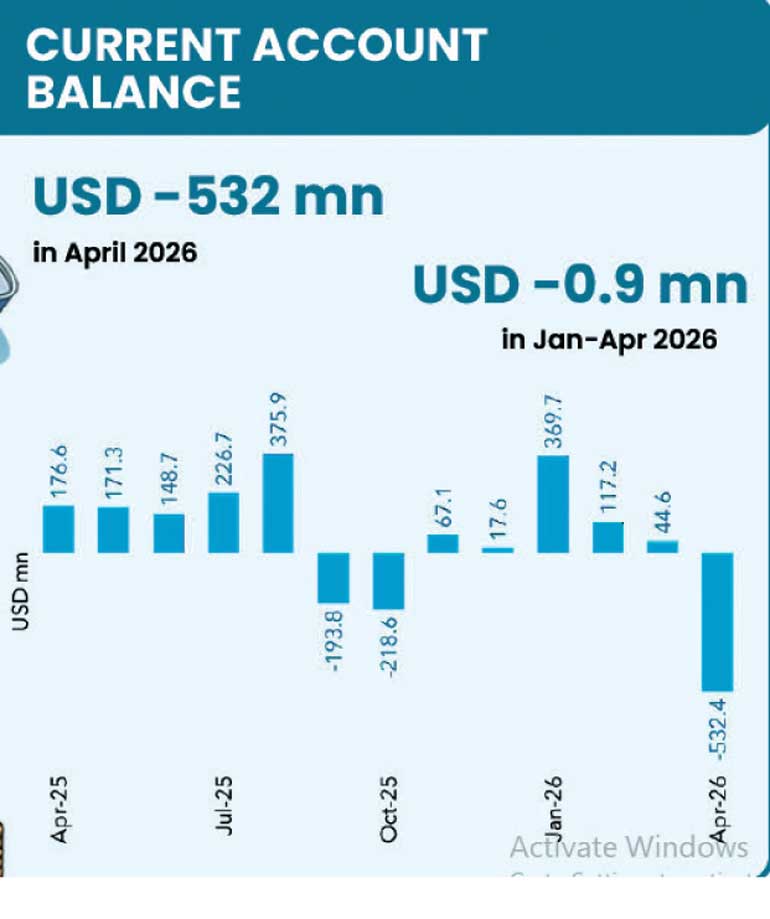
Sri Lanka’s current account slipped into a deficit of $ 532.4 million in April from a surplus of $ 176.6 million a year earlier, as the economic fallout from the Middle East conflict sharply widened the trade gap and weighed on tourism earnings, according to the Central Bank of Sri Lanka’s (CBSL) latest External Sector Performance report.
The deterioration of 204.1% year-on-year (YoY) in April also erased the cumulative surplus recorded during the first three months of the year, resulting in a marginal current account deficit of $ 0.9 million for the January-April period, compared to a surplus of $ 1.12 billion in the corresponding period of 2025.
The CBSL said the widening merchandise trade deficit, moderation in the services surplus, and a higher primary income deficit outweighed the continued growth in workers’ remittances.
The merchandise trade deficit expanded to $ 1.38 billion in April from $ 717.7 million a year earlier, as imports surged 45.7% YoY to $ 2.46 billion, significantly outpacing export growth of 10.9% YoY to $ 1.07 billion.
For the first four months of 2026, the trade deficit widened to $ 3.69 billion from $ 2.26 billion a year ago, reflecting a 25.2% YoY increase in imports against a 5.1% YoY rise in exports.
A major contributor to the import bill was fuel, with expenditure soaring 149.9% YoY to $ 886 million in April amid higher global oil prices triggered by the ongoing Middle East conflict and increased import volumes.
Vehicle imports also continued to exert pressure on the external account, with spending on personal and commercial vehicles amounting to $ 208 million in April, bringing cumulative expenditure on motor vehicle imports to $ 821 million during the first four months of the year.
The services account surplus fell 37.8% YoY to $ 229.2 million in April, largely due to weaker tourism receipts. The cumulative services surplus contracted by 24.3% YoY to $ 1.2 billion during January-April.
Tourist arrivals declined for a second consecutive month to 135,643 in April, down 22.3% from a year earlier, while earnings fell 38.8% YoY to $ 157.1 million.
For the first four months of the year, tourism earnings declined 19.4% YoY to $ 1.11 billion. The CBSL attributed the decline in tourist arrivals and earnings to the impact of the Middle East conflict, which has affected travel demand and regional connectivity.
Workers’ remittances, however, remained a key source of external sector resilience. Remittance inflows rose 18.8% YoY to $ 767.9 million in April, while cumulative inflows increased 24.5% YoY to $ 3.06 billion during the first four months of 2026.
Foreign investments in the Government securities market registered a marginal net inflow of $ 2 million, while foreign investments in the Colombo Stock Exchange (CSE), including both primary and secondary market transactions, recorded a net outflow of $ 16 million during the month of April.
Despite the pressures on the current account, the CBSL noted that gross official reserves stood at around $ 6.8 billion at end-April, including the swap facility with the People’s Bank of China (PBOC), providing import cover of three and a half months.
Meanwhile, the Sri Lankan rupee depreciated by 5.4% against the US dollar on a year-to-date (YTD) basis as at end-May, reflecting heightened external sector pressures following the escalation of the Middle East conflict since late February. The CBSL said the depreciation trend was broadly in line with that observed in peer economies.
It also noted that the completion of the combined Fifth and Sixth Reviews under the International Monetary Fund (IMF) Extended Fund Facility program on 27 May would provide immediate access to about $ 695 million, supporting the country’s reform program and external sector stability.




