Sunday Sep 13, 2026
Sunday Sep 13, 2026
Saturday, 3 January 2026 00:43 - - {{hitsCtrl.values.hits}}
 |
| Industry and Entrepreneurship Development Deputy Minister Chathuranga Abeysinghe |
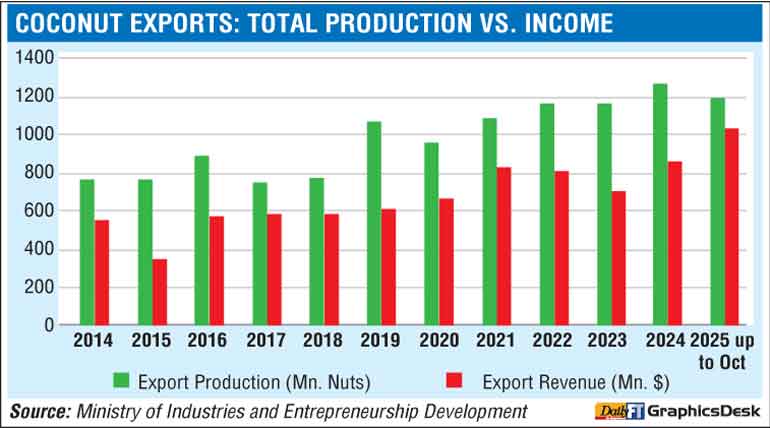
The country’s coconut sector has recorded a landmark year in 2025, with export earnings surpassing $ 1 billion and projected to reach around $ 1.2 billion by year-end, Industry and Entrepreneurship Development Deputy Minister Chathuranga Abeysinghe yesterday said, highlighting the industry’s growing importance in the country’s export basket.
He said the performance represents a sharp increase from $ 800 million in 2024, translating into year-on-year (YoY) growth of over 40% and marking a major milestone for the coconut industry.
The Deputy Minister described the outcome as one of the standout achievements in Sri Lanka’s export performance this year.
Abeysinghe noted that the primary constraint to further expansion of the sector remains nut productivity, an issue the Government began addressing through a series of structural interventions initiated in 2025. These include measures to improve crop yields and expand the extent of coconut cultivation.
However, he cautioned that such reforms are expected to deliver tangible results only over the medium to long term.
In the short term, he said, the most effective lever available in 2025 was encouraging behavioural change in domestic coconut consumption. This approach focused on promoting more efficient household usage, the adoption of alternative products for daily consumption, and the use of simple technologies to reduce domestic waste.
Alongside these efforts, the Government allowed coconut exporters to import limited quantities of coconut milk and kernel-based products strictly for re-export purposes. Abeysinghe said that although the volumes imported were minimal, the policy intervention was timely and helped prevent shortages in the domestic market while maintaining the growth momentum of coconut exports.
He attributed the sector’s strong performance to coordinated action across multiple Government institutions, including the Plantation Ministry, the Industries Ministry and the Export Development Board (EDB), as well as to the cooperation of the public.
According to Abeysinghe, citizens played a crucial role by understanding the scientific rationale for redirecting previously wasted domestic consumption towards higher-value export markets.
With coconut now firmly established as a strategic export crop, Abeysinghe said Sri Lanka has significant potential to further scale up earnings.
He expressed confidence that, supported by ongoing productivity reforms and sustained market development, coconut-based exports could reach $ 2.5 billion by 2030, adding that the country is firmly on track to achieve that target.




