Friday Oct 16, 2026
Friday Oct 16, 2026
Saturday, 14 March 2026 00:00 - - {{hitsCtrl.values.hits}}
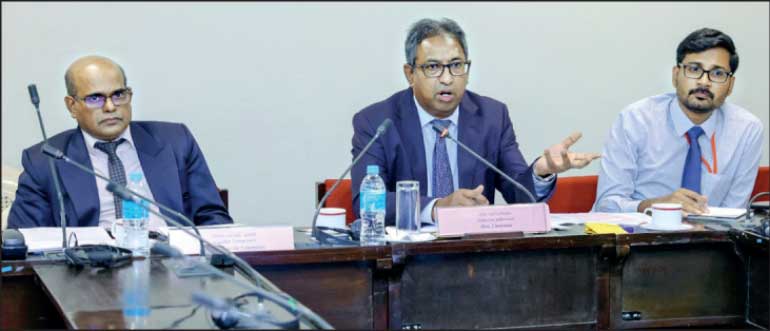
The Committee on Public Finance (CoPF) has approved the proposal to determine salaries and service conditions for officers and employees of the Commission to Investigate Allegations of Bribery or Corruption (CIABOC), paving the way for recruitment under the country’s strengthened anti-corruption framework.
The decision was taken when the Committee met in Parliament this week (10) under the Chairmanship of MP Dr. Harsha de Silva. The meeting was attended by Deputy Ministers Nishantha Jayaweera and Chathuranga Abeysinghe, along with MPs Ravi Karunanayake, Wijesiri Basnayake and Nimal Palihena.
The move comes as part of the implementation of the Anti-Corruption Act No. 03 of 2023, which introduced sweeping changes to the country’s anti-graft architecture and restructured the operations of the Commission.
CIABOC Director General Ranga Dissanayake informed the Committee that the Commission will function as a newly structured institution under the 2023 law.
He noted that the legislation provides for the appointment of the required officers and employees, but their remuneration and service conditions must be determined with parliamentary approval and the concurrence of the Finance Minister.
Dissanayake also expressed concern about the delay in operationalising key provisions of the law, noting that nearly two years had passed since the Anti-Corruption Act was enacted.
According to the Finance Ministry, the Department of Management Services has already approved 971 positions required for the Commission’s staff, together with their salary structures and special allowances.
During deliberations, the CoPF observed that the proposed salary for legal officers attached to the Commission was lower than the remuneration of legal officers in the Attorney General’s Department. Despite this discrepancy, the Committee decided to approve the proposal in order to avoid further delays in recruitment and the operationalisation of the institution.
However, the Committee emphasised that the salary scales should be reviewed in the future to ensure the Commission is strengthened as an effective institution.
It was also noted that a separate proposal regarding the salary scales of the Commission’s leadership, including the Chairman, Commissioners and Director General will be submitted later. The CoPF indicated that these salaries are expected to align with those of judges of the Court of Appeal, consistent with earlier recommendations made by the Committee.
CoPF members pointed out that it would be reasonable for the Commission’s personnel to receive higher remuneration compared with the broader public sector, given the sensitive nature of their responsibilities.
They noted that officers of the CIABOC are prohibited from engaging in outside employment, personal income-earning activities or consultancy work, while also facing heightened risks of conflicts of interest.
The Committee also discussed structural challenges facing the Commission, particularly its heavy concentration in Colombo.
CIABOC Director General said the centralised structure poses practical difficulties when conducting investigations or raids across the country and when summoning witnesses to give evidence.
Dissanayake indicated that the Commission intends to expand its presence outside the capital, with plans to establish at least nine provincial offices initially, before gradually expanding further to strengthen countrywide anti-corruption enforcement.




