Friday Oct 16, 2026
Friday Oct 16, 2026
Saturday, 17 January 2026 01:16 - - {{hitsCtrl.values.hits}}
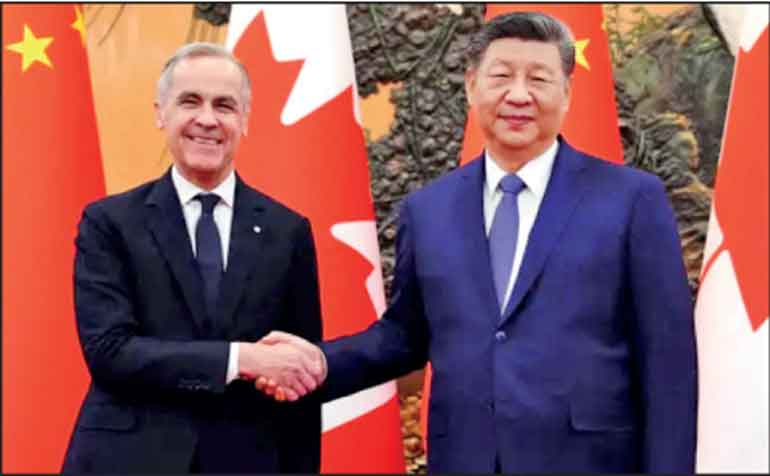
Canadian Prime Minister Mark Carney (left) with Chinese President Xi Jinping
China and Canada have agreed to roll back a series of punitive tariffs following high-level talks in Beijing between Chinese President Xi Jinping and Canadian Prime Minister Mark Carney, signalling a tentative thaw after years of trade and diplomatic friction.
Under the agreement, China is set to reduce tariffs on Canadian canola oil to 15% from the current 85% by 1 March, while Ottawa will apply a most-favoured-nation tariff of 6.1% on Chinese electric vehicles, Carney told reporters after the meeting.
The understanding marks a breakthrough following prolonged tit-for-tat trade measures that had weighed on bilateral commerce. Xi described the outcome as a “turnaround” in relations, while for Carney it represents a diplomatic and economic win, making him the first Canadian leader to visit China in almost a decade.
Carney has been seeking to diversify Canada’s trade relationships, particularly as uncertainty persists around United States trade policy and the renewed use of tariffs under former President Donald Trump. Observers say the agreement could also open the door to increased Chinese investment in Canada, a sensitive issue given Ottawa’s proximity to the US market.
Speaking to reporters, Carney suggested that recent engagement with Beijing had become more predictable, describing discussions with Chinese officials as “realistic and respectful”. At the same time, he stressed that Canada continues to draw clear boundaries in its relationship with China, including on human rights, election interference and national security concerns.
“We take the world as it is, not as we wish it to be,” Carney said when asked about China’s human rights record, adding that Ottawa had made its “red lines” clear during talks.
The agreement follows years of strained relations. In 2024, Canada imposed 100% tariffs on Chinese electric vehicles, mirroring similar measures taken by the US. Beijing responded last year with tariffs on more than $ 2 billion worth of Canadian agricultural and food exports, including canola products, contributing to a 10% decline in Chinese imports from Canada in 2025.
As part of the latest deal, Canada will cap imports of Chinese electric vehicles eligible for the lower tariff rate at 49,000 units, reflecting concerns among domestic automakers about competition from lower-cost Chinese models. China will also reduce tariffs on other Canadian exports, including lobsters, crabs and peas.
China remains Canada’s second-largest trading partner, though trade volumes remain well below those with the US. During his three-day visit, Carney also met senior executives from major Chinese firms and oversaw the signing of several agreements on energy and trade cooperation.
Analysts say the visit represents a pragmatic recalibration rather than a full rapprochement. Colin Robertson, a former Canadian diplomat and vice-president of the Canadian Global Affairs Institute, described it as a “reset of the relationship” that is more modest in ambition but grounded in realistic expectations.
The two countries’ relationship deteriorated sharply after Canada detained Huawei executive Meng Wanzhou in 2018 at the request of the US, followed by China’s arrest of Canadian citizens Michael Kovrig and Michael Spavor on espionage charges. All three were released in 2021.
Carney acknowledged that differences between the two systems would continue to limit cooperation, but argued that direct engagement was preferable to public confrontation. “We’re very clear about where we cooperate and where we differ,” he said, adding that issues such as Taiwan and Hong Kong were raised during the discussions.




