Thursday Mar 26, 2026
Thursday Mar 26, 2026
Friday, 20 March 2026 00:06 - - {{hitsCtrl.values.hits}}
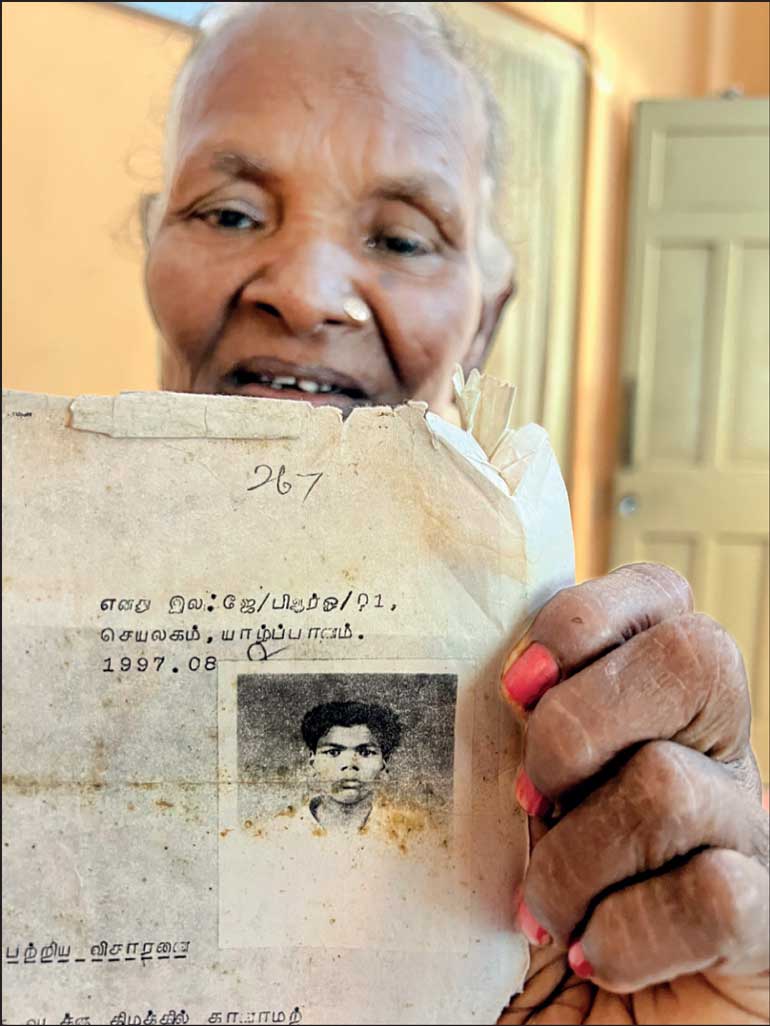
Vallipuram Thilagamalar holds up a photo of her missing son
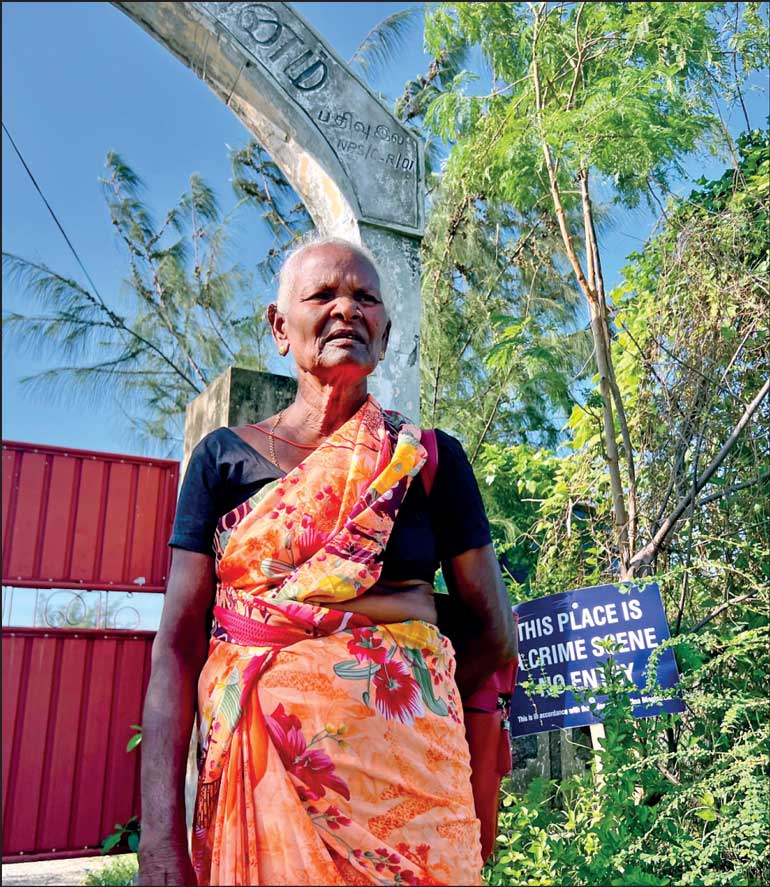
Vallipuram Thilamalar stands near the unearthed mass grave in Chemmani, Jaffna, where over 200 human remains were found
Text and Pics by Aanya Wipulasena
It was a sandalwood-coloured shirt. Vallipuram Thilagamalar, 74, recognised it as soon as she saw it among the items laid out for identification, in August last year. She said it was the last thing her 19-year-old son wore, made from cloth he selected himself, before he went missing in 1996.
The shirt was displayed alongside a feeding bottle, a school bag, a Bata slipper, a shirt, clothes believed to belong to children, toys, and a small child’s anklet and bangle and other artifacts found during the excavations at the mass grave in Chemmani, Jaffna.
“He was detained by the armed forces on 12 November 1996. I had warned him against going out that day,” Thilagamalar said, explaining that it was a dangerous time for young men to walk around alone. Since his detention, Vallipuram Rahukumar had not been seen again.
With no information about his whereabouts, Thilagamalar lodged a police complaint and wrote to the Chairman of the Human Rights Task Force, Jaffna, days after his disappearance. All to no avail.
Desperate, in 1998 she lodged a new entry with the Chavakachcheri Police. Her complaint states, “My son was arrested at the Sentry Point at Sangathanai, while returning from his sister’s house at Kodikamam.
“I went to the Sentry Point and inquired from the Army camps in the locality and to date I could not get any information.”
Years, later she said, “I went to everyone I could. I cried asking for help to find my son. No one did anything.”
She had no information about him until his shirt was unearthed last year, bringing difficult but renewed hopes of finally learning what happened to her son.
Since excavations began, after discovery of human remains by local construction workers at the Sinthupathy Cemetary, in February last year, 239 skeletal remains have been unearthed. The 240th (S-218) set of remains was found tangled with others that have yet to be fully excavated and was left in place for careful recovery at the next phase.
A source close to the case said the CID informed the court that the production number of the Bata slipper had been sent to the manufacturer for analysis, placing its production date between 1983 and 1995. Meanwhile, archeological experts were called to analyse the positions the skeletons were found in, as at least one appeared to be in a seating position.
Now, after months of delays since excavations were last conducted, Jaffna Magistrate fixed April 20, 2026, as a tentatively to resume its work.
Lawyer representing the victims, Ranitha Gnanarajah said, furthermore, water accumulated in the site will be removed on March 27. The court also ordered to clean the site twice a week under the supervision of a JMO, and repair and renovate the report huts that were damaged by the Ditwah cyclone and monsoonal rains, while security at the site is to remain.
Mahalingam Sahila, 60, longs to find answers for what happened to her brother who went missing in 1996 when he was 21 years old. She said it is difficult to grieve his loss without having answers.
“I still remember what he ate the last time I saw him. String hoppers and tomato gravy. Whenever I see that, I remember him,” she said.
She recalls her brother as a friendly young man. “He was friends with everyone in the village,” she said fondly.
He last wore a grey shirt, a brown pair of trousers, pair of slippers and a chain with a star shaped pendent. None of these were recovered from the excavations thus far, but she says she remains hopeful.
According to the Office on Missing Persons the Chemmani mass grave is the seventeenth mass grave officially recorded in the country. When UN High Commissioner for Human Rights, Volker Turk, visited the site in June last year, he said it was a ‘step further towards accountability and justice’ and closure.
The International Commission of Jurists (ICJ), in a statement in July last year, said the Chemmani exhumations must go beyond forensics, urging authorities to investigate disappearances, identify victims, prosecute perpetrators, and ensure justice.
In Jaffna, Director of Law and Human Rights Centre, Selvaras Jeyathileepan is working with the families of missing persons.
“Before the Chammani mass grave was found the families were fed up. They were searching for answers for years, and this reignited their hopes,” he said adding that at first the family members were ‘shocked’ with the news.
Selvaras says that the families want foreign parties to monitor the investigations. “If we are satisfied (with the locally done investigations) we won’t ask for foreign interventions.”
The case is due to be called in an open court on 8 April 2026, to discuss and conduct a site visit.
For Thilagamalar, who is having health problems related to her age. Tears fall uncontrollably when she speaks about her son. “He was a good boy,” she said.



