Thursday Oct 22, 2026
Thursday Oct 22, 2026
Saturday, 7 February 2026 02:06 - - {{hitsCtrl.values.hits}}
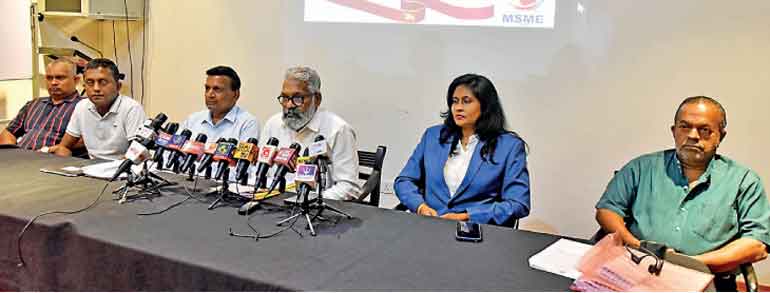
The Ceylon Federation of Micro, Small and Medium Enterprises (MSMEs) has called for urgent structural reforms to the country’s lending and regulatory framework, warning that flawed policy responses during successive national crises have disproportionately harmed small businesses while enabling excessive profit accumulation within the financial sector.
Addressing the media on Thursday, the Federation outlined a clear path forward, centred on corrective measures to address what it described as unjust interest recovery and weak regulatory oversight since 2022.
To ensure uniform and enforceable implementation, the Federation urged the Government to enact special legislation, if necessary, to give legal effect to these measures. It argued that voluntary guidelines and temporary concessions have repeatedly failed to protect borrowers during crises, highlighting the need for binding statutory safeguards.
Placing Sri Lanka’s experience in a global context, they pointed to the international shift away from bank-controlled interest rate benchmarks, citing the abolition of the London Interbank Offered Rate (LIBOR) in the UK. Following revelations that major banks had manipulated LIBOR to boost profits at the expense of customers, UK authorities replaced it with the Sterling Overnight Index Average (SONIA), a transparent and risk-free benchmark designed to restore public trust.
Drawing more comparisons with international responses, they cited the United Arab Emirates, where the Central Bank ordered six-month loan deferrals without additional fees or interest following recent floods, effectively shielding borrowers during a disaster.
The Federation opined that this precedent demonstrates the inherent risks of allowing banks to influence key pricing benchmarks and underlines the need for greater transparency in Sri Lanka’s own interest rate framework.
They also criticised the handling of debt moratoriums introduced during the COVID-19 pandemic, describing their implementation as critically flawed. The Federation claimed the Central Bank announced moratoriums without issuing clear and uniform guidelines on interest capitalisation, creating a regulatory vacuum that financial institutions exploited.
“Loans were rescheduled in ways that maximised institutional advantage, with interest compounded through opaque mechanisms that borrowers struggled to understand,” they alleged.
According to the Federation, when repayment demands were later issued, a significant majority of financial institutions failed to provide detailed explanations or breakdowns of how inflated loan balances had been calculated.
“MSME owners who questioned these figures were often met not with restructuring support, but with threats of parate execution, including the seizure of property, vehicles and other assets,” they claimed.
They warned that such practices undermine confidence in the financial system and deepen economic inequality, particularly during periods of national distress.
“Regulators, must function as a shield for citizens and productive enterprises during crises, rather than as instruments that facilitate profit accumulation at the expense of economic survival,” they said.
The Federation stressed that MSMEs which obtained loans on or before April 2022 were subjected to unprecedented interest rate shocks, and argued that banks should be required to refund excess interest collected between May 2022 and November 2024. According to the Federation, this period coincided with extreme rate volatility that borrowers neither caused nor could reasonably absorb.
To facilitate this process without destabilising the banking system, the Federation proposed that the Government issue tax credits to banks based on the 2023 and 2024 financial years. These credits would allow banks to recover the cost of interest refunds gradually over a five-year period, using fiscal space already created through elevated tax revenues from the sector.
They also called for the immediate suspension of Credit Information Bureau (CRIB) and non-performing loan (NPL) listings for borrowers who were classified as non-performing on or after the Easter Sunday attacks, noting that repeated external shocks have distorted the true creditworthiness of many otherwise viable enterprises.
The Federation warned that continued NPL classification without contextual relief is accelerating business failures and permanently excluding entrepreneurs from formal credit markets.
They maintained that addressing these structural failures is essential to preserving the MSME sector, sustaining employment and restoring trust between borrowers, banks and the State.
Pic by Kithsiri de Mel




