Thursday May 28, 2026
Thursday May 28, 2026
Friday, 30 January 2026 00:04 - - {{hitsCtrl.values.hits}}
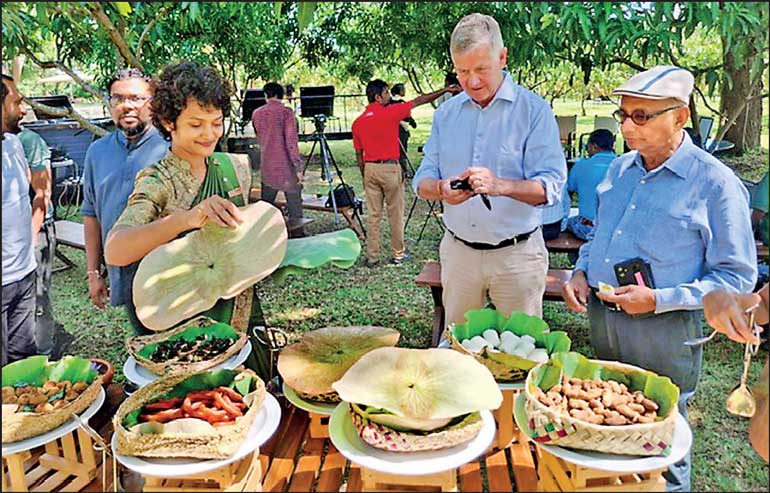
Refreshments at the symposium: Amba Yalu Resort Manager Jeewanthi Adikari with Erik Solheim and Chandra Wickramasinghe
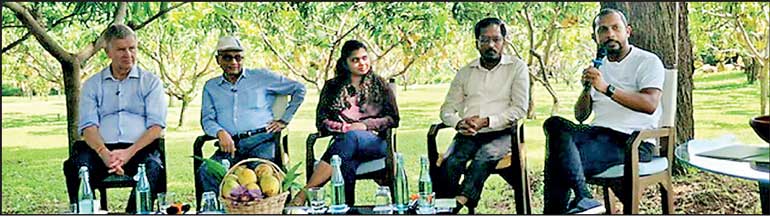
The distinguished panel (from left): Global leader on environmental development and Norwegian diplomat Erik Solheim, Thema Collection Chairman/Managing Director Chandra Wickramasinghe, Market Development Facility Sector Coordinator – Tourism Nimesha Palliyaguru, Eco Treats Tourism Chairman and sustainable tourism expert Dr. Samantha Pathirathna, and Zero Plastic Movement Founder Nishshanka De Silva
By Uma Chandrasiri
Industry leaders and sustainability advocates met at Thema Collections’ Amba Yaalu, Kandalama recently to discuss avenues of practical change and growth toward positioning Sri Lanka as a sustainability-led tourist destination.
The discussions focused on environment responsive tourism, drive toward zero plastic usage, climate focused investments and data-driven decision making geared toward sustainability and profitability.
Global leader on environmental development and Norwegian diplomat Erik Solheim kicked off the symposium, stressing on Sri Lanka’s biggest strength in attracting tourists, its beauty and culture within a framework of compactness. “Tourism is probably the greatest job created on the planet, for both the highest qualified and those with lesser qualifications. Sri Lanka can benefit from lessons learnt from the rest of the world to safeguard and enhance her environmental assets, increase Electric Vehicle penetration, better utilise renewable energy sources, move toward eliminating single use plastics and create greener cities by facilitating walking and biking, especially with regard to tourists” he said. He cited examples toward sustainable and eco-friendly practices of India, touting Tamil Nadu’s eco circuit from Chennai to Rameshwaram and the combined solar and hydro power facility of Andra Pradesh which is the largest in the world.
Thema Collection Chairman and Managing Director, Chandra Wickramasinghe highlighted the timely need of qualitative over quantitative tourism. The bold and innovative leader who opened the first hotel in the East Coast in the immediate aftermath of the Sri Lankan civil war with Maalu Maalu Resort and Spa, Pasikudah stated that the risk he took was also a move toward economic reconciliation. “terrorism and tourism will never blend in with each other and today we are fighting terrorism against the environment,“ he said, stressing on the importance of creating acceptable policies toward sustainability and poverty elimination, especially in the North and East. The pioneer in launching Sri Lanka’s first 100% women led hotel, Amba Yaalu Kandalama, Wickramasinghe bemoans the fact that women constitute only a mere 10% of the total work force of the hospitality industry. “The other significant foreign currency earners such as foreign employment and the tea and garment industries employ a much higher percentage of personnel “ he added.
Speaking on his fight against the use of plastic and the drive toward stringent regulations, Zero Plastic Movement Founder Nishshanka De Silva stated that even though the prime selling point of the tourism industry is the environment, it is a crime that Sri Lanka still uses nearly 20 million shopping bags, nearly 15 million lunch sheets and 10 million PET bottles daily, which adds to pollution and is a significant deterrent to sustainable tourism. Sri Lanka also recycles only about 3% of the total plastic produced. De Silva however is proud of a law which was passed recently which mandates that each and every plastic product manufacturer recovers 40% of the total production from the market. Failure to comply will initially result in penalties and ultimately in the cancellation of the manufacturer’s Business Registration. “Tourism is all about the environment, community and culture. “Our culture has no connection to plastic while the use of it destroys the environment and our community,” he concluded.
Eco Treats Tourism Ltd. Chairman and Sustainable Tourism expert Dr. Samantha Pathirathna reiterated that agriculture, human settlement and biodiversity need to be integrated in a climate responsive manner. “We require a far greater understanding of our National Fiscal Plan and even though national and provincial level adaptation plans have been developed, it took the natural disaster Ditwa for the country to realise that we need climate responsive investments,” he added.
Market Development Facility (MDF) Sector Coordinator Tourism Nimesha Palliyaguru contributed to the discussion by adding that data- driven decision making is imperative toward advancing sustainable tourism. A recent visitor flow analysis conducted by MDF has revealed that even though the number of tourist arrivals to the country has increased, the per day spend per visitor has dropped significantly. An approximate per day spend per visitor of $ 170 in 2018 is currently averaging below $ 140. As part of their ongoing efforts toward sustainable tourism development, MDF, in collaboration with a local tour operator, has launched the island’s first ever carbon calculated tour itinerary aimed at the EU market. “These methods attract EU visitors who are conscious of the environment, are willing to travel slowly yet spend more,” she added.




