Saturday Oct 24, 2026
Saturday Oct 24, 2026
Tuesday, 8 September 2026 03:23 - - {{hitsCtrl.values.hits}}
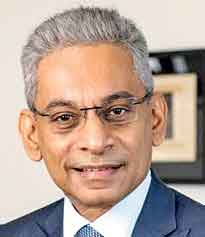 |
| Steven Thiru |
Commonwealth Lawyers Association (CLA) President Steven Thiru has raised a series of procedural fairness concerns following his observation of Supreme Court proceedings challenging the constitutionality of the proposed 22nd Amendment, while stopping short of commenting on the merits of the case.
Thiru attended the second day of hearings, held on 2 September, in the Ceremonial Court of the Supreme Court, at the invitation of the Bar Association of Sri Lanka (BASL).
The visit formed part of the CLA’s mandate to promote judicial independence under the Commonwealth (Latimer House) Principles.
A five-member bench headed by Chief Justice Preethi Padman Surasena, along with Justice Achala Wengappuli, Justice Arjuna Obeyesekere, Justice Sampath B. Abeykoon and Justice K.M.G.H. Kulatunga, heard a total of 67 petitions filed against the proposed amendment, which seeks to raise the retirement age of Supreme Court judges to 67 years and Court of Appeal judges to 65 years. The Attorney General was named Respondent, with 27 Interveners opposing the petitions.
Thiru noted that the BASL’s motions seeking the Chief Justice’s recusal and a hearing before a full bench of all 17 sitting judges were dismissed on 1 September, with no reasons given beyond the Court’s assertion of jurisdiction. The recusal application had cited a potential conflict of interest, as the Chief Justice would be the first Supreme Court judge eligible to benefit from the proposed amendment.
“An independent, impartial, honest and competent judiciary is integral to upholding the rule of law,” Thiru said, citing the Latimer House Principles, while emphasising that his observations were not intended to suggest bias on the part of the Chief Justice or to prejudge the recusal application’s merits.
Thiru also flagged the composition of the bench as a matter warranting scrutiny, pointing out that four judges senior to Justice Wengappuli, namely Justice Yasantha Kodagoda, Justice A. H. M. D. Nawaz, Justice Shiran Gooneratne and Justice Janak De Silva, were not empanelled. He said the absence of publicly apparent reasons for excluding a full or more senior bench risked fuelling perceptions that other judges had been excluded for ulterior motives, though this did not, of itself, establish any unlawfulness.
A further concern related to the Chief Justice’s refusal to permit Petitioners’ Counsel to make oral submissions in reply after the Interveners and the Solicitor General, representing the Respondent, had concluded on 2 September. Petitioners were instead directed to file written replies by 3 p.m. on 3 September. Thiru observed that since the Court had sat until 10.45 p.m. on the first day, it could have accommodated a limited oral reply after proceedings concluded at 5.30 p.m. on the second day, particularly as not all Counsel had intended to reply orally.
Separately, the BASL on 3 September, informed the Court it would not tender post-hearing written submissions, citing the denial of the oral right of reply, with several other Petitioners reported to have taken a similar position.
Thiru also held discussions during his visit with Opposition Leader Sajith Premadasa on preserving judicial independence, while attempts to meet Justice and National Integration Minister Harshana Nanayakkara and Justice and National Integration Ministry Secretary Ayesha Jinasena PC did not materialise before he concluded his visit on 3 September.
The Supreme Court is constitutionally required to deliver its determination on the petitions by 8 September, under Article 121(2) of the Constitution, Thiru noted.




