Monday Nov 23, 2026
Monday, 23 November 2026 00:22 - - {{hitsCtrl.values.hits}}

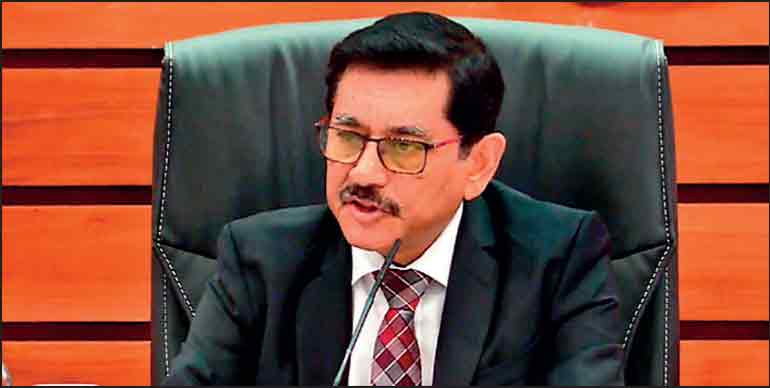
CBSL Governor Dr. Nandalal Weerasinghe
The Central Bank of Sri Lanka (CBSL) has tightened controls on import advance payments after detecting repeated abuse of a facility that allowed importers to remit up to $ 50,000 abroad against an invoice without the goods ever arriving, Governor Dr. Nandalal Weerasinghe said on Friday.
Speaking at the post-Monetary Policy Review media briefing, Dr. Weerasinghe said the CBSL’s Department of Foreign Exchange was investigating outflows made under an earlier circular issued by the Import and Export Control Department. He said ‘the number of unnotified cases was massive’ and that action had so far been taken only on the cases that had been reported.
Under the earlier rules, an importer could obtain an advance of up to $ 50,000 from a commercial bank by presenting an invoice. The payment was recorded in the Customs ASYCUDA system, and the goods were required to arrive within 180 days. Because banks released funds against an invoice and non-arrival could only be confirmed after 180 days, abuse could go undetected for months.
Dr. Weerasinghe said checks had found that ‘the very same person had come to certain bank branches representing different companies’ to obtain repeated advances.
Customs was required to notify the CBSL’s Foreign Exchange Department when goods failed to arrive, but had not shared this information for a long period despite repeated requests. Some transactions were never recorded at Customs at all. Customs has previously said the alleged transfers fell outside its operational mandate, and that such transactions would have been visible to the banking system and the CBSL’s Financial Intelligence Unit (FIU).
Applicants must now provide a Tax Identification Number (TIN) to request an advance. The Import and Export Control Department has issued regulations requiring background checks before funds are released, covering whether the importer has prior records, who the beneficial owner is, and what the company does. A new mechanism also allows commercial banks to check whether an applicant has already obtained an advance from another bank.
Fines have been imposed on a large number of companies. The cases are being treated as fraud, with legal action being pursued alongside regulatory penalties, following a Police investigation prompted by information that individuals were using the facility repeatedly.
Violations by Board of Investment (BOI)-registered companies are handled by the Import and Export Control Department, while the CBSL’s Foreign Exchange Department acts against other entities once Customs reports them.
The measures add to regulations gazetted on 18 June under the Imports and Exports (Control) Act, which require banks to report import-related foreign currency payments to Customs in real time and importers to register with Customs before making advance payments. Those rules followed investigations into more than $ 85 million in alleged remittances for imports that never entered the country.
President Anura Kumara Dissanayake told Parliament in June that nearly $ 1 billion had been remitted through bank telegraphic transfers as advance payments since 2023 without any imports arriving. He linked the transactions to drug money and criminal activity, alleging the involvement of certain bank branches.
CBSL officials later told Parliament’s Committee on Public Finance (CoPF) that the FIU had repeatedly warned successive governments, the Treasury, and banks from 2021 that advance import payments were being used for trade-based money laundering.