Thursday Oct 22, 2026
Thursday Oct 22, 2026
Saturday, 7 March 2026 00:41 - - {{hitsCtrl.values.hits}}
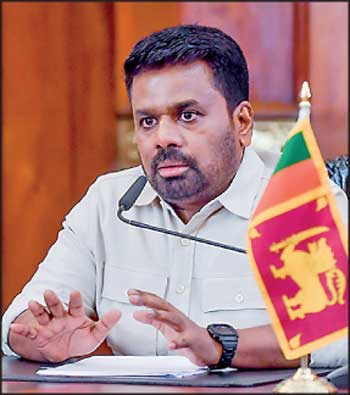 |
| President Anura Kumara Dissanayake |
President Anura Kumara Dissanayake said the Central Bank of Sri Lanka has presented the Government with a scenario-based assessment of the possible economic impact of the ongoing conflict in the Middle East, including a worst-case outcome which authorities do not expect to materialise.
Speaking at a special press conference on Thursday, the President said the Central Bank had submitted its projections the previous day outlining potential responses of the financial market under different developments in the conflict.
“The Central Bank of Sri Lanka provided us with their forecasts yesterday. These projections for the financial market have been prepared in three scenarios: the current situation, a moderately developed neutral scenario and a potentially disastrous scenario, the last of which we do not expect,” Dissanayake said, according to a transcript released by the President’s Media Division.
He said the analysis was intended to guide policy responses as the Government monitors developments in the region and their possible spill-over effects on Sri Lanka’s economy.
“The report outlines how the financial market is likely to behave under each scenario and we are making decisions accordingly. At the same time, we are monitoring the daily macroeconomic indicators of the country, including food security, employment and the activities of the Finance Ministry and we are taking necessary measures based on these observations,” the President said.
Dissanayake did not disclose further details of the Central Bank’s forecasts or the assumptions underpinning the three scenarios. However, the remarks indicate that authorities have begun contingency planning for possible economic disruptions while maintaining that the most severe outcomes are unlikely under current conditions.
Dissanayake said another key consideration was the situation of Sri Lankans living abroad, noting that the Government was evaluating the interventions required to protect them in the current context and to safely repatriate them to Sri Lanka if conditions deteriorate.
He said the safety of tourists currently in the country was also a priority, stressing that ensuring their security was essential for the continued growth of the tourism sector. The President added that authorities had been coordinating with hoteliers, travel agencies and other stakeholders on measures such as granting a two-week visa-free stay to tourists unable to leave the country and arranging safe repatriation through alternative routes.
Dissanayake also noted that several cargo ships scheduled to arrive at Sri Lankan ports while en route to the Middle East were presently unable to proceed due to the prevailing situation. These vessels were being temporarily accommodated at the Port of Colombo while authorities explored solutions to provide relief and allocate land for container storage.
He further said attention was being directed towards tea exports, a sector with a direct impact on the economy. According to the President, Minister of Foreign Affairs Vijitha Herath was currently in India seeking support to sustain the sector. While acknowledging that the situation could evolve unpredictably, Dissanayake said the Government remained cautiously optimistic while also preparing for worst-case scenarios.
Dissanayake reiterated that the Sri Lankan economy was in a position to withstand the latest external shock, citing improved fiscal and external sector indicators.
He said the country had already purchased nearly $ 700 million from the market, which he described as evidence of the economic strength that had been built in recent months.
Referring to the impact of Cyclone Ditwah, Dissanayake noted that the disaster had caused damage estimated at $ 4.1 billion. By that time, the Government had already presented the year’s Budget to Parliament. Nevertheless, he said, without altering the Budget framework, the Government was able to allocate Rs. 500 billion separately to address the impact of the cyclone, helping dispel concerns that the economy would collapse as a result of the disaster.
The President further noted that 2025 recorded the lowest Budget deficit announced in recent history while also generating the highest Government revenue on record. He added that the current account balance had exceeded $ 1.8 billion, pointing out that historically Sri Lanka’s current account had turned positive only on four occasions, with the present period being one of them.
Dissanayake also said the primary balance stood at 2.3% according to the parameters set by the International Monetary Fund, while the country was currently exceeding 5%.
He acknowledged that the trajectory of the situation could not be predicted with certainty, but said the Government’s response would depend on how developments unfolded. However, based on present conditions, he said Sri Lanka was fully capable of coping with the situation.




