Thursday Oct 08, 2026
Thursday Oct 08, 2026
Thursday, 21 May 2026 06:17 - - {{hitsCtrl.values.hits}}
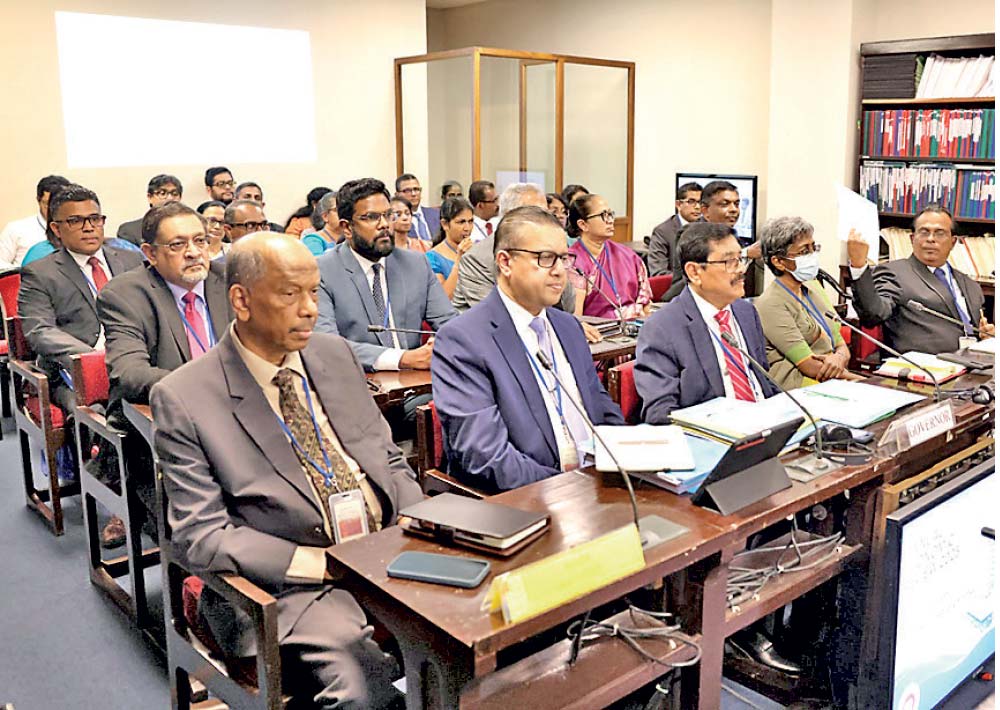
Governor Dr. Nandalal Weerasinghe (third from left) with other CBSL officials before CoPF
Central Bank of Sri Lanka (CBSL) Governor Dr. Nandalal Weerasinghe recently defended Sri Lanka’s flexible exchange rate framework and rejected claims that the recent rupee depreciation had mechanically worsened the country’s debt burden, arguing that external debt obligations must be assessed in foreign currency terms rather than through nominal rupee conversions.
Appearing before the Committee on Public Finance (CoPF) last week, Dr. Weerasinghe was questioned extensively by United National Party (UNP) MP Ravi Karunanayake on the impact of the weakening rupee on Government debt stocks, debt-to-GDP metrics, and broader macroeconomic management.
Karunanayake argued that the recent depreciation of the rupee had significantly increased the nominal rupee value of Sri Lanka’s external debt stock and raised concerns over the impact on the Government’s balance sheet and Budget position. He also questioned whether CBSL’s anti-inflationary stance was constraining economic growth.
Responding, Dr. Weerasinghe said the CBSL’s mandate under the law was limited to maintaining price stability and financial system stability, while broader growth generation depended on sectors such as tourism, agriculture, and industry.
The Governor said the argument that a one-rupee depreciation against the US dollar automatically increases Government debt by tens of billions of rupees represented only a partial reading of the broader macroeconomic picture. He stressed that Sri Lanka’s external debt stock, estimated at around $ 30 billion, does not change in dollar terms because of exchange rate movements.
Dr. Weerasinghe said external obligations ultimately have to be serviced through foreign currency earnings rather than domestic currency accounting values, arguing that the key challenge for Sri Lanka was strengthening the country’s capacity to generate dollars through exports, remittances, and other inflows.
He further noted that exchange rate depreciation also has offsetting effects across the economy, including improved export competitiveness and higher Government revenue from import duties and other dollar-linked taxes.
The Governor cautioned against interpreting debt sustainability solely through nominal rupee movements, stating that external debt is internationally evaluated in foreign currency terms because repayment obligations are denominated in foreign exchange.
Dr. Weerasinghe also defended the market-based exchange rate regime adopted under Sri Lanka’s current monetary framework, saying currency movements should reflect underlying demand and supply conditions rather than administrative controls by the CBSL.
Drawing comparisons with regional economies, he noted that countries such as India had also permitted currency depreciation despite holding substantial foreign reserves, as exchange rate flexibility formed part of broader macroeconomic adjustment mechanisms.
The Governor maintained that assessing the economic impact of currency depreciation required evaluating the overall macroeconomic balance, including implications for exporters, import demand, remittances, and external competitiveness, rather than isolating debt stock conversions in Rupee terms alone.
The exchange at the CoPF also revived debate over positions previously advanced during the Yahapalana administration, when Sri Lanka adopted a more flexible exchange rate framework under an International Monetary Fund (IMF)-supported reform program.
A May 2016 Letter of Intent to the IMF signed by then Finance Minister Ravi Karunanayake stated that a “clear commitment to exchange rate flexibility” was necessary to adjust to shifting external conditions, rebuild foreign exchange reserves, and allow the CBSL to focus on price stability.
The document also acknowledged that the CBSL had reduced intervention in September 2015 and allowed the exchange rate to be “largely determined in the market,” resulting in a sharper depreciation of the rupee during that period (https://www.imf.org/external/np/loi/2016/lka/051216.pdf).
Separately, former CBSL Deputy Governor Dr. W.A. Wijewardena argued in a 2018 article that while temporary intervention may be necessary to stabilise disorderly market conditions, prolonged artificial support for an overvalued currency could undermine export competitiveness, encourage imports, and eventually trigger deeper economic instability.
He also noted that while rupee depreciation raises the nominal local currency value of foreign debt, the Government simultaneously benefits from higher rupee revenues linked to import duties and foreign currency inflows.
Dr. Wijewardena further argued that long-term currency stability ultimately depends on improving Sri Lanka’s current account position and export competitiveness rather than attempting to engineer sustained appreciation of the rupee. Drawing comparisons with Singapore’s long-term productivity-driven currency strength, he cautioned that attempts to artificially strengthen the rupee without corresponding gains in productivity and external competitiveness could prove economically damaging.
He said sustainable relief from depreciation pressures would require broader structural reforms capable of generating persistent current account surpluses over time (https://www.ft.lk/Columnists/Rupee-s-sad-destiny-of-one-way-journey-to-depreciation/4-654254).




