Thursday Sep 17, 2026
Thursday Sep 17, 2026
Thursday, 17 September 2026 05:06 - - {{hitsCtrl.values.hits}}
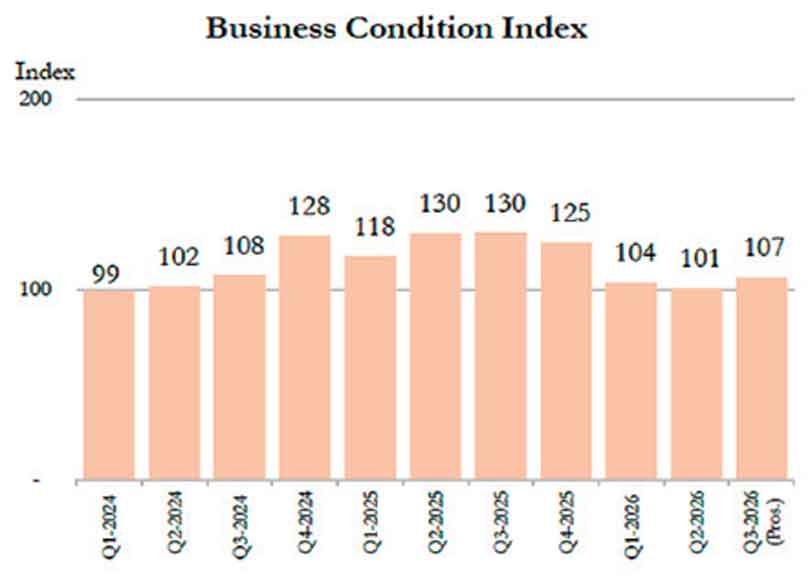
The Central Bank of Sri Lanka’s (CBSL) Business Condition Index eased to 101 in the second quarter of 2026, from 104 in the first quarter, as heightened macroeconomic uncertainty stemming from the conflict in the Middle East weighed on firms’ sentiment.
The Business Condition Index, compiled from the balance of opinion among around 100 surveyed firms selected in line with the composition of Sri Lanka’s GDP, captures firms’ assessments of current and future business conditions. A reading above 100 indicates improving conditions, 100 signals no change, and below 100 signals worsening conditions.
Firms expect a relative improvement in business confidence in the third quarter, with the Index projected to rise to 107, the CBSL said, as global tensions ease. The slowdown in overall sentiment during the second quarter was driven primarily by weaker readings in the Agriculture and Industry sectors, while the Services sector remained resilient.
For the third quarter, demand and sales volumes are projected to expand year-on-year (YoY), led by the Industry and Services sectors, while Agriculture is expected to remain below the neutral threshold. Capacity utilisation is projected to improve in line with these broader demand conditions, while the balance of opinion on investment is also expected to strengthen, mainly driven by Industry and Services, where most firms said they plan to invest for expansion.
Labour availability is expected to remain a constraint. Both skilled and unskilled labour availability are projected to stay below the neutral threshold in the third quarter, the CBSL said, even as the balance of opinion on bank credit demand is expected to rise, largely reflecting firms’ operational funding needs.
Reviewing developments in the second quarter, the CBSL said the Industry and Services sectors buoyed overall sales and demand volumes, driving an improvement in business activities, while Agriculture remained broadly around the neutral threshold. Overall capacity utilisation and the balance of opinion on investment both improved on a year-on-year basis during the quarter.
Firms also reported a notable YoY increase in input and output prices in the second quarter, a trend evident across all three sectors.
The balance of opinion on demand for bank credit increased across all sectors during the quarter, while credit accessibility was reported as broadly normal. Among respondents who described credit conditions as tight, the primary headwinds cited were higher-than-expected market lending rates and prevailing balance sheet constraints.



