Tuesday Nov 10, 2026
Tuesday Nov 10, 2026
Tuesday, 10 November 2026 00:53 - - {{hitsCtrl.values.hits}}
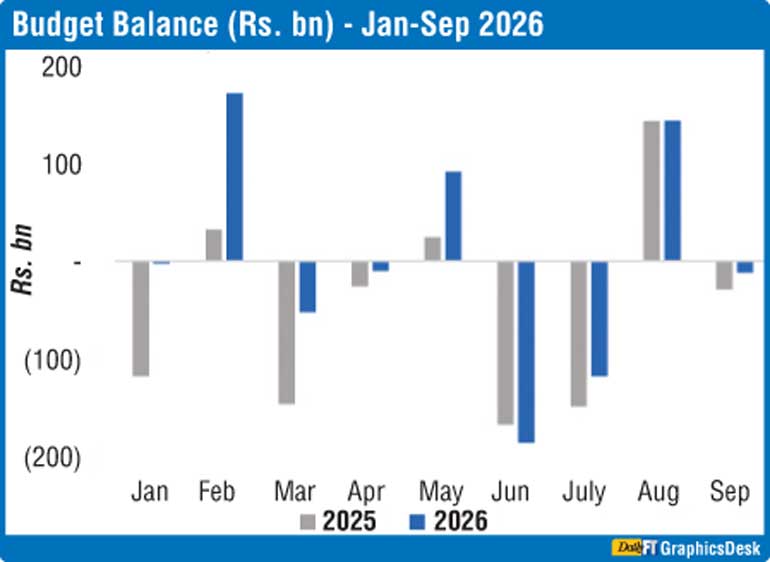
The Government’s Budget recorded a surplus of Rs. 22.3 billion in the first nine months of 2026, reversing a deficit of Rs. 441.4 billion a year earlier, as revenue from motor vehicle imports drove a 20% increase in collections that outran a slower rise in spending.
This is according to the latest Finance, Planning and Economic Development Ministry’s Fiscal Review Report.
Revenue excluding grants rose to Rs. 4,594.9 billion from Rs. 3,827.0 billion, while total expenditure increased 7.1% to Rs. 4,579.3 billion from Rs. 4,276.3 billion. The Ministry attributed the turnaround to the revenue increase ‘together with the rationalization of government expenditure’.
Total revenue and grants of Rs. 4,601.6 billion reached 86.8% of the Rs. 5,300 billion annual estimate, while expenditure stood at 60.6% of the Rs. 7,557 billion provision.
The nine-month surplus conceals a deterioration in the closing month.
September recorded a deficit of Rs. 13.1 billion, the first monthly shortfall since July, after a surplus of about Rs. 145 billion in August, according to figures in the previous month’s report.
Monthly revenue growth eased to 13.5% in September from 20% cumulatively, while expenditure growth accelerated to 8.6% from 7.1%, calculations from the Ministry’s data show.
The primary balance, which excludes interest payments and is the central indicator under Sri Lanka’s IMF-supported program, posted a surplus of Rs. 1,843.9 billion, up 25.8% from Rs. 1,465.1 billion, and already 5.1 times the Rs. 360 billion primary surplus projected for the full year in the 2026 Budget. September’s primary surplus of about Rs. 199.3 billion, against an implied interest bill of about Rs. 212 billion, was the only factor keeping the overall balance positive.
The Budget projects an annual overall deficit of Rs. 2,257 billion, implying the final quarter must absorb a deficit of about Rs. 2,279 billion to meet the target.
Tax revenue rose 19.3% to Rs. 4,252.1 billion, with VAT up 22% to Rs. 1,505.6 billion and income tax up 20% to Rs. 996.4 billion. VAT on imports, the largest single component collected by Sri Lanka Customs, rose 14% to Rs. 690.3 billion, while Customs excise duty rose 15% to Rs. 636.1 billion. Motor vehicle excise accounted for Rs. 381.0 billion of that, up 9.1% or Rs. 31.7 billion, and excise on liquor rose 22% to Rs. 204.9 billion.
The Ministry identified vehicle imports as the principal source of growth. “The total revenue (excluding grants) increased by 20 percent to Rs. 4,594.9 billion in the first nine months of 2026 from Rs. 3,827.0 billion in the same period of 2025, mainly due to the substantial revenue collection from import of motor vehicles,” it said.
Non-tax revenue rose 29.8% to Rs. 342.9 billion, or 95.2% of its annual estimate, while grants fell 14.6% to Rs. 6.7 billion.
Customs collected 89.8% of its Rs. 2,206 billion annual estimate, the Inland Revenue Department 83.9% of Rs. 2,401 billion and the Excise Department 84.2% of Rs. 245 billion, taking the combined achievement to 86.6%. “In the first nine months of 2026, Sri Lanka Customs and Inland Revenue department became the largest contributors to the Government Revenue, individually accounting for 47 percent of the total tax revenue collected, while Excise Department was the third-largest contributor,” the Ministry said.
Recurrent expenditure rose 5.6% to Rs. 4,036.6 billion, or 69.1% of the annual estimate, with interest at 45% of the total, subsidies and transfers 26% and salaries and wages 23%. Interest payments fell 5% to Rs. 1,821.6 billion.
Capital expenditure and net lending rose 19.2% to Rs. 542.8 billion, but reached only 31.6% of the Rs. 1,719 billion allocation, leaving more than two thirds of planned investment spending unexecuted with a quarter of the year remaining. The IMF has pressed the Government to accelerate spending execution, including on disaster-related support.
The economy expanded 4.2% in the second quarter of 2026, slowing from 5.0% a year earlier, with gross domestic product at constant prices of Rs. 3,029.8 billion against Rs. 2,908.6 billion.




