Sunday Oct 04, 2026
Sunday Oct 04, 2026
Friday, 22 May 2026 00:26 - - {{hitsCtrl.values.hits}}
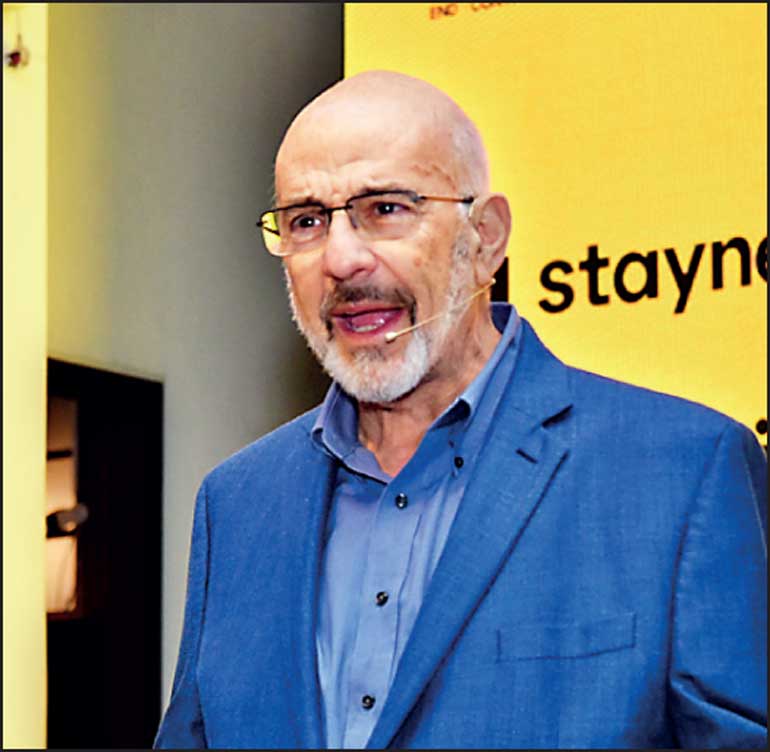
Staynex Chairman Jeff Hoffman – Pic by Shehan Gunasekara
By Charumini de Silva
An early architect behind the global growth of Booking.com, Jeff Hoffman last week called on smaller nations such as Sri Lanka to seize emerging technologies and shifting consumer behaviour to leapfrog larger competitors in the global travel economy.
Delivering the keynote at Hatch Works in Colombo during a session titled ‘Why Small Nations Can Leapfrog,’ Hoffman, who is now Staynex Chairman and Priceline Co-Founder, said the future of industries, particularly travel and tourism, will belong to those who can adapt fastest to technological disruption and changing customer expectations.
Sharing lessons from his entrepreneurial journey, Hoffman said he begins each day asking a simple question: “What can be done today that was not possible yesterday?”
He argued that in a world where innovation is accelerating at unprecedented speed, businesses and countries alike must continuously identify new technologies that can fundamentally change how industries operate, while also closely monitoring how consumer behaviour evolves.
Drawing from his own experience in the travel industry, Hoffman recounted how frustration while waiting in long airport check-in lines led him to create one of his earliest innovations, the self-service airport kiosk.
“The idea emerged after questioning why passengers had to queue for printed boarding passes when automated systems were already transforming banking through ATMs. The concept eventually scaled globally, changing how travellers interact with airports,” he said.
Hoffman said a second major inflection point came with the rise of the internet, which shifted control from travel agents to consumers by giving travellers direct access to pricing and inventory.
“That shift ultimately led to the creation of Priceline and the broader evolution of Booking.com, which has since grown into one of the world’s largest travel platforms, operating across over 220 countries and territories,” he added.
However, Hoffman said the travel industry is now facing an even bigger transformation, driven by artificial intelligence (AI), personalisation technologies, and changing traveller profiles.
He noted that entirely new travel segments, such as digital nomads, have emerged, while younger generations, including Gen Z and Gen Alpha, are increasingly making travel decisions based on personal purpose, wellness, and self-discovery rather than simply convenience or price.
“The traveller has changed, and the technology has changed. That creates a completely new opportunity to redesign the travel experience,” Hoffman pointed out.
He said this convergence of new consumer behaviour and technological capability is what drew him to support emerging travel innovation platforms such as Staynex, which aims to integrate AI-driven personalisation, conversational booking, and curated travel experiences into a single platform.
Hoffman reiterated that smaller nations that move quickly to adopt such technologies and build differentiated travel ecosystems have a unique opportunity to compete globally, adding that innovation rather than scale will define the next generation of tourism leaders.



