Saturday Aug 08, 2026
Saturday Aug 08, 2026
Thursday, 6 August 2026 04:47 - - {{hitsCtrl.values.hits}}

By Charumini de Silva
Sri Lanka’s corporate boards must fundamentally rethink how they govern if businesses are to remain competitive in an increasingly volatile and disruptive world, with the greatest danger lying not in making the wrong decisions but in continuing to operate on outdated assumptions. This was the resounding message from the concluding Fireside Chat on ‘Building Future-Ready Sri Lankan Boards—Road Ahead’ at the Sri Lanka Corporate Director Summit 2026, where an influential panel of business leaders, policymakers, regulators and international experts called for a decisive shift from compliance-driven governance towards strategic leadership focused on long-term value creation, resilience and sustainable growth.
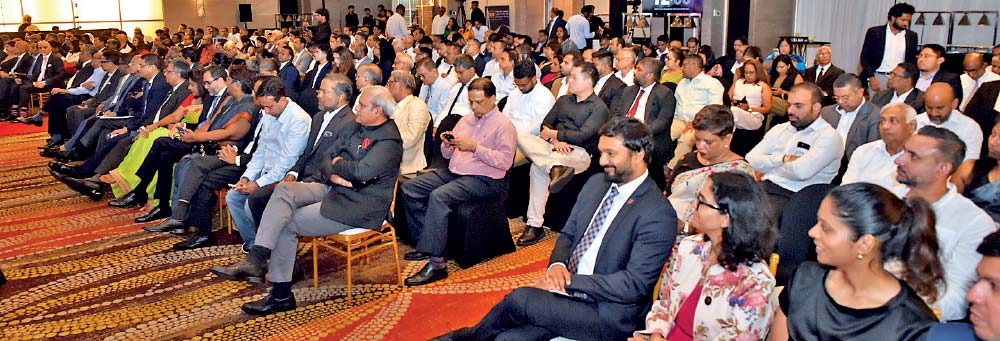
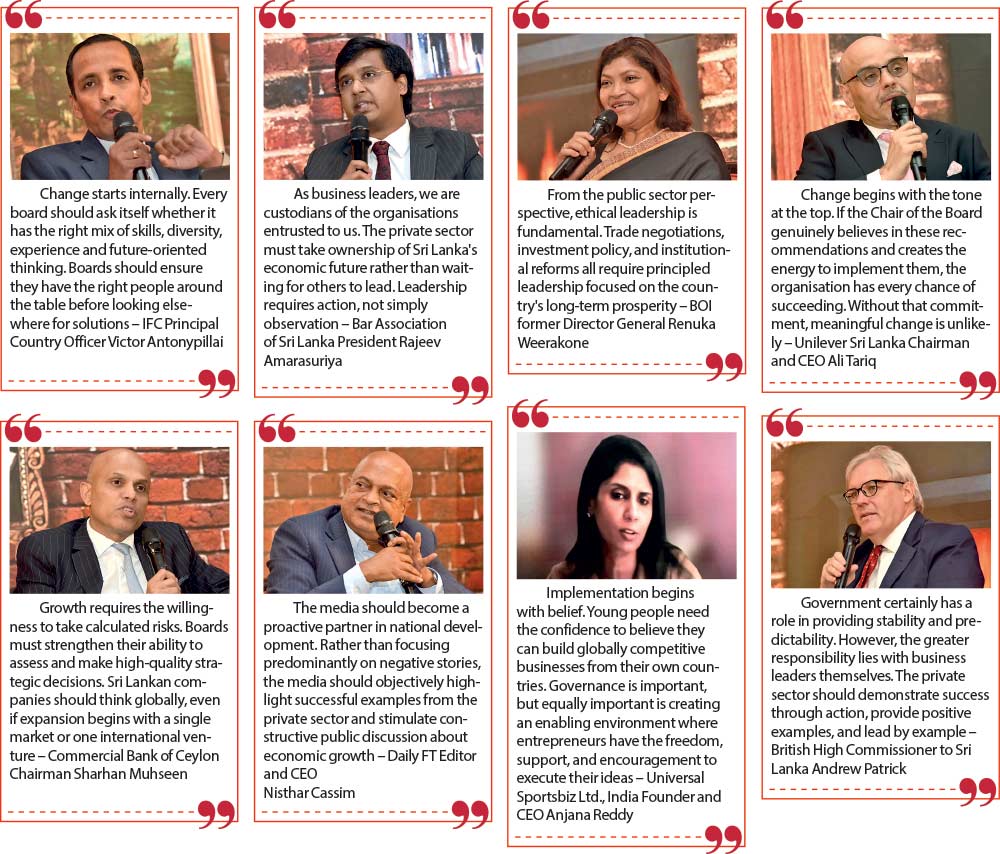
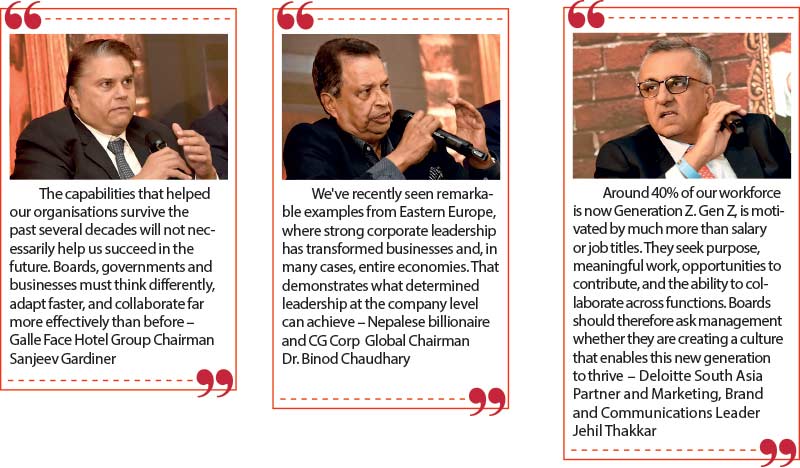
Held before an audience of over 400 board directors, CEOs, senior executives, regulators, academics and governance professionals, the panel discussion featured; Deloitte South Asia Partner and Marketing, Brand and Communications Leader Jehil Thakkar, British High Commissioner to Sri Lanka Andrew Patrick, Universal Sportsbiz Ltd., India Founder and CEO Anjana Reddy, Nepalese billionaire and CG Corp Global Chairman Dr. Binod Chaudhary, Galle Face Hotel Group Chairman Sanjeev Gardiner, Unilever Sri Lanka Chairman and CEO Ali Tariq, Bar Association of Sri Lanka President Rajeev Amarasuriya, International Finance Corporation (IFC) Principal Country Officer Victor Antonypillai, Board of Investment (BOI) former Director General Renuka Weerakone, Commercial Bank of Ceylon Chairman Sharhan Muhseen and Daily FT Editor and CEO Nisthar Cassim.
The session was moderated by World Bank in Sri Lanka and Maldives Head-Finance and Administration Melanie Kanaka and Securities and Exchange Commission of Sri Lanka former Chairman Faizal Salieh.
The Fireside Chat also explored what Sri Lanka must do to ensure a competitive investment destination by becoming active challengers of conventional thinking, continuously questioning the assumptions underpinning business models, customer behaviour and competitive advantage in a world being reshaped by artificial intelligence (AI), geopolitical tensions, climate risks, shifting demographics and accelerating technological change. They also stressed stronger board independence, greater gender and age diversity, regulatory transparency, policy consistency and a digitally enabled public sector were critical, whilst asserting younger board talent, promoting innovation via strategic dialogue and encouraging closer collaboration between Government and the private sector essential not merely to withstand disruption, but to seize the opportunities it creates, laying the foundation for a new generation of globally competitive Sri Lankan enterprises.
Below are excerpts of the discussion;
Q: From your perspective, what do you see as the single greatest risk facing boards and businesses over the next decade?
Tariq: From my perspective, the greatest risk facing businesses and boards over the next decade will not be making the wrong decisions. The greatest risk will be continuing to operate based on yesterday's assumptions. Boards of most companies were designed to function in relatively stable and predictable environments. As we all know and as Dr. Chaudhary highlighted earlier, that is no longer the reality. Going forward, boards will need to spend less time asking whether they are doing the right things, and considerably more time asking whether they are still right about the assumptions that matter most. Take Nokia as an example. Nokia did not fail because it lacked technological capability. It failed because it held the wrong assumptions about what customers would ultimately value. The company continued to execute effectively, but against an outdated premise that technology alone would remain the primary source of competitive advantage. Meanwhile, Apple redefined competition by focusing on software, ecosystems, and customer experience.
Q: What is the single biggest mindset shift Sri Lankan boards need to make to move from compliance-driven governance to growth-oriented leadership?
Tariq: I believe I have already touched on that. The mindset shift is precisely this: the biggest risk is not making the wrong decision. The real risk is continuing to operate based on outdated assumptions about the business, the market, and the customer. That is the challenge boards must continually test and challenge.
Q: From your experience, and from your external perspective on Sri Lankan boards, do you believe our boards have a foresight problem, or is it more a preparedness and capability problem?
Dr. Chaudhary: This time, you've certainly put me on the spot! I hesitate to generalise because I have seen some exceptional boards in Sri Lanka. Companies such as John Keells and Brandix have demonstrated remarkable governance over many years. They had the courage to pursue international growth and global listings at a time when very few organisations were even considering such moves. At a time no one thought about it. The level of foresight demonstrated by many Sri Lankan companies in the past has been truly impressive. However, if I look at more recent years, I do feel that something has changed. There are many contributing factors; the inherent issues, geopolitical environment, political transitions, the economic crisis, COVID-19, and other disruptions. Perhaps, as a result, the level of ambition that once characterised many Sri Lankan companies has diminished somewhat. Historically, that ambition was driven by visionary boards that consistently looked beyond immediate challenges and focused on long-term opportunities. I'd like to acknowledge two individuals in this regard. One is my friend late Ken Balendra, whom I have had the privilege of observing across different boards, including some of our own. Another is the late Ken Balendra. The way he helped build and guide John Keells, together with the strong succession that followed, remains one of the finest examples of effective board leadership. Ultimately, I would reiterate my earlier point: to a very large extent, it is the quality of leadership that determines the quality of governance.
Q: Your Excellency, how can economic diplomacy help position Sri Lanka as a more attractive destination for investment and innovation?
Patrick: Let me begin by reinforcing an important point. Many Sri Lankan companies are already world-class and successfully attract international investment. Economic diplomacy can certainly enhance a country's appeal, but it cannot create the underlying product. First, you need a strong investment proposition; diplomacy then helps communicate and promote it.
I believe Sri Lanka needs to focus on two priorities.
First, continue telling the country's story. It is important that investors understand the economic crisis is behind Sri Lanka and that the country is moving towards a stronger and more stable future. That broader narrative matters. Second, economic diplomacy needs to be highly targeted. Rather than promoting everything, Sri Lanka should focus on sectors where it has genuine strengths and where there is clear investor interest, whether in London or elsewhere. A focused, sector-specific approach is often much more effective than a broad message. To answer your question about governance, from conversations with UK investors, two themes consistently emerge. The first is genuine board independence. Investors want to see independent directors who are empowered to challenge management, hold the CEO and Chair accountable, and exercise meaningful oversight. This is deeply embedded in UK corporate governance standards. Of course, the Sri Lankan context is different. Many companies have dominant shareholders or are family-controlled businesses, which naturally creates different governance dynamics. Nevertheless, board independence remains an important signal for international investors.
The second area is gender diversity. The UK has made significant progress over recent years, and investors increasingly expect diverse boards as a marker of good governance and stronger decision-making. While Sri Lanka has made progress, I believe this is an area where investors will continue to look for further improvement.
Q: What is one practical step Sri Lanka should take today to strengthen the quality of its boards over the next decade?
Gardiner: Exactly. One thing we perhaps should do is build a pipeline of very young directors. Even today, the average age of board members tends to be quite senior. Of course, life experience and professional experience make a significant difference, but Sri Lanka is relatively small compared to its neighbours. To be globally competitive, we must attract investment into this country and strengthen our local boards. Over the next five years or so, it is vital that we develop a young, vibrant pool of board talent, perhaps individuals in their late 20s or early 30s, who are trained, nurtured, and prepared for board leadership. I believe the SLID can play a very significant role in this by helping to develop capable young directors. If you look at many of the world's most innovative organisations and global companies, a large number were founded by young entrepreneurs, particularly in technology and other emerging sectors. They think differently. Diversity on boards is not only about gender; it is also about age, perspective, and the ability to see the future differently from those of us who have been doing things the same way for many years.
Q: What is holding boards back? What is the greatest danger facing Sri Lankan boards today? Is it excessive risk-taking, excessive caution, or simply inertia?
Muhseen: I think that one is, in my experience, relatively straightforward. Sri Lankan boards tend to be very cautious. That caution also stems from our history. For much of the past 50 years, organisations have been operating in survival mode. The mindset shift that is now required is moving from protection to growth. That is a fundamental transformation. In general, our boards remain focused on preserving rather than pursuing growth. To make that shift, boards need greater confidence in the future. With that confidence, they will be better positioned to implement strategies that are far more growth-oriented.
Q: From a regulatory perspective, how supportive is the BOI to investors in terms of process efficiency and ease of doing business?
Weerakone: That's an important question. When we talk about ease of doing business, we need to recognise that the BOI is not the only player responsible for creating a conducive investment environment. This requires all government agencies to work together, and that is something we have been discussing through various committees established to improve coordination. Within the BOI's sphere of responsibility, however, significant progress has been made. One of the biggest strides has been in digitisation, enabling investors to experience greater transparency and faster processes. For example, an application process that remained manual for more than 40 years is now fully digital. Today, investors from anywhere in the world can submit applications to the BOI online. Another area that requires continued attention is ESG. This is important not only from the perspective of accessing new markets and attracting global buyers, but also in developing investment zones. We are looking at transforming these into eco-industrial parks so that investors coming into Sri Lanka have the confidence of operating in sustainable industrial environments. These are some of the practical steps being taken to streamline processes and facilitate investment.
Q: Are we underestimating how sophisticated institutional investors have become?
Muhseen: Given the number of listed companies we have and the investor roadshows conducted by the Colombo Stock Exchange (CSE), I believe we have a good appreciation of how sophisticated institutional investors have become. What I particularly liked was the earlier discussion about ambition. Ambition and governance are not opposing concepts. Strong ambition does not mean weak governance. On the contrary, ambition must be supported by strong governance. Sri Lanka has made progress in strengthening its governance framework through regulatory reforms. At the same time, governance should not become so restrictive that it gets ahead of business realities. It must remain an enabling framework. We also need to recognise that our listed market is relatively small, with a market capitalisation of under $ 5 billion. Sri Lanka now needs to focus on building many more large companies, and governance frameworks should evolve in a way that supports that growth while maintaining high standards.
Q: Are Sri Lankan boards allocating enough agenda time to innovation, or are they still dominated by compliance and reviews of historical performance?
Tariq: Let me begin by clarifying what we mean by innovation. We're not just talking about new products. Innovation includes how we conduct business, how we-think, how we redesign business models, how we operate, and, of course, product innovation as well. Having said that, I don't believe boards themselves should spend excessive time focusing on innovation. Innovation should be left to the experts; to marketers, engineers, scientists, and management teams. Innovation is an outcome. What boards should focus on is ensuring there is sufficient strategic foresight within the organisation. Boards need to spend time challenging the assumptions underpinning the business. They need enough fluency to understand the major forces reshaping the world such as geopolitics, AI, changing consumer behaviour, climate change, and many others. If boards facilitate those conversations and encourage management to think strategically about those forces, innovation will naturally follow. The experts will then develop the appropriate solutions. One practice I particularly value comes from a listed company, where I serve on the board. Every board meeting includes a standing agenda item called "shifting sands." Under this agenda item, every business function presents what is changing in the external environment, what those changes mean for their function, and how they are responding. Every quarter, management must return with fresh insights, and the board challenges their thinking.
I believe this kind of structured strategic conversation is far more valuable than simply placing innovation, as a standalone agenda item.
Q: Should innovation become a standing agenda item at every board meeting?
Gardiner: I agree with much of what Ali said. If you over-structure board meetings by making innovation a mandatory agenda item, you may actually limit the discussion. Innovation should be driven by management. The board's role is to challenge management's thinking. This is where board diversity becomes critically important, not only gender diversity, but also age diversity. We need younger directors alongside experienced board members. Our customers are becoming younger. If you look at regions such as East Africa, for example, much of the population is under 30. Those are tomorrow's customers. Boards therefore need people who can challenge conventional thinking from different perspectives, including younger members who bring fresh ideas.
Q: Do you see governance becoming an integral part of Sri Lanka's investment strategy? How important are regulatory certainty and consistency?
Weerakone: I think everyone here would agree that policy consistency is one of the most important considerations for international investors. Alongside consistency, regulatory transparency is equally important. An investor who enters a country based on one regulatory framework does not want to find that framework unexpectedly changed six or seven months later. These two elements; policy consistency and regulatory transparency must go hand in hand. To deliver on the country's investment commitments, we also require a capable and efficient public administration. Government institutions ultimately provide a service to investors, and that service must be transparent, predictable, and compliant with established procedures. There have been occasions where investors have been promised approvals or concessions that certain institutions were not actually authorised to grant. Such situations create significant operational difficulties later. Good governance is therefore fundamental to investor confidence and to the country's overall investment proposition.
Q: Do you have any out-of-the-box thoughts you'd like to share?
Amarasuriya: My perspective is slightly different from the others on the panel. Yes, regulation and governance are important. But we must also recognise that regulation often struggles to keep pace with innovation. Markets evolve much faster than regulatory frameworks. If Sri Lanka wants to leapfrog its development, institutions such as the BOI, the Central Bank, the Securities and Exchange Commission (SEC), and others will also need to think differently and become more agile. From another perspective, we often describe the private sector as the engine of economic growth. My question is—is the private sector truly driving that engine? Governments change every five years, so are the policies and regulations. However, has the private sector collectively taken sufficient responsibility for advocating long-term national direction and policy consistency? I believe there is considerable room for stronger leadership from the private sector. Chambers of commerce and business leaders should speak with one voice on issues of national importance. We cannot continue with overnight changes to Customs duties, taxes, or regulations. Businesses require predictability. Even during periods of crisis, the private sector has an important responsibility to engage constructively with the Government and advocate for sound economic policy. Looking around this room today, I believe everyone here has a significant responsibility. If we truly believe the private sector is the engine of growth, then it must also be prepared to provide leadership, promote policy consistency, and speak up when national economic interests are at stake.
Q: How can boards and Government work together to improve national competitiveness while maintaining investor confidence?
Gardiner: I think Dr. Chaudhry summed it up well earlier. We cannot ignore the fact that the world is becoming smaller and markets are no longer purely domestic. There are valuable lessons we can learn from countries such as the UAE and Singapore. If you look at how they have structured company formation, board governance, universities and public institutions, you see a coordinated approach, where the Government and independent institutions work together effectively. For a country like Sri Lanka, with a population of just over 22 million, it is vital that the Government and the private sector work in partnership to streamline processes, simplify the establishment of businesses, encourage international investment and support local companies in expanding overseas. There is no alternative, if Sri Lanka is to grow at the pace it needs. If we don't change, we will simply be left behind.
Q: Sharhan, do you have a perspective on that?
Muhseen: I do. One critical lesson for boards operating in emerging markets is that they must learn to govern through uncertainty. You cannot wait for perfect policy stability before making decisions. If boards are waiting for Sri Lanka to become another Singapore or Dubai before acting, they may be waiting for a very long time. Instead, boards need to build dynamism and flexibility into their governance structures, so they can navigate uncertainty confidently. Until the external environment becomes more stable, uncertainty itself should be treated as the norm. Strong governance should enable organisations to operate successfully despite that uncertainty. That would be my recommendation.
Q: From the perspective of an international organisation, what are your thoughts on how boards and governments can work together to improve competitiveness?
Antonypillai: One important point is that while consistency in policy is desirable, we also need to recognise that we live in an extraordinarily dynamic world. Technology is advancing rapidly, geopolitical events are reshaping economies and the future is arriving much faster than before. Boards therefore need to think carefully about technology, not simply adopting it because it is fashionable, but ensuring they use the right technology for the right reasons, always keeping people at the centre. Ultimately, companies exist to serve human beings. Boards should continually ask themselves whether they are genuinely improving people through the decisions they make. At the same time, businesses cannot expect governments to provide every solution. It is often better to light a candle than complain about the darkness. Across many countries where we work, business is no longer "business as usual." None of us expected events such as global conflicts or disruptions to energy and supply chains in March this year, yet these developments have had profound effects on economies worldwide. Companies therefore need to anticipate change rather than wait for others to respond. For Sri Lanka's private sector, this also raises an important question. We have many companies that have operated successfully for decades, some for more than a century. But how many have truly become global companies? If we look at organisations in India such as Tata or Reliance, they deliberately transformed themselves into global businesses. We can also look at companies represented here today that have successfully expanded internationally. Sri Lankan companies have tremendous history and capability, but comparatively few have established a significant global presence. That suggests something needs to change. Vision alone is not enough. There must also be the courage and commitment to execute that vision. It is a broad topic, but I believe those are some of the key issues.
Q: How can the media contribute to achieving this synergy?
Cassim: I'd like to offer a slightly different perspective. In 2027, Sri Lanka will mark 50 years since economic liberalisation. For five decades we have spoken about a private sector-led economy. Against that backdrop, we should ask ourselves whether the media, in its broadest sense, not just the English-language press, but all media has fully supported that vision. Despite the many positive contributions made by the private sector, there often remains a degree of public mistrust. The question is whether the media has helped explain the role of the private sector in driving economic development, or whether it has sometimes reinforced scepticism. Over the next 50 years, we need a media landscape that ‘objectively’ understands and communicates the importance of private sector-led growth. The media has a significant role in advocating for sound economic policies and amplifying constructive conversations around investment, entrepreneurship and competitiveness. Rather than viewing the media with apprehension, the private sector should engage with it openly. Trust needs to be built on both sides. The only way forward is greater engagement, not avoidance.
Q: In an increasingly mobile labour market, how can Sri Lankan companies compete for exceptional talent?
Reddy: I founded my company at a young age and have been part of India's startup ecosystem for many years. I belong to a generation where many of us went overseas to study. Most of the generation before us stayed abroad and built successful careers with large multinational companies. What has changed in India is that many young entrepreneurs have chosen to return home. Why did we come back? It was because of the opportunities that emerged, the consistency of Government policies, the availability of capital, and an environment that encouraged entrepreneurship. After studying in the US and learning about venture capital and private equity, I was able to return to India, raise funding from some of the world's leading venture capital firms and build my business at home. The reason I share my own experience is that the same principles apply elsewhere. About 30 years ago, South Asia largely exported talent to the rest of the world. Today, many talented people want to return home, build businesses, and create global companies from their own countries. For that to happen, countries need to provide a safe, stable, transparent and opportunity-rich environment, where entrepreneurship is encouraged. Take Bangalore as an example. I'm not originally from Bangalore, but I moved there because the entire ecosystem existed; venture capital, mentors, legal expertise, technology talent, and experienced entrepreneurs. That ecosystem attracted talent from across India and around the world. Talent is absolutely critical and attracting it requires companies, governments, investors, and the wider ecosystem to work together.
Q: How involved should boards be in leadership succession, workforce capability and organisational culture?
Thakkar: The answer is that boards should be deeply involved in all three because they are all strategic matters. That said, there is a fine line between governance and management and boards must exercise their responsibilities carefully. Given everything we've discussed today; the pace of change, uncertainty, AI and technological disruption, board members themselves must continuously build their own capabilities. Whether that means bringing younger directors onto boards or helping existing directors develop new skills, ‘continuous learning is essential’. I also believe boards can no longer operate in functional silos. A member of the Audit Committee should also understand technology, geopolitics, talent, and strategy. Likewise, someone with a people or HR background, should also be conversant with emerging technologies and global trends. No single director can know everything, but boards should collaborate, draw on one another's expertise and regularly engage external specialists, where necessary. Only then can they make informed decisions about leadership succession, capability building and organisational culture.
Q: What questions should boards be asking management about attracting and retaining world-class talent?
Thakkar: The first question is whether the organisation truly understands what today talent wants. Take our own organisation in India, which employs around 150,000 people. Around 40% of our workforce is now Generation Z. Gen Z, is motivated by much more than salary or job titles. They seek purpose, meaningful work, opportunities to contribute, and the ability to collaborate across functions. Boards should therefore ask management whether they are creating a culture that enables this new generation to thrive. These employees are digital natives and increasingly AI-natives. Are we giving them the environment they need to contribute fully? Or are we still making talent decisions based on yesterday's assumptions? Those are the questions boards should be asking.
Q: We've heard many excellent recommendations today. How do we ensure that these recommendations are actually implemented?
Cassim: Let’s make the Sinhala press more proactive and supportive. We don’t have a Sinhala business section in major newspapers or even in Tamil ones. It is very sad. The media should become a more proactive partner in national development. Rather than focusing predominantly on negative stories, the media should objectively highlight successful examples from the private sector and stimulate constructive public discussion about economic growth and competitiveness. Greater engagement between business leaders and the media, particularly Sinhala media is essential.
Antonypillai: Change starts internally. Every board should ask itself whether it has the right mix of skills, diversity, experience and future-oriented thinking. Boards should ensure they have the right people around the table before looking elsewhere for solutions.
Amarasuriya: As business leaders, we are custodians of the organisations entrusted to us. The private sector must take ownership of Sri Lanka's economic future rather than waiting for others to lead. Through chambers of commerce and collective action, business leaders need to advocate consistently for sound policy, long-term thinking, and economic reform. Leadership requires action, not simply observation.
Weerakone: From the public sector perspective, ethical leadership is fundamental. Long-term national strategy, not short-term interests; must guide decision-making. Trade negotiations, investment policy, and institutional reforms all require principled leadership focused on the country's long-term prosperity.
Tariq: Change begins with the tone at the top. If the Chair of the Board genuinely believes in these recommendations and creates the energy to implement them, the organisation has every chance of succeeding. Without that commitment, meaningful change is unlikely.
Gardiner: The capabilities that helped our organisations survive the past several decades will not necessarily help us succeed in the future. Sri Lanka has lived through conflict, economic crises, and uncertainty. But survival is no longer enough. Boards, governments and businesses must think differently, adapt faster, and collaborate far more effectively than before.
Muhseen: Growth requires the willingness to take calculated risks. Boards must strengthen their ability to assess and make high-quality strategic decisions. Sri Lankan companies should think globally, even if expansion begins with a single market or one international venture. We can learn from countries such as Taiwan and India, whose companies have successfully built global businesses. The ingredients already exist within Sri Lanka. What is required is the ambition to act.
Reddy: Implementation begins with belief. Young people need the confidence to believe they can build globally competitive businesses from their own countries. Governance is important, but equally important is creating an enabling environment where entrepreneurs have the freedom, support, and encouragement to execute their ideas.
Patrick: Government certainly has a role in providing stability and predictability. However, the greater responsibility lies with business leaders themselves. The private sector should demonstrate success through action, provide positive examples, and lead by example. We sometimes place too much emphasis on what governments should do, when much of the transformation begins with courageous leadership within companies themselves.
Dr. Chaudhary: We've recently seen remarkable examples from Eastern Europe, where strong corporate leadership has transformed businesses and, in many cases, entire economies. That demonstrates what determined leadership at the company level can achieve.
– Pix by Shehan Gunasekara