Friday Oct 16, 2026
Friday Oct 16, 2026
Friday, 24 July 2026 00:23 - - {{hitsCtrl.values.hits}}
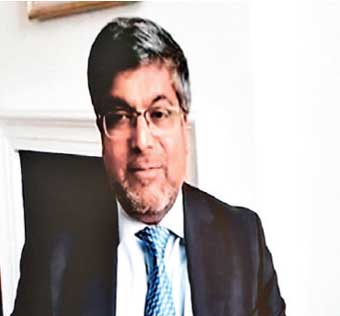 |
| Prof. Sir Nishan Canagarajah |
University of Leicester President and Vice-Chancellor Prof. Nishan Canagarajah on Wednesday said boards must evolve beyond their traditional oversight role and become faster, more agile, and globally minded if organisations are to remain competitive in an increasingly uncertain world.
Delivering a keynote address on ‘Future-Ready Sri Lanka Boards: Leading Through Innovation, Talent, Technology and Global Competitiveness’ at the Sri Lanka Corporate Director Summit 2026, organised by the Sri Lanka Institute of Directors (SLID), Prof. Canagarajah said the pace of global change has fundamentally altered the way boards need to operate.
Reflecting on his appointment as President and Vice-Chancellor of the University of Leicester in November 2019, just months before the COVID-19 pandemic, he said the experience highlighted the importance of understanding an organisation and responding rapidly to unforeseen disruptions.
Having spent his first four months visiting every academic department and professional services division to listen to staff, Prof. Canagarajah said the exercise provided invaluable insight that helped him lead the University when it was forced to close in March 2020.
“Boards can no longer assume they have the luxury of time to analyse every implication before acting. Change is happening far too quickly,” he said.
Stressing that organisations should not operate permanently in crisis mode, he opined that governance structures must be sufficiently agile to respond quickly while maintaining sound oversight and accountability.
Prof. Canagarajah said globalisation has transformed the operating environment for organisations across all sectors, making it essential for boards to look beyond domestic markets.
“Whether you’re in manufacturing, services, education, or any other sector, your organisation now operates within a global context,” he said.
He noted that while globalisation creates opportunities to attract international talent, it also increases competition for skilled professionals, requiring organisations to create environments that encourage talent to remain.
Drawing on recent visits to China, India, and Vietnam, he observed that many Asian economies are increasingly strengthening regional partnerships and building self-sustaining economic ecosystems rather than relying solely on traditional Western markets.
“Sri Lanka, too, should be thinking carefully about its place within this changing global landscape,” he said.
Prof. Canagarajah said the traditional emphasis on compliance, assurance, and risk management remains essential, but warned that excessive caution can limit an organisation’s ability to innovate and compete.
“Today’s environment requires boards to become more entrepreneurial, to encourage innovation, and give management sufficient space to take calculated risks,” he said.
He identified three defining characteristics of future-ready boards; the ability to respond quickly to change, a global outlook, and a willingness to embrace calculated risk.
In terms of board effectiveness, Prof. Canagarajah said organisations must ensure they have the right mix of skills, experience, and perspectives around the board table.
He insisted that diversity today extends beyond gender and should encompass diversity of thinking, professional backgrounds, and experiences.
Drawing on his experience working with venture capital firms, he said investors increasingly scrutinise the quality of leadership teams and governance structures before committing capital. “The right mix of skills, governance, and values often determines whether they choose to invest,” he noted.
Prof. Canagarajah also stressed the importance of flexible strategic planning in an unpredictable global environment.
Rather than relying on a single long-term strategy, he said organisations should prepare multiple scenarios to enable rapid responses to changing conditions.
He cited challenges faced by some UK universities that became heavily dependent on international student income, leaving them vulnerable when Government policies and global mobility patterns shifted after the COVID-19 pandemic.
“Universities are now responding by establishing overseas campuses and expanding transnational education rather than relying solely on students travelling to the UK,” he added.
Prof. Canagarajah said strategy alone is insufficient without an organisational culture that encourages open debate and constructive challenge.
He questioned whether boards genuinely welcome dissenting views or whether hierarchical cultures discourage employees from raising concerns.
Citing Boeing as an example, he noted that concerns had been raised internationally about whether commercial priorities had, at times, outweighed safety considerations.
“Strong governance requires a culture where challenge is welcomed, not discouraged,” he said, adding that no single individual possesses all the answers.
He also called for regulators to strike an appropriate balance between compliance and innovation, pointing out that while regulation is essential, it should not prevent organisations from adapting to rapidly changing economic conditions.
Prof. Canagarajah said that future-ready organisations will be those capable of continuously adapting their governance, business models, and strategic direction as global conditions evolve.




