Monday Jul 13, 2026
Monday Jul 13, 2026
Monday, 13 July 2026 03:10 - - {{hitsCtrl.values.hits}}
By Charumini de Silva
|
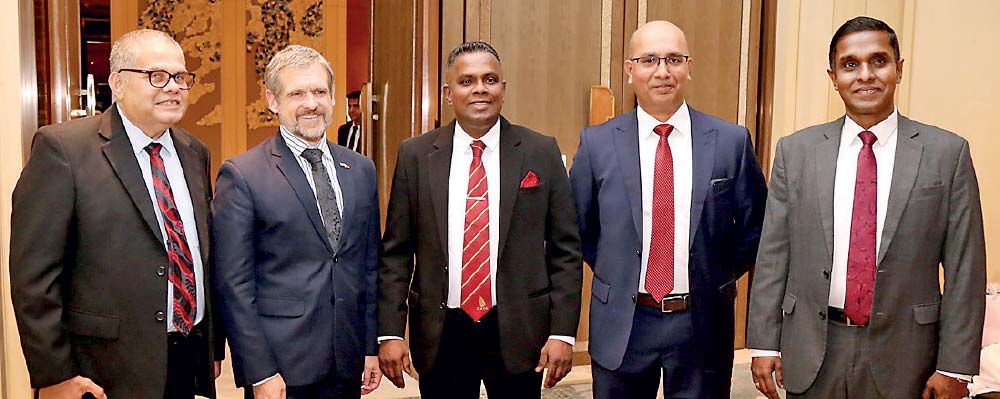
High Commissioner Matthew Duckworth
|
Australia has reaffirmed its support for Sri Lanka’s ambition to join the Regional Comprehensive Economic Partnership (RCEP), with High Commissioner Matthew Duckworth urging the country to continue pursuing trade reforms and digitalisation to strengthen its competitiveness and integration into regional supply chains.
Addressing the 60th anniversary celebrations and 56th Annual General Meeting (AGM) of the Sri Lanka Shippers’ Council (SLSC) last Friday, Duckworth said Australia strongly supports Sri Lanka’s efforts to become a member of the world’s largest free trade agreement (FTA), describing it as a key component of the Indo-Pacific’s economic architecture.
He said the RCEP is more than a conventional trade agreement, bringing together 15 economies across Southeast Asia, North Asia, and the Pacific to facilitate trade, investment, and regional economic integration.
“This is not just a trade agreement. It is a piece of economic architecture that binds together the Indo-Pacific region,” he said.
Duckworth noted that the RCEP would strengthen regional supply chains, simplify rules of origin, lower Customs barriers, and improve trade facilitation, ultimately creating greater opportunities for businesses and investors.
He stressed that such reforms require strong support from the private sector, particularly industry organisations such as the SLSC.
“Governments cannot undertake major reforms alone. They need the support of industry groups that understand the value of trade, the needs of business, and the economic opportunities these agreements can create,” he stressed.
Acknowledging that reforms often face resistance from vested interests, including those benefitting from protectionist policies or inefficient systems, Duckworth said organisations such as the SLSC play a vital role in advocating for policies that enhance national competitiveness.
The High Commissioner also commended the Council’s longstanding advocacy for the digitalisation of Sri Lanka’s trade and border procedures, describing the initiative as consistent with both the Sri Lankan Government’s digital economy agenda and its broader efforts to improve governance and reduce opportunities for corruption.
“Your ongoing call for the full digitalisation of trade processes aligns closely with the Government’s priorities of digitalisation and improving transparency,” he said.
Duckworth noted that Australia is similarly modernising its own border management systems to make international trade faster and more efficient.
Reflecting on Sri Lanka’s maritime heritage, the High Commissioner said the island has served as a strategic trading hub for more than two millennia, connecting major civilisations across the Indian Ocean and facilitating the exchange of goods, cultures, and technologies.
He said the Port of Colombo has continued that legacy by emerging as one of the world’s leading transshipment hubs, while recalling that the then Ceylon Shipping Corporation became the first South Asian carrier to launch container services between South Asia and Europe in 1980.
Duckworth also praised the SLSC for its six decades of advocacy on behalf of the country’s trading community, outlining it as an important institution in improving shipping efficiency, promoting trade reforms, and supporting transparent business practices.
He noted that around 90% of global trade is transported by sea, supported by over 55,000 merchant vessels and around 1.5 million seafarers, with around 60% of global container traffic linked to Asia.
Highlighting Colombo Port’s continued importance in global shipping, he referred to the arrival of the ultra-large container vessel MSC MARIELLA in April 2025, noting it as another demonstration of the Port’s growing capabilities and strategic relevance.
Duckworth also noted the importance of maritime cooperation in the Australia-Sri Lanka relationship, citing collaboration on maritime domain awareness, port security, hydrography, search and rescue operations, and efforts to combat illicit trafficking across the Indian Ocean.
On bilateral trade, he said that Australia exports approximately $ 120 million worth of lentils to Sri Lanka annually, with Sri Lanka processing and re-exporting the product to around 25 countries, illustrating the value of regional supply chains and trade partnerships.
“We may be island nations separated by thousands of nautical miles, but our prosperity depends on safe, open, and efficient sea lanes across the Indian Ocean,” Duckworth said.
He called for continued collaboration between the two countries to strengthen transparency, embrace innovation, and promote sustainable trade, expressing confidence that closer economic cooperation would contribute to a more stable and prosperous Indian Ocean region.