Friday Oct 16, 2026
Friday Oct 16, 2026
Friday, 30 January 2026 00:24 - - {{hitsCtrl.values.hits}}
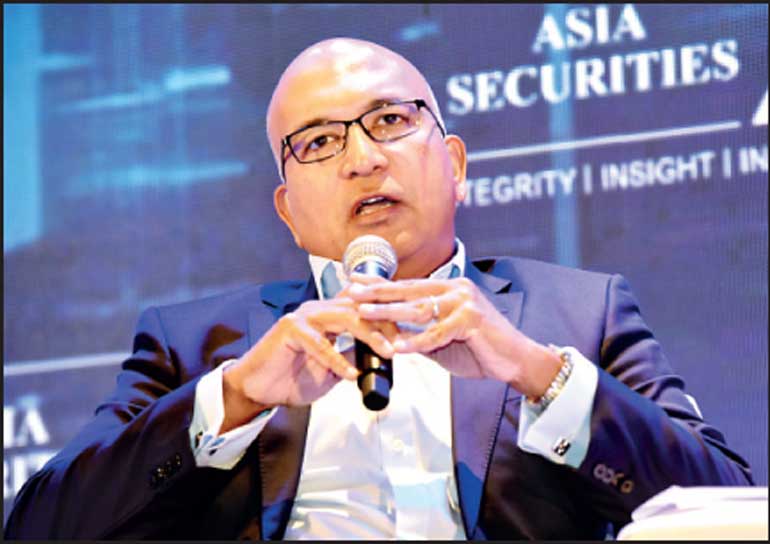
Chairman Dumith Fernando
– Pic by Shehan Gunasekara
Asia Securities Chairman Dumith Fernando said Sri Lanka’s equity market in 2026 is likely to be driven primarily by domestic investors, with interest rate stability and improving participation supporting valuations even without significant foreign inflows.
Taking a macro view of the market, Fernando said three factors would shape equity performance this year, starting with the interest rate environment. He said interest rates were likely to move within a range of 50 to 100 basis points (bps), which would not materially alter asset allocation decisions.
“We don’t believe that level of interest rate movement will create significant dislocation for the equity asset class,” he said, adding that relative attractiveness between equities and fixed income remained broadly unchanged.
Fernando cautioned against overly conservative index forecasts, noting that lower index targets implied either weak earnings growth or significant multiple compression. He said such outcomes would require a sharp rise in equity risk premiums, which he did not expect.
He said investor behaviour already reflected a growing appreciation of equities, supported by zero capital gains tax and a 15% withholding tax. According to data he cited, the number of active equity investors rose to about 98,000 last year, up from around 60,000 in 2024, while new Central Depository Systems (CDS) accounts opened increased from 19,000 to 57,000 over the same period. In the first three weeks of this year alone, about 5,000 new accounts were opened.
“That trend of understanding the differential between fixed income and equity returns is still very much alive,” Fernando said.
On foreign flows, the Chairman said global capital was increasingly seeking diversification rather than targeting emerging markets as a category. While he acknowledged positive sentiment towards emerging and frontier markets in 2026, he said Sri Lanka should not rely on foreign inflows to drive equity returns.
“My outlook for 2026 is that we don’t really need foreign flows to drive the market up another 20–25%,” he said, adding that any foreign inflows would be incremental upside.
Fernando said sustained improvement in sovereign credit confidence was critical to attracting foreign capital, particularly the ability to refinance external debt when it falls due in 2028. He said Sri Lanka’s financial ratios were broadly consistent with a single-digit sovereign rating, but stressed the importance of demonstrating policy consistency and institutional reform.
He also highlighted market liquidity as a constraint, noting that foreign investors invest in individual stocks rather than the index. “We need more stocks with large amounts of liquidity,” he said, pointing to the need for more sizeable listed companies, including potential reforms involving State-owned enterprises.
Fernando said foreign investor interest was gradually broadening beyond traditional blue chips into growth-oriented sectors, including digital and telecom-related companies, but reiterated that deeper liquidity was essential for sustained foreign participation.
On fixed income, he said interest differentials remained attractive, particularly in local currency instruments, though he noted that larger inflows would require improved scale and market depth.




