Friday Oct 16, 2026
Friday Oct 16, 2026
Wednesday, 4 February 2026 00:25 - - {{hitsCtrl.values.hits}}
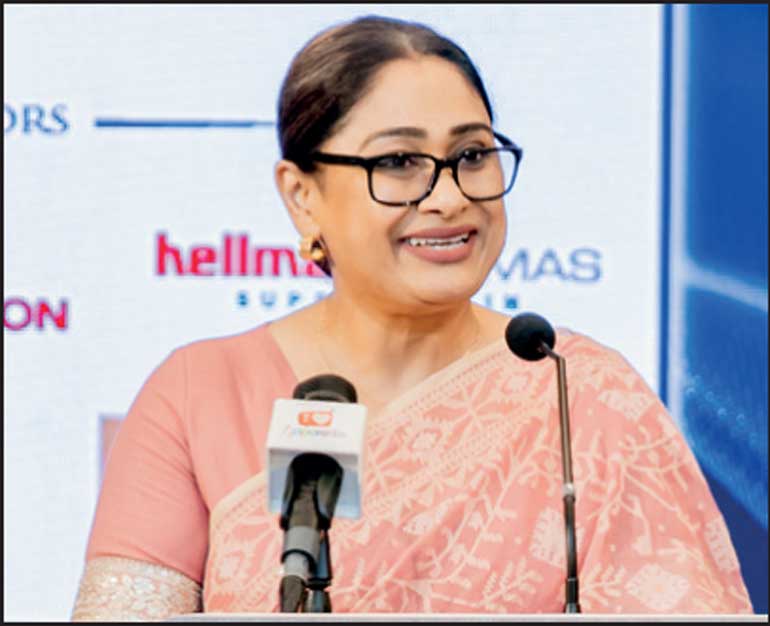
SLAEA Chairperson Rajitha Jayasuriya
Sri Lanka Apparel Exporters Association (SLAEA) Chairperson Rajitha Jayasuriya said the industry has identified deeper integration with India, accelerated technological transformation and urgent policy reforms as key priorities for 2026, warning that intensifying regional competition leaves little room for complacency.
Speaking at the association’s 2025 Annual General Meeting recently on the industry’s forward agenda, SLAEA Chairperson said securing quota-free access to the Indian market, ensuring consistent and predictable trade flows, and strengthening integration within regional value chains will be critical to sustaining growth.
Jayasuriya described a stronger India–Sri Lanka apparel corridor not merely as an economic opportunity, but as a strategic imperative for both countries, given India’s rapid expansion as a global apparel market, sourcing hub and retail powerhouse. “By working more closely together, we can strengthen trade, deepen regional value chains, and increase Sri Lanka’s participation in India’s growing retail and apparel Ecosystem,” she added.
Emphasising the importance of diplomatic and institutional support, Jayasuriya said the industry looks to Indian High Commissioner Santosh Jha and senior Indian officials, including Deputy High Commissioner of India Dr. Satyanjal Pandey, to support this vision through active engagement and representation.
She said a mutually value-adding partnership would enable Sri Lanka to deepen its participation in India’s growing apparel ecosystem while strengthening regional supply chains.
At the same time, she cautioned that Sri Lanka faces fast-moving competition across Asia. Cambodia has emerged as the fastest-growing apparel supplier to the US, European Union (EU) and the UK, while Vietnam continues to advance through automation, smart factory investments and an expanding network of free trade agreements. Bangladesh, meanwhile, retains a dominant position in large-scale basic apparel production. Against this backdrop, she stressed that Sri Lanka cannot afford to stand still if it is to protect and expand its market share.
Jayasuriya noted that the Government’s 2026 Budget has sent encouraging signals, including export-friendly measures, digital tax reforms and targeted investment incentives. However, she said much of the reform agenda remains unfinished, and the industry’s roadmap for 2026 and beyond is built around urgency, sharper focus and sustained forward momentum.
“We are prioritising technology and innovation—accelerating automation, deepening our adoption of AI, and making operations fully data-driven. Market diversification is a core focus, expanding Sri Lanka’s presence across Asia, the Middle East, and Africa, where opportunities are growing,” she pointed out.
SLAEA Chairperson also said workforce development remains equally critical, noting that the industry plans to invest further in skills development, strengthen gender equity and safeguard worker wellbeing. She stressed that people remain the foundation of Sri Lanka’s apparel sector and are essential to maintaining its reputation for quality and ethical production.
“Sustainability and environmental, social and governance (ESG) performance will play an even stronger role going forward, with the industry committed to enhancing traceability, embedding circularity into production processes and reducing emissions across the value chain to meet evolving global buyer and regulatory expectations,” she added.
To support these efforts, Jayasuriya reiterated calls for urgent and decisive Government action. These include improving ease of doing business through the full implementation of the National Single Window (NSW) and Electronic Travel Authorisation (ETA) systems, establishing a dedicated trade office to prioritise key free trade agreements with the US, EU, UK and emerging markets, and developing supply chain infrastructure, including the full operationalisation of the Eravur Fabric Park.
She also stressed the need for policy stability and closer collaboration with domestic and international partners to build a skilled workforce and provide training and financial support to SMEs, enabling them to comply with global sustainability and traceability requirements.
She highlighted the continued engagement between industry, State agencies and international partners as essential to building long-term competitiveness and resilience. Jayasuriya extended appreciation to the Export Development Board (EDB), the Board of Investment (BOI), Sri Lanka Customs and the Sri Lanka Ports Authority (SLPA), noting that their cooperation has enabled the apparel sector to respond to global demand, manage complexity and continue generating value for the national economy.
Reflecting on her first year as the first woman Chairperson of the SLAEA, Jayasuriya said that while the milestone was significant, the overriding focus quickly shifted to navigating the scale and complexity of challenges confronting the industry.
“At the outset of the year, we set clear goals, not only for export growth, but also for the policy and operational reforms required to sustain competitiveness. Many of these objectives were tested by forces beyond our control: tariff uncertainty in the United States, heightened geopolitical instability arising from the Russia-Ukraine conflict, disruptions linked to the Red Sea crisis, and domestically, the removal of SVAT and severe climate-related events, all unfolding while Sri Lanka was navigating economic recovery under an IMF-supported program,” she said.
Despite these pressures, Jayasuriya said export performance remained strong. Exports to the US grew by 2.15% during the year, even amid tariff uncertainty, while shipments to the UK increased by 0.74%. Non-traditional markets recorded growth of 4.8%, and exports to the EU rose sharply by 12.48%, reinforcing Europe’s position as one of Sri Lanka’s most stable and strategically aligned long-term partners.
She noted that achieving overall growth in such a disrupted year was a testament to the resilience, discipline and adaptability of Sri Lankan apparel manufacturers.
She also stressed that the negotiated reduction of US tariffs from 44% to 20% helped ease cost pressures and protect competitiveness, and acknowledged the role played by the Government of Sri Lanka and industry stakeholders in securing this outcome.
Looking ahead, she said the UK’s Developing Countries Trading Scheme (DCTS), which came into effect from 1 January 2026, provides Sri Lanka with tariff-free access and full global sourcing flexibility, describing it as one of the most advantageous trade regimes the country has secured.
Jayasuriya thanked the UK Government, High Commissioner Andrew Patrick and UK economic and trade teams, and also acknowledged the role of the Joint Apparel Association Forum (JAAF) in working closely with the UK High Commission to secure favourable terms.
She asserted that the deepening relationship with Europe was particularly significant, pointing to sustained interest from EU-based entrepreneurs and brand owners such as Dr. Veronesi as evidence of long-term confidence in Sri Lanka.
She said such investments have translated into increased EU exports, higher value addition and stronger integration into European supply chains, and stressed that attracting more long-term, value-aligned investment is critical to balancing Sri Lanka’s export portfolio and reducing exposure to tariff-related risks in its largest market, the United States.
However, she cautioned that compliance with evolving EU sustainability and due diligence regulations has become a non-negotiable requirement for market access.
Frameworks such as the Corporate Sustainability Due Diligence Directive (CSDDD), enhanced traceability standards and digital product passports (DPP) will increasingly determine competitiveness. “To remain competitive and credible, we must create a support system to enable SMEs and supply chains to meet these standards, through transparency, sustainable materials and processes, and robust data systems,” she said.
Jayasuriya also called on the Government to take urgent policy steps to secure the renewal of GSP+, warning that with India nearing the conclusion of a free trade agreement (FTA) with the EU, Sri Lanka must move faster to avoid losing ground in one of its most important growth markets.
Outlining the industry’s immediate policy priorities, she stressed the need for sustained and proactive trade diplomacy to protect and expand preferential market access, predictable and timely fiscal administration, particularly VAT refunds and the acceleration of the Government’s digital reform agenda for exporters.
While the removal of SVAT could not be reversed, she noted that continuous engagement through industry chambers and JAAF has already resulted in significantly improved VAT refund timelines, and thanked Treasury Secretary Dr. Harshana Suriyapperuma and Inland Revenue Department officials for their responsiveness, urging that such performance be institutionalised.
She acknowledged progress made through a pilot project integrating an API with RAMIS 2.0 to enable data matching between enterprise resource planning systems and the tax platform, describing it as an important first step. However, she said the next priority must be the introduction of a fully fiscalised e-invoicing system for exporters, treated as a national priority to improve liquidity, compliance, transparency and competitiveness, and to align Sri Lanka with peers such as India, Indonesia and Kenya.
Jayasuriya said strong partnerships between Government, industry, brands, development agencies and workers’ organisations will be essential for Sri Lanka to not only compete but thrive in a rapidly evolving global apparel landscape.
She reaffirmed the industry’s commitment to being a constructive, solution-driven partner and said Sri Lanka’s apparel sector will continue to lead with purpose, grounded in ethics, craftsmanship, innovation and resilience.
“As global conditions continue to shift, with bold and decisive action, Sri Lanka will not merely participate in the future of global apparel, but play a role in shaping it, driven by belief in its people and clarity in its strategic direction,” she expressed confidence.




