Monday Sep 21, 2026
Monday Sep 21, 2026
Friday, 20 February 2026 00:26 - - {{hitsCtrl.values.hits}}
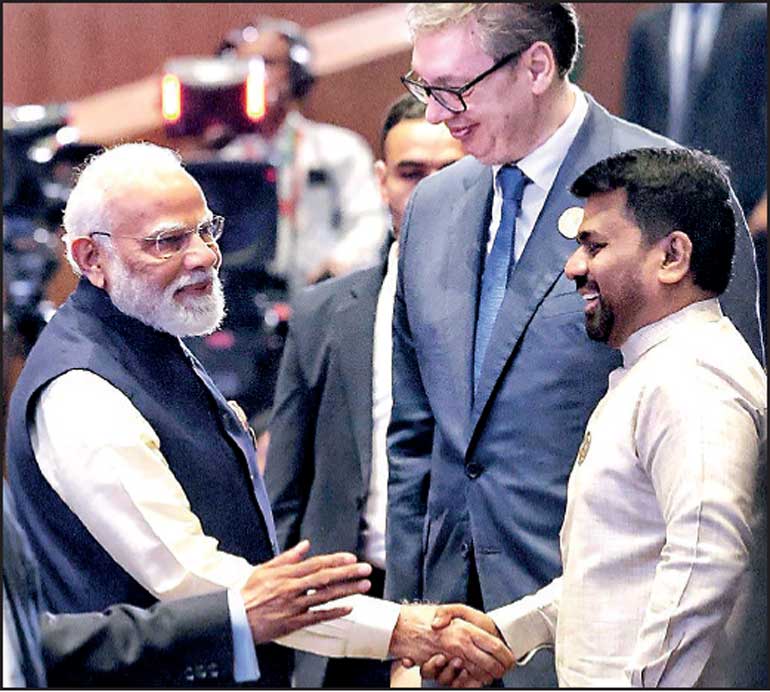
President Anura Kumara Dissanayake with Indian PM Narendra Modi
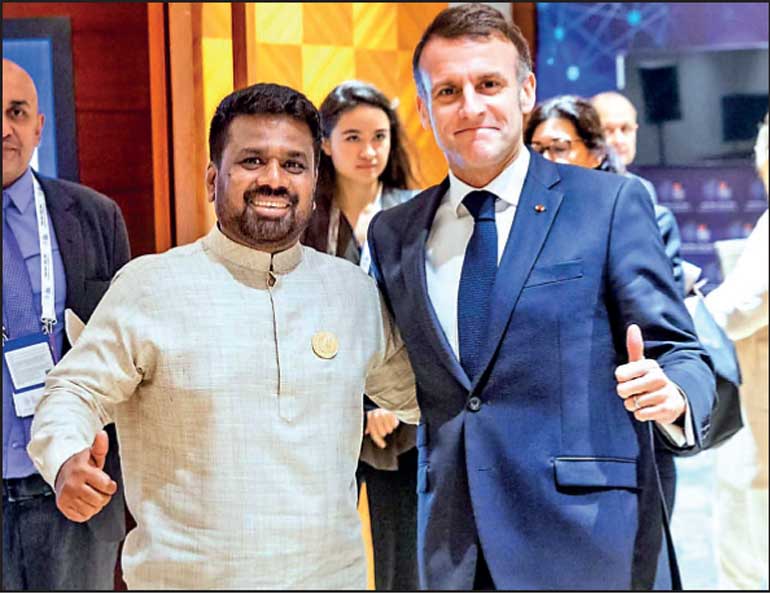
President Anura Kumara Dissanayake with French President Emmanuel Macron
Sri Lanka has signalled that its artificial intelligence (AI) strategy will centre on regional integration, infrastructure development, and regulatory alignment rather than standalone technological ambition, with President Anura Kumara Dissanayake outlining a cooperation-driven approach at the AI Impact 2026 Summit in New Delhi.
Addressing a Leaders’ Session yesterday at the summit convened by Indian Prime Minister Narendra Modi, the President said Sri Lanka views AI infrastructure as the next frontier of economic and cultural cooperation and proposed regional collaboration built on affordable access, centrally governed language datasets, common evaluation and security mechanisms, and integrated capacity development.
The remarks position Sri Lanka as seeking to anchor itself within a shared regional AI ecosystem, with an emphasis on building trusted data infrastructure, strengthening legal frameworks on personal data protection and cyber security, and digitising local language and cultural knowledge to ensure broader inclusion.
The President said Sri Lanka is exploring the development of data infrastructure with AI capabilities to meet both national and regional needs, and underscored the importance of working closely with India and other countries advancing digital public infrastructure and technological skills to establish sustainable and secure regional AI data centre capacities.
He said Sri Lanka is prepared to share common values on artificial intelligence, ensuring that no one is left behind and to move forward collectively through mutual learning based on ethical principles.
The President made these remarks yesterday addressing the Leaders’ Session of the AI Impact 2026 Summit convened in New Delhi by Narendra Modi.
A number of Heads of State and dignitaries attended the session, including French President Emmanuel Macron, Abu Dhabi Crown Prince Sheikh Khaled bin Mohamed bin Zayed Al Nahyan, Brazil President Luiz Inácio Lula da Silva and the Bhutan Prime Minister Tshering Tobgay.
President Dissanayake in his address said: “It is a great honour to join you in New Delhi at this defining moment when AI is transforming economies, governance systems and societies. AI is a transformative force that will have a profound impact on national development trajectories; much like industrialisation did in previous centuries.
“However, the widening gap between countries empowered by AI and those lacking such capabilities poses a serious risk of fragmentation in the digital economy. Countries that fall behind could face further marginalisation from global growth and emerging economic opportunities, thereby jeopardising the inclusive, equitable and sustainable development goals we aspire to achieve.
“Like many emerging economies, Sri Lanka has yet to fully establish the infrastructure required to harness the full potential of AI. Therefore, a decisive moment has arrived for us to act with clarity of purpose and confidence.
“Sri Lanka possesses a technologically skilled young human resource base. We also have a strong legal framework and an economic culture linked with international partnerships. We are updating legal frameworks on personal data protection and cyber security, continuing to invest in digital public infrastructure and strengthening institutions that safeguard public trust while encouraging innovation.
“Globally, there is ongoing debate on the ambitions, rights and safeguards relating to AI. Yet, I wish to highlight a critical dimension that has often been overlooked, which is cultural alignment.
“These technologies must be utilised to further promote the cultural values and capabilities of humanity. If global AI systems are confined to only a few languages and viewpoints, there is a risk of eroding our unique cultural diversity.
“For countries such as Sri Lanka and India, language and culture are not only matters of pride but also foundations of trust. Achieving such cultural alignment requires broad inclusion and preservation. Our local languages and cultural knowledge must be digitised and integrated into AI systems. At the same time, maximum attention must be given to safety and security, with mechanisms established to protect our cultural values from potential adverse impacts of AI.
“Our vision is not one of isolated achievement, but of integration. We view AI infrastructure as the next frontier of economic and cultural cooperation. Accordingly, Sri Lanka proposes regional collaboration based on four core elements: affordable access, centrally governed language datasets, common evaluation frameworks and security tools, as well as integrated capacity development.
“Through this endeavour, I believe that the benefits of AI can be accessed more broadly and equitably by all. In this context, Sri Lanka is exploring the development of data infrastructure with AI capabilities that can meet both national and regional needs.
“By working closely with India and other nations that are emerging as global leaders in digital public infrastructure and technological skills, Sri Lanka has significant potential to establish sustainable, secure and future-ready regional AI data centre capacities.
“It is our understanding that no country can build an AI-ready future alone. It is therefore encouraging that the joint declaration agreed upon in New Delhi, reflecting the views of many nations of the world and the region, underscores the importance of such cooperation.
“Therefore, I wish to affirm that Sri Lanka stands ready to share common values on artificial intelligence, ensuring that no one is left behind, to learn mutually and to move forward collectively on an ethical foundation.”
According to an August 2025 report by the Institute of Policy Studies (see: https://www.ft.lk/front-page/Nearly-quarter-of-workforce-exposed-to-GenAI-IPS/44-780522) about 1.83 million workers in Sri Lanka, or 22.8% of the employed population, are in jobs that could be exposed to Generative Artificial Intelligence (GenAI). This is below the global average of about 25%.
The report noted that while AI can raise productivity, actual exposure is limited by digital readiness. Only 480,543 of the 1.83 million potentially exposed workers are both digitally literate and employed in workplaces with adequate digital facilities.
Sri Lanka enters its artificial intelligence push with comparatively strong digital infrastructure, but structural gaps in usage, institutional coherence and trust remain.
A December 2025 Asian Development Bank (ADB) assessment noted that Sri Lanka scores 0.765 on the Telecommunications Infrastructure Index, one of the strongest in the region, and is connected to eight submarine cables, giving it significant international bandwidth capacity. National 4G/LTE coverage stands at 97%. However, utilisation lags: only 51% of the population used the internet in the three months prior to data collection in 2023, and fixed broadband penetration remains modest at 10.1 subscriptions per 100 households.
Quality and performance constraints also persist. Rural broadband speeds are slow, public networks underperform, and 80% of Government agencies connected to Lanka Government Network 2.0 operate at just 2 Mbps. While coverage is extensive, effective use and service quality remain uneven.
The Government’s cloud infrastructure has faced strain. The Lanka Government Cloud (LGC 2.0) is oversubscribed and was affected by a ransomware attack in 2023. Plans are underway to procure LGC 2.5 and develop LGC 3.0 as a more secure, government-wide public–private platform.
On policy, Sri Lanka has articulated an ambition to build a $ 15 billion digital economy by 2030 under its Digital Economy Blueprint, placing digital public infrastructure at its core. New institutional reforms include the establishment of a Digital Economic Authority to steer policy and a GovTech unit to focus on implementation. However, key regulatory frameworks on cybersecurity, interoperability and cloud governance remain in draft form, and the Data Protection Authority is not yet fully functional.
Digital public services are comparatively advanced in sectors such as health, education, tourism and trade, yet adoption remains uneven and integration across ministries limited. Fragmented data systems, limited open data tools and weak citizen trust constrain impact.
The ADB report noted that Sri Lanka’s digital infrastructure base is solid, but utilisation, governance coherence and capacity building will determine whether the country can translate infrastructure strength into scalable digital transformation.




