Saturday Jul 04, 2026
Saturday Jul 04, 2026
Friday, 8 May 2026 02:06 - - {{hitsCtrl.values.hits}}
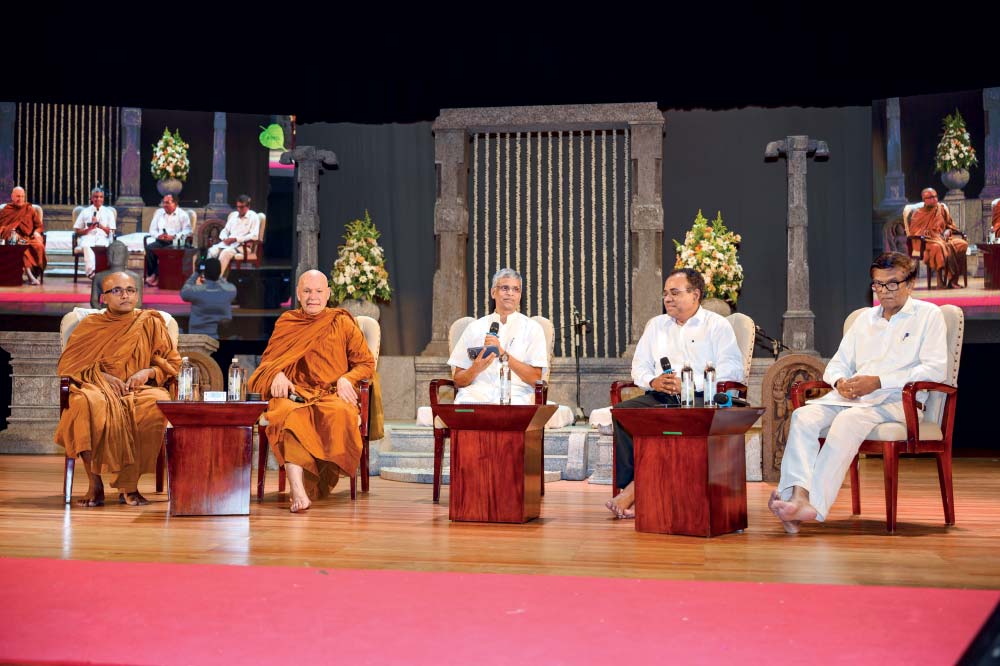
Well-known Sri Lankan corporate leader and mindfulness centric management coach Deepal Sooriyaarachichi (centre) moderates the panel discussion involving Ajahn Brahmali Thero, Madampelle Dammita Thero, University of Colombo Faculty of Medicine Dean, Centre for Meditation Research (CMR) Chair and Senior Professor of Anatomy, Genetics and Biomedical informatics Prof. Vajira Dissanayake and University of Colombo Emeritus Professor of Medicine Prof. Saroj Jayasinghe
 We are ever present in our ‘death seat’ each moment. Part of cultivating ‘Samma Ditti’ would be to reflect on our awaiting death each day. It would be an integral part of living with the right view if we wake up each day thinking – I could die today. It is because one human contemplated death in a profound way 2500 years ago that we have the Buddha Dhamma today
By Surya Vishwa
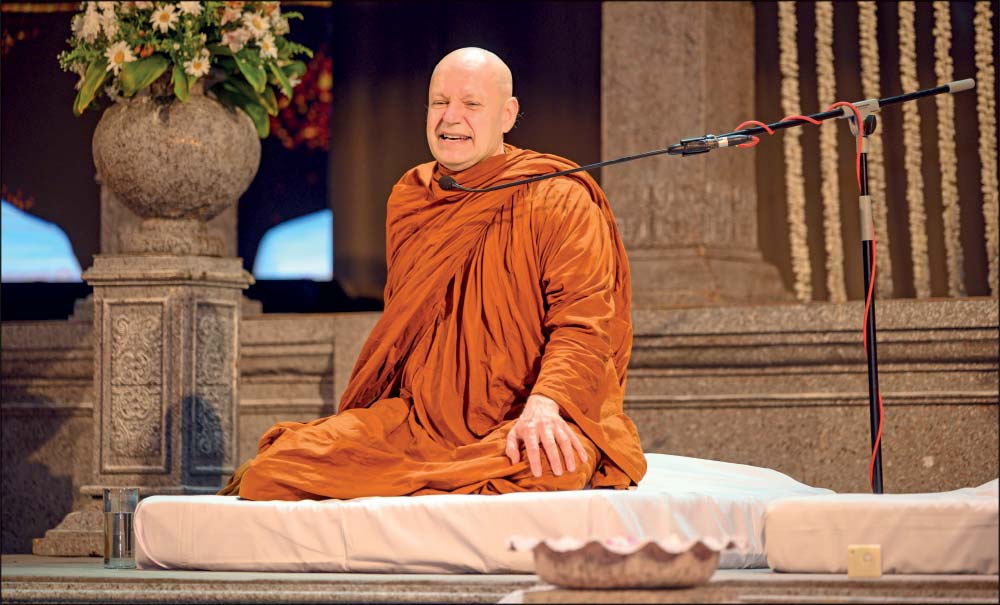
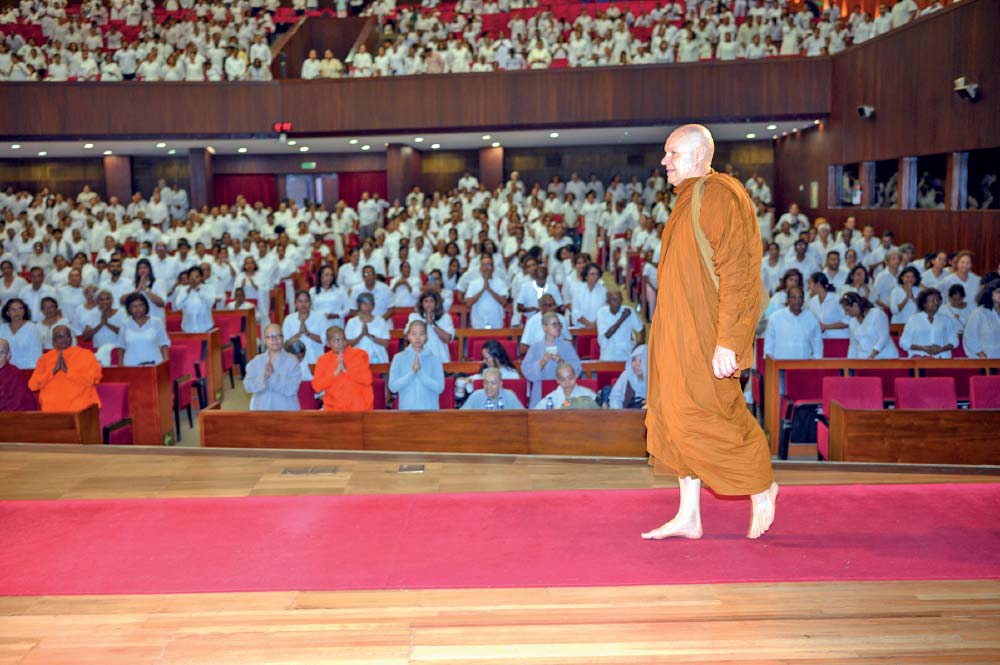
Cultivating the right view (Samma Ditti) – ‘Samma’ meaning correct and ‘Ditti’ meaning understanding/view was the main theme of the 1 May Poya day Dhamma message imparted by Norwegian born Buddhist Monk, the Ajahn Brahmali.
A frequent visitor to Sri Lanka for the purpose of imparting the Buddha Dhamma, he had arrived in the country in April this year on invitation of the Ajahn Brahm Society of Sri Lanka. Brahmali Thero lives in Western Australia at the Bodhinayana monastery located in Serpentine in Perth and which is headed by the British born Ajahn Brahmavanso Thero, a staunch Dhamma friend of Sri Lanka.
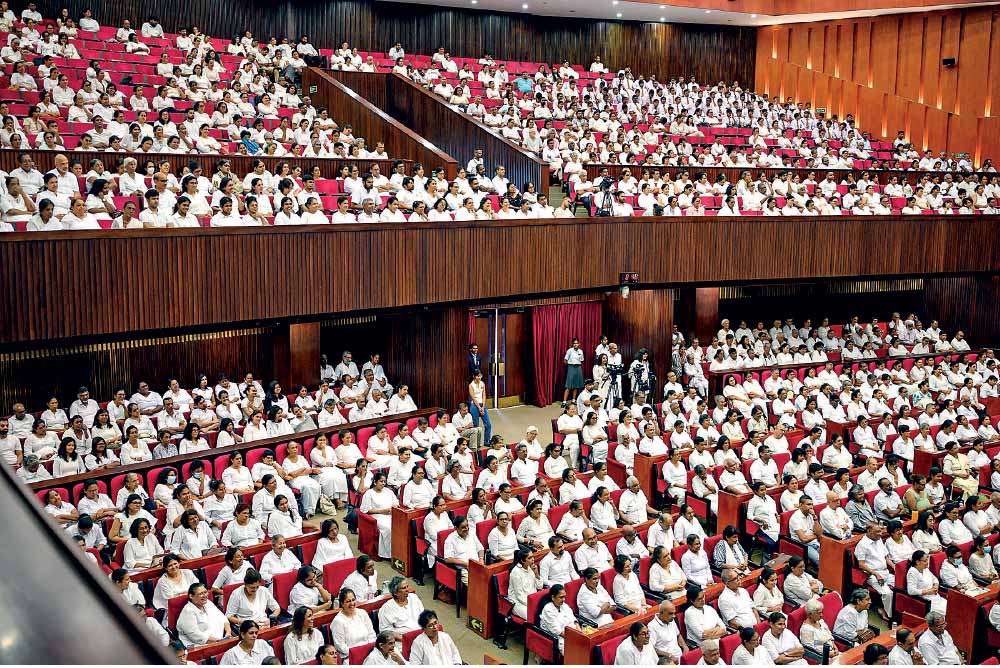
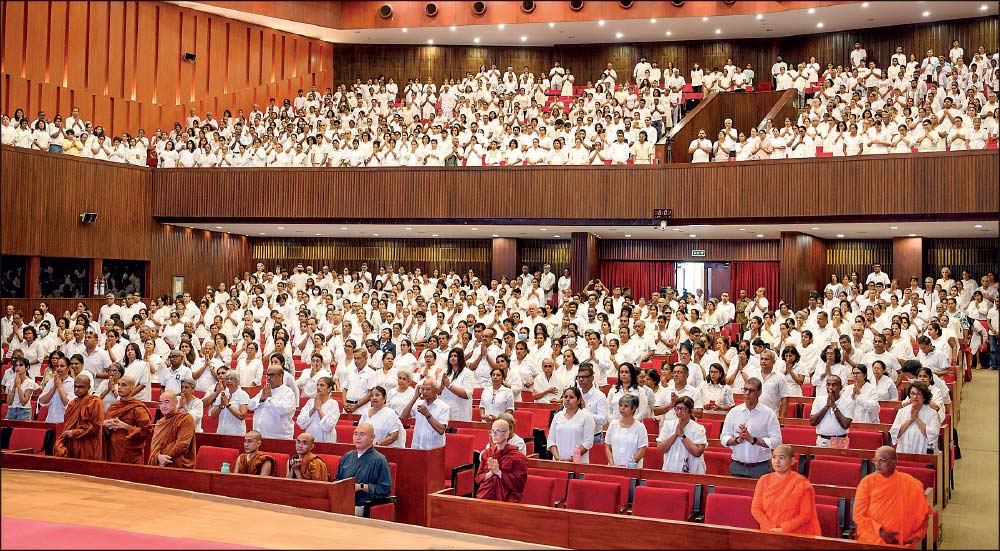
“When we allow the right view to develop within us, we help eliminate the ‘I’ of ego and thereby conceit and self centredness which is the root of suffering. These are the defilements that create problems and prevent a happy life,” Brahmali Thero stated to a packed Sri Lankan audience at the BMICH in Colombo.
He highlighted the importance given by the Buddha on spiritual friendship (Kalyana Mithra). He noted that the Buddha had corrected Ananda Thero who had assumed that the relevance of spiritual friendship was 50% to the Buddhist path, and stressed instead that the importance of ‘Kalyana Mithra’ to a successful Buddhist life was 100%. Having the positive influence of friends who nurture the right view will help cultivate ‘Samma Ditti’of a larger segment of society creating a harmonious reality, Brahmali Thero noted.
Right view in everyday life
To explain the honing of the right view in everyday life he used the example of death, explaining that it is not morbidity to contemplate death as a minute possibility awaiting us any given time, irrespective of age. He reminded that death is an ever present part of nature and a fact interwoven with the unpredictable essence of existence.
“We are ever present in our ‘death seat’ each moment. Part of cultivating ‘Samma Ditti’ would be to reflect on our awaiting death each day. It would be an integral part of living with the right view if we wake up each day thinking – I could die today,” Brahmali Thero advised. He reminded Sri Lankans that it is because one human contemplated death in a profound way 2500 years ago that we have the Buddha Dhamma today.
He then elaborated on the interconnectedness of the four noble truths and the eightfold path in Buddhism to establishing a healthy relationship with the overarching possibility of death. Death that occurs following unwise living would lead to innumerable consequences connected to rebirth in its different dimensions and realms.
Among the many similes narrated to get the message across on the difference between wisdom and ignorance, Brahmali Thero used the story of how two friends end up in two very different dominions after death; one in the deva loka (world of the gods) achieved after prudent living and the other as a worm in a heap of dung (result of ignorant indulgence). The numerous efforts of the Deva to get the former human but now worm friend of his to the deva loka fails because the ‘worm’ understands only the ‘warm comfort and never ending food’ of the dung. The final attempt of liberating ‘the worm’ into the realm of gods end with the worm demanding to know if there was lovely food like the dung in the world of gods and when confronted with a decisive ‘no’ insists that he will remain within what he knows as the wondrous world of dung! Through his interesting story telling style he made Sri Lankans see that what we become so possessive of in this world is linked to suffering and clarified the much misunderstood idea that Buddhism is obsessed with suffering.
I am sometimes asked in the West as to whether Buddhism is all about ‘dukkha’ (suffering). I reply that it is the opposite, that Buddhism is all about ‘Sukkha’ – happiness and more happiness. Sukkha (happiness) in Buddhism is achieved when the nature of unhappiness is comprehended. When the delusion of ego, attachment and all human acts connected with these are released and replaced with unlimited kindness, compassion and empathy, then it is a Sukkha life, in this world and beyond
Buddhism is all about ‘Sukkha
“I am sometimes asked in the West as to whether Buddhism is all about ‘dukkha’ (suffering). I reply that it is the opposite, that Buddhism is all about ‘Sukkha’ – happiness and more happiness. Sukkha (happiness) in Buddhism is achieved when the nature of unhappiness is comprehended. When the delusion of ego, attachment and all human acts connected with these are released and replaced with unlimited kindness, compassion and empathy, then it is a Sukkha life, in this world and beyond, Brahmali Thero explained. Therefore, it was clarified that the life of a true Buddhist is a very happy one when the debris of sorrow is cleared with the daily maintenance of ‘right view.’
Brahmali Thero emphasised that the basic idea of Samma Ditti is enshrouded in the Buddhistic linguistics of Metha, Muditha and Karuna (which could be translated and encompassed generically as supreme kindness). Brahmali Thero then spoke of the co-relationship between kindness and forgiveness. He pointed out that if thoughts and actions are linked to the manifestation of these two qualities in everyday activities that it would result in the conquering of the clingy and egoistic ‘I’ along with the ensuing delusions.
The word ‘toxic’ was not suitable in relevance to another human being if one follows the Buddha’s teachings because it boxes an individual narrowly and harshly. Every human deserves loving compassion and kindness, with the correct view that all humans are caught in the web of samsaric suffering
The Poya day program was held from 7.30 a.m. to 4 p.m. on 1 May including two talks by Brahmali Thero, a question and answer session and a panel discussion. Around one hour was devoted to Brahmali Thero answering questions written by participants and the answers were translated and explained in Sinhala by Madampelle Dammitta Thero based in Sri Lanka.
Madampelle Dammitta Thero carried out a central clergy level leadership role in the Dhamma activities of the day, facilitating a pre-program one hour morning Dhamma preparedness of the attendees and translating the entire day’s sessions of Brahmali Thero to Sinhala with perfect accuracy in split level timing, and being part of the panel that examined the link between science and Buddhism.
The topics of the questions by the audience to Brahmali Thero included aspects such as how to respond Buddhistically to ‘toxic’ family members, whether rituals are helpful to the goal of liberation (nirvana) and the two types of Samma Ditti as defined by the Buddha and applicable to worldly life and to achieving a higher consciousness leading to liberation thereafter.
In providing the answers Brahmali Thero clarified that the word ‘toxic’ was not suitable in relevance to another human being if one follows the Buddha’s teachings because it boxes an individual narrowly and harshly. Every human deserves loving compassion and kindness, with the correct view that all humans are caught in the web of samsaric suffering.
On the question of Buddhistic rituals Brahmali Thero stated that immersing oneself in too many rituals may not be helpful but that to some extent it may assist in attaining non-attached liberation as prioritised through Buddhism. The reference of ‘Samma Ditti’ (Right View) by the Buddha was meant for the happiness in this life and for the ultimate goal of freedom from the repetitive samsara, he reminded.
The Poya day program was arranged and funded by the Ajahn Brahm Society of Sri Lanka which included the free provision of lunch for nearly 2,000 participants.
Immersing oneself in too many rituals may not be helpful but that to some extent it may assist in attaining non-attached liberation as prioritised through Buddhism. The reference of ‘Samma Ditti’ (Right View) by the Buddha was meant for the happiness in this life and for the ultimate goal of freedom from the repetitive samsara
Panel discussion
A panel discussion was held on the impact of mindfulness meditation on health as seen and researched by Western science medical professionals in Sri Lanka and how it corresponds with Buddhism. This discussion was moderated by Deepal Sooriyaarachichi, well known Sri Lankan corporate leader and mindfulness centric management coach. The panel was represented by Ajahn Brahmali Thero, Madampelle Dammita Thero, University of Colombo Faculty of Medicine Dean, Centre for Meditation Research (CMR) Chair and Senior Professor of Anatomy, Genetics and Biomedical informatics Prof. Vajira Dissanayake and also by University of Colombo Emeritus Professor of Medicine Prof. Saroj Jayasinghe, ranked among the world’s top 2 scientists according to the Stanford database and a pioneer in combining medicine with humanities, society and environment.
The panel provided diverse insights into the impact of mindfulness meditation on patients and the levels of decrease in symptoms and cures that follow. Ajahn Brahmali spoke of the importance of mindfulness to be encouraged as part of the whole practice of Buddhism and not just as an isolated fragment. Prof. Vajira Dissanayake explained the research and practice based evidence gathered by the CMR through health recoveries of patients who react when introduced to mindfulness as part of the medical care and convalescence process.
Prof. Saroj Jayasinghe spoke of the modern science based evidence of the impact of mindfulness in the medical sphere.
The event ended with a loving kindness meditation guided by Ajahn Brahmali, the success of which was almost palpable where the audience was asked to exude loving kindness to the whole human sphere. A special tribute was paid to Danish born Buddhist monk Mettavihari Thero who lived in Sri Lanka for around five decades and was a founding patron of the Ajahn Brahm Society of Sri Lanka. Mettavihari Thero passed away last December at the age of 80 years. It was pointed out by Brahmali Thero under the leadership of Mettavihari Thero, the Ajahn Brahm Society had been instrumental in helping Sri Lankans practice Buddhism in daily life and supporting monks and nuns in forest monasteries, alongside many related activities. The annual visits of Ajahn Brahm Thero and Ajahn Brahmali Thero are facilitated by the Ajahn Brahm Society and Mettavihari Thero’s relentless work in this regard and the humility in which he carried out his service to Sri Lanka was remembered with gratitude.