Thursday Oct 15, 2026
Thursday Oct 15, 2026
Wednesday, 3 December 2025 05:19 - - {{hitsCtrl.values.hits}}
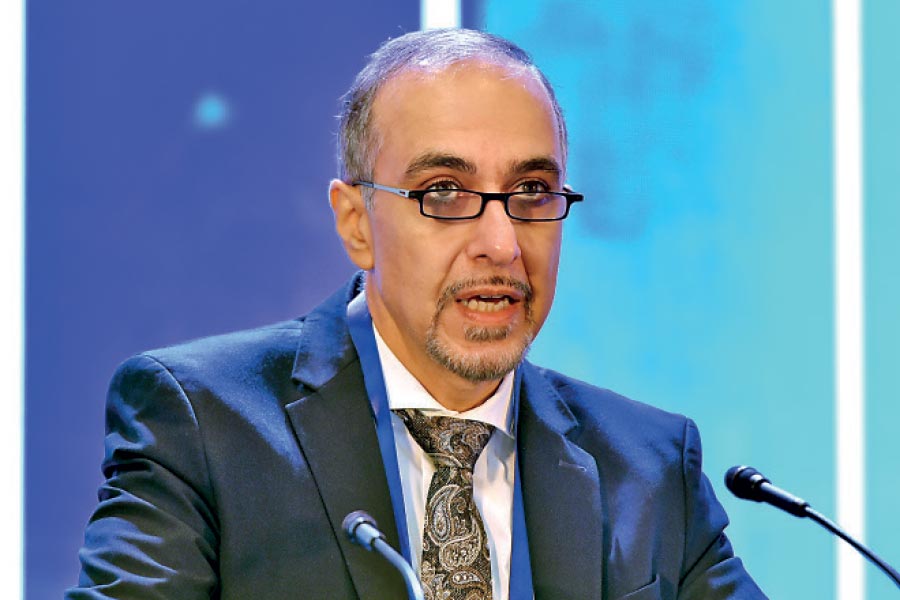
World Bank Country Manager for Sri Lanka and Maldives Gevorg Sargsyan
Sri Lanka must shift from post-crisis stabilisation to fast, investment-led growth by dismantling trade barriers, improving productivity and mobilising private capital, World Bank Country Manager for Sri Lanka and Maldives Gevorg Sargsyan told the Sri Lanka Economic and Investment Summit organised by the Ceylon Chamber of Commerce yesterday.
In a wide-ranging presentation, Sargsyan said the country had made tremendous achievements in stabilising the economy, but warned that growth remained too weak to ease fiscal pressure or reduce poverty.
“Stability has been broadly achieved, but sustaining it requires a new policy environment,” he said. “Sri Lanka cannot rely on austerity alone. Faster growth is the only path that reduces the need for painful fiscal measures.”
He opened by acknowledging the national crisis triggered by recent extreme weather. “My heart goes out to all Sri Lankans affected by the devastating disaster. The World Bank has already redirected its support toward urgent recovery needs,” he said.
Sargsyan said GDP grew 5% last year and around 2% this year, with Budget surpluses recorded since 2020 and reserves improving. He credited recovery to three factors: “The sharpest fiscal adjustment in decades, completion of domestic and near-complete external debt restructuring, and critical new laws such as the Public Finance Management Act, the Public Debt Management Act and the Central Bank Act.”
Despite this, he cautioned that public debt remains above 100% of GDP and debt service absorbs almost half of Government revenue. “At current growth rates, the fiscal space will remain strained. Markets need a strong commitment to reforms,” he said.
Commenting on President Anura Kumara Dissanayake’s claim that economy would grow 7% in GDP, Sargyan said: “We think that 7% growth that President (Anura Kumara Dissanayake) announced during the 2026 Budget Speech, is absolutely achieved. However, what kind of Sri Lankan debt will this economic growth trajectory bring? Will the fiscal space be strained?
He argued that Sri Lanka can achieve the Government’s target of 7% annual growth, but only with a decisive push on second-generation reforms.
Sargsyan said Sri Lanka’s openness had deteriorated sharply. “Trade and investment as a share of GDP fell from around 40 percent in 2000 to just 20 percent in 2024,” he said. Reforms should include tariff reduction, phasing out para-tariffs, modernising Customs, complying with the WTO Trade Facilitation Agreement and establishing a National Single Window.
He warned that productivity had turned negative in recent years. “Look at agriculture. Coconut productivity per acre is twenty times higher in peer countries. This is not a marginal issue; it affects households and export competitiveness,” he said.
He also highlighted the fall in port and logistics rankings. “Sri Lanka once ranked sixth or seventh globally. It has now slipped to twentieth. Logistics must be fixed if trade is to grow.”
On State-owned enterprises, he called for commercially-oriented reforms. “Reducing losses, improving governance and opening space for private investment in energy, transport and logistics are essential.”
Sargsyan said businesses struggle to secure land, labour and capital. “A modern land framework, clearer title conversion, better administration and deeper financial intermediation are needed,” he said. Labour rules should be modernised to reduce hiring restrictions and align with contemporary work practices.
“Sri Lanka needs a surge in private investment. The fiscal space is extremely limited,” he said. Investor interest is visible in logistics, energy and food sectors, but converting interest into commitments requires “greater openness and a transparent PPP framework.”
As the economy adjusts, he warned of uneven impacts on workers. “There will be winners and losers. This makes targeted, data-driven social protection critical, especially after the disaster.”
Sargsyan stressed that reversing the slide in productivity is essential for poverty reduction. “One million young people will enter the workforce in the next decade. They must enter a growing economy, not a stagnant one,” he said.
Despite challenges, he remained optimistic. “Sri Lanka has come a long way from crisis. This stability is a hard-won victory. The next chapter is to unlock integrated, sustainable, inclusive growth,” he said.
He concluded by reaffirming the World Bank’s commitment. “We stand ready to work with the Government and private sector to turn adaptation into durable prosperity so that the benefits of recovery reach every Sri Lankan. Let us build that future together.”




