Friday Oct 02, 2026
Friday Oct 02, 2026
Tuesday, 11 August 2026 02:02 - - {{hitsCtrl.values.hits}}
By Charumini de Silva
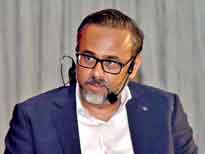 |
| CEO Jawahar Ganesh – Pic by Upul Abayasekara |
AMW CEO Jawahar Ganesh has called for Sri Lanka and India to establish a direct Indian rupee (INR)-Sri Lankan rupee (LKR) settlement mechanism, insisting that it could reduce businesses’ exposure to US dollar (USD) volatility and ease pressure on Sri Lanka’s foreign exchange reserves.
Speaking at the ‘India Calling’ forum last week, organised by the Lanka India Business Association, he said AMW currently imports around $ 200 million worth of goods annually, predominantly from India, but continues to settle transactions in USD.
Ganesh noted that the SLR had depreciated by around 11% against the dollar over the past year, from around Rs. 300 to Rs. 335-340, increasing the rupee cost of imports even when suppliers’ dollar prices remained unchanged.
“If we had been able to purchase in INR, Sri Lankan customers could potentially have benefitted from that 11% difference,” he said.
Ganesh said a key obstacle was the absence of a directly published and transacted INR-LKR rate between the Reserve Bank of India (RBI) and the Central Bank of Sri Lanka (CBSL), with transactions currently being routed through the dollar.
“INR goes to USD, and USD comes back to LKR,” he said, questioning why the two Central Banks could not establish a daily direct conversion rate to facilitate bilateral settlements.
He proposed that the RBI and CBSL explore publishing a daily direct INR-LKR conversion rate that could be used by commercial banks and businesses.
A second challenge, he said, was the availability of INR liquidity in Sri Lanka, given the country’s trade deficit with India.
Sri Lanka imports around $ 4.5 billion worth of goods from India annually, while it exports around $ 1.5 billion, against total bilateral trade of about $ 6.7 billion, excluding tourism.
Ganesh pointed out that growing Indian tourist expenditure could help address the rupee liquidity issue.
With around half a million Indian visitors currently arriving in Sri Lanka, he said a potential increase to 1 million visitors spending an average $ 200 each could generate substantial INR inflows.
“If that grows to 1 million visitors spending $ 200 each, why can’t they pay in INR?” he asked.
He suggested that those rupee reserves could subsequently be used to settle payments to Indian suppliers, reducing the need to use scarce USD.
“This means we don’t have to lose dollars that we need for other purposes, including our International Monetary Fund (IMF)-related obligations,” Ganesh said.
He said Indian banks and Sri Lankan banks had expressed willingness to facilitate greater INR use, following a rupee convention organised by the Indian High Commission in June, but the absence of direct settlement remained the key constraint.
“I have one humble request for ‘India Calling’: Can we get INR to LKR straight?” Ganesh said, offering to be part of any negotiations with Indian authorities.



