Sunday Jul 26, 2026
Sunday Jul 26, 2026
Tuesday, 9 December 2025 00:28 - - {{hitsCtrl.values.hits}}
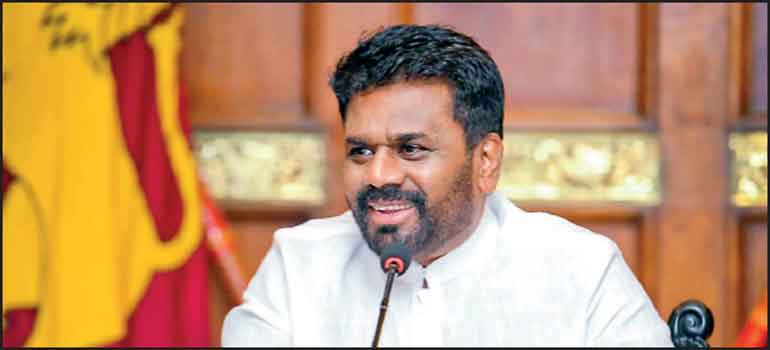
President Anura Kumara Dissanayake
President Anura Kumara Dissanayake used an interview with US publication Newsweek to outline the Government’s priorities at a moment when the country is attempting to stabilise an economy hit by debt distress and a climate disaster. He said the greatest challenge is breaking the cycle in which progress is followed by repeated setbacks.
“Our biggest challenge is achieving sustainable and equitable development while dealing with overlapping crises. We just completed historic debt restructuring and then Cyclone Ditwah struck. Although we managed to recover from the economic crisis, our economy is still fragile and now over a million people have been affected by disaster. We have to move beyond the cycle where every achievement is temporary. We must prove that Sri Lanka remains resilient and viable,” President Dissanayake told Newsweek
which described the
interview as candid.
On geopolitical ties, Dissanayake said Sri Lanka retains the autonomy to work with major partners but does not frame those relationships as a balancing act. He said the country’s ties with India are deep and historic, China remains a strategic economic partner, and the United States is Sri Lanka’s largest export market.
“India is our closest neighbour and first responder. China is a strong economic and political partner. The United States and Sri Lanka also have deep ties and shared democratic values. We don’t look at our relations with these important countries as balancing. Each of our relationships is important to us.”
On relations with Washington, he said Sri Lanka wants market access, climate finance and technology partnerships.
“We need climate finance. We just lost several billions of dollars due to Cyclone Ditwah. We need grants for early warning systems, resilient infrastructure and coastal protection. We want US companies to invest in digital infrastructure, manufacturing and renewable energy. What we offer is a strategically placed, stable, democratic partner in the Indo Pacific.”
On debt sustainability, Dissanayake said the post-default recovery is now intersecting with climate impacts and that international frameworks must evolve.
“We will have to service debt while simultaneously rebuilding from climate disasters. This is why debt sustainability frameworks for climate-vulnerable countries must change. We are increasing Government revenue, broadening our tax base through digitalisation and protecting social spending. We cannot impose austerity on people who have lost everything.”
He outlined the domestic relief agenda shaped by Cyclone Ditwah, including rebuilding homes, restoring agriculture and maintaining targeted subsidies. He said the Government expects these measures to provide visible relief while remaining within IMF parameters.
On investment, Dissanayake said Sri Lanka is putting in place predictable rules and institutions to meet long-standing investor concerns.
“We are establishing transparent, rules-based evaluation with clear criteria. Foreign investors want clarity, consistency and confidence. We have introduced a single-window approval system. We are drafting a new Investment Protection Act. There will be no special treatment for insiders. Approvals will be made on merit and national benefit.”
On long-running Chinese infrastructure projects, including Hambantota and Port City, he said these are commercial realities that must be managed to protect economic value and national sovereignty.
“The Hambantota Port operates transparently. Our Navy and customs are in control. The lease is commercial, not military. Port City is a commercial development. We have to monitor operations, ensure compliance with Sri Lankan law and maintain sovereignty. These projects are realities that we must manage with a clear-eyed assessment of our interests.”
On disaster response and future preparedness, he said the Government will overhaul systems exposed by Cyclone Ditwah.
“Cyclone Ditwah was catastrophic. Response was rapid but longstanding weaknesses were visible. We have launched a comprehensive review of disaster management systems. We will improve forecasting, pre-position equipment, and map high-risk areas. With climate change, destruction of this scale should have been expected. At least now we will put effective and accountable systems in place.”
He said Sri Lanka risks being trapped in a cycle of climate shocks unless investment and global support shift to resilience.
“We will be trapped if we don’t act now. Help us build climate-resilient infrastructure. Help us diversify our economy towards climate-resilient industries. Share technology so communities have time to evacuate. Help us build natural mitigation systems. We must break this cycle.”
Throughout the interview, Dissanayake used the platform to signal that recovery, geopolitical steadiness and climate adaptation form the core of his Government’s economic strategy as it attempts to draw investment and rebuild confidence after successive crises.



