Monday Aug 10, 2026
Monday Aug 10, 2026
Friday, 12 December 2025 00:23 - - {{hitsCtrl.values.hits}}
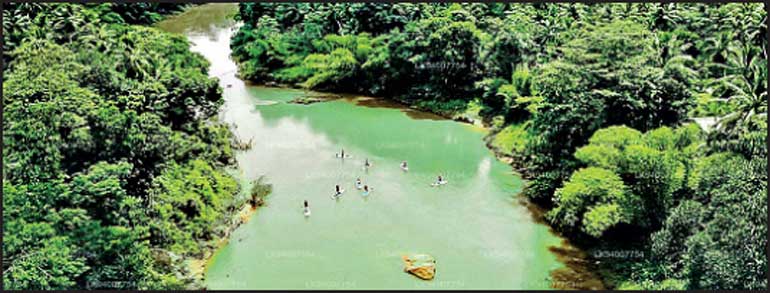
Mahaweli River
The Asian Development Bank (ADB) yesterday said it has approved a $ 200 million loan to support the ongoing Mahaweli Development Program, Sri Lanka’s largest multi-use water resources development initiative.
The program aims to transfer excess water from the Mahaweli River to the drier northern and northwestern parts of Sri Lanka. The Mahaweli Water Security Investment Program Stage 2 Project will directly benefit more than 35,600 farming households in the North Central Province by strengthening agriculture sector resilience and enhancing food security.
The ADB leads the joint co-financing effort for the project, which is expected to mobilise $ 60 million from the OPEC Fund for International Development and $ 42 million from the International Fund for Agricultural Development, in addition to the ADB financing.
“While Sri Lanka has reduced food insecurity, it remains a development challenge for the country,” said ADB Country Director for Sri Lanka Takafumi Kadono. “Higher agricultural productivity and crop diversification are necessary to achieve food security, and adequate water resources and disaster-resilient irrigation systems are key.”
The project will complete the Government’s North Central Province Canal (NCPC) irrigation infrastructure, which is expected to irrigate about 14,912 hectares (ha) of paddy fields and provide reliable irrigated water for commercial agriculture development (CAD).
It will help complete the construction of tunnels and open and covered canals. The project will also establish a supervisory control and data acquisition system to improve NCPC operations. Once completed, the NCPC will connect the Moragahakanda Reservoir to the reservoirs of Huruluwewa, Manankattiya, Eruwewa, and Mahakanadarawa.
The CAD component will construct 13 pressurised pipe distribution networks to provide reliable and efficient irrigation for high-value crops across 5,039 ha of upland fields. These networks will provide on-farm drip irrigation and “water on demand” for farmers.
The project will transform agriculture production systems by integrating a disaster-resilient value chain from seedling and planting to harvesting and post-harvest handling. It will also enhance access to financial services and agriculture extension services, such as training for farmers.
In upland CAD areas, the project will promote perennial crops with export potential, such as mango, papaya, guava, and passion fruit. In lowland paddy areas, it will support seasonal diversification into other crops, such as mung bean, chili, maize, groundnut, and other vegetables, particularly during the Yala cultivation season from April to September.
The project will also assist farmer organisations in operating as business entities, adopting smart, market-driven production systems with tailored access to financial services, extension support, and marketing through public and private producer partnerships.
Sri Lanka was hit by Cyclone Ditwah in late November, resulting in the country’s worst flood in two decades and the deadliest natural hazard since the 2004 tsunami. The disaster damaged over 160,000 ha of paddy fields along with nearly 96,000 ha of other crops and 13,500 ha of vegetables.




