Friday Oct 02, 2026
Friday Oct 02, 2026
Saturday, 25 April 2026 02:23 - - {{hitsCtrl.values.hits}}
 Exports could rise by 47% if gaps are addressed, ADB says
Weak export growth has widened trade deficit and pressured the rupee
Narrow export base leaves economy exposed to external shocks
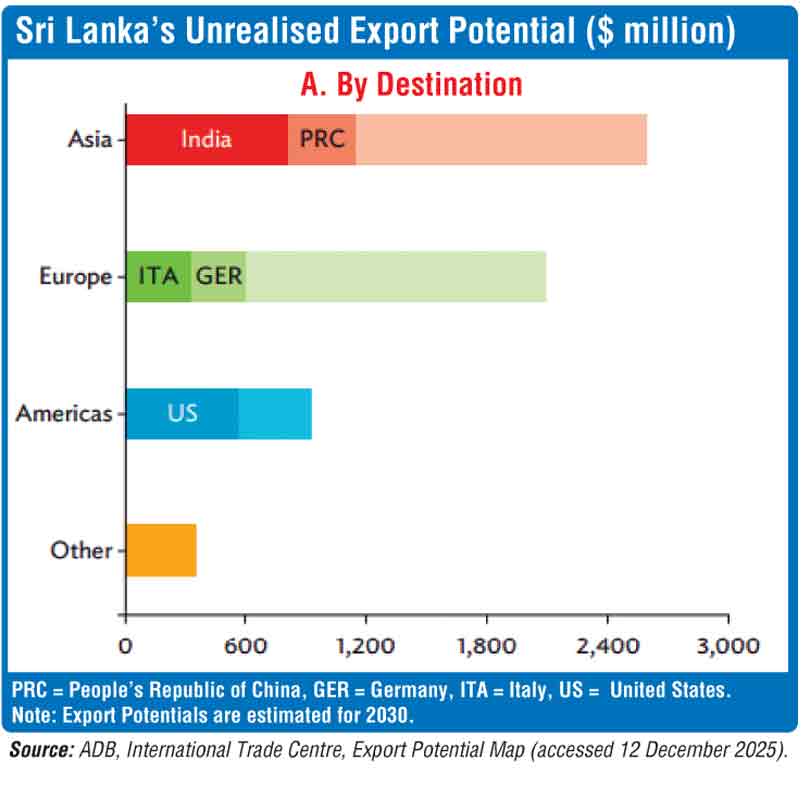
Sri Lanka’s export sector is operating well below potential, with an estimated $ 6 billion in unrealised export capacity, as weak trade performance continues to strain the country’s external position and weigh on currency stability.
This is according to a recent Asian Development Bank brief notes that if this untapped potential were fully realised, Sri Lanka’s exports could increase by 47%, providing a critical buffer as external debt repayments are set to accelerate from 2028.
The ADB said Sri Lanka’s need to purchase foreign currency to service these obligations is expected to exert pressure on the rupee, while the Central Bank’s capacity to defend the currency remains constrained by limited reserves. As of December 2025, usable reserves covered only around three months of goods imports.
Sri Lanka’s export growth has lagged behind regional peers, with nominal exports rising by just 16% between 2015 and 2024, compared with stronger gains in economies such as Cambodia, India and Pakistan. This underperformance, combined with a broad-based rise in imports following the post-war construction boom, has widened the trade deficit and strained the current account, contributing to currency depreciation.
At a sectoral level, the ADB identifies apparel as the largest source of unrealised export opportunity at $ 1.9 billion, followed by tea, and spices and nuts. Beyond earnings, exports are seen as a driver of productivity and higher wages, with exporting firms typically adopting advanced technologies and paying more than non-exporters.
This pattern is evident in Sri Lanka’s apparel sector and, more prominently, in the IT and business process management industry, which continues to offer higher-paying jobs for young graduates.
However, the country’s export base remains narrow. Textiles and garments, tea and rubber products have accounted for around two-thirds of merchandise exports over the past decade, with the United States, the European Union and the United Kingdom absorbing an average of 56% of exports.
This concentration leaves Sri Lanka vulnerable to external demand shocks. In 2020, exports fell by 16% amid the collapse in global garment demand during the COVID-19 pandemic, compared with a 2% contraction across the rest of developing Asia.
The ADB noted that strengthening exports is central to maintaining macroeconomic stability, particularly as foreign exchange requirements rise. Expanding export earnings, alongside tourism receipts and remittances, will be essential to building external buffers and easing pressure on the balance of payments.
Against this backdrop, recent trade data indicate modest growth but fragile momentum. Total export earnings in the first quarter of 2026 rose 1.6% year-on-year to exceed $ 4.3 billion, according to the Sri Lanka Export Development Board. Merchandise exports increased 1.2% to over $ 3.3 billion, while services exports grew 3.13% to $ 921.11 million, supported by ICT/BPM, construction, financial services and logistics.
However, March performance weakened, with total exports declining 5.2% year-on-year to over $ 1.46 billion. Merchandise exports fell 4.94% to above $ 1.18 billion, while services exports dropped 6.26% to $ 286.92 million, reflecting disruptions to global trade flows and logistical constraints.



