Thursday Oct 08, 2026
Thursday Oct 08, 2026
Monday, 4 May 2026 04:54 - - {{hitsCtrl.values.hits}}
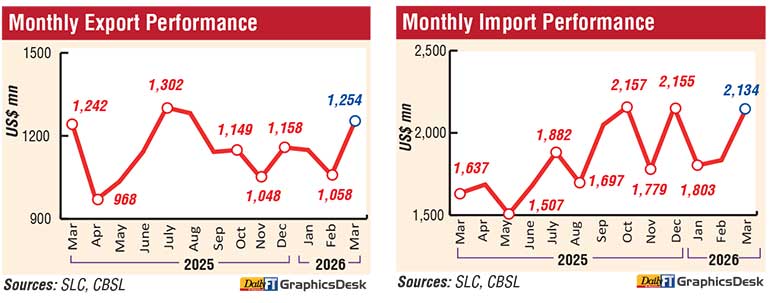
Sri Lanka’s current account surplus declined 43.9% year-on-year (YoY) to $ 531.5 million in the first quarter of 2026, as a widening trade deficit, up 122% from a year ago, and weaker services inflows weighed on the external account, despite support from higher workers’ remittances and a lower primary income deficit.
The current account recorded a marginal surplus of $ 44.6 million in March, down 90.7% YoY, reflecting rising import costs and weakening services earnings following the escalation of the Middle East war.
According to data released by the Central Bank of Sri Lanka (CBSL), the merchandise trade deficit widened 50% to $ 2.31 billion in the first three months of the year from $ 1.54 billion a year earlier, with imports rising 18.1% YoY to $ 5.77 billion, outpacing export growth of 3.4% to $ 3.46 billion.
In March alone, imports increased 30.3% YoY to $ 2.13 billion, while exports rose 1% to $ 1.25 billion, increasing the trade gap by 122% YoY to $ 880 million.
Fuel imports were a key driver, surging 74.7% YoY to $ 630 million in March due to higher global prices and volumes linked to the ongoing conflict. Vehicle imports amounted to $ 195 million during the month, bringing cumulative imports for 1Q to $ 613 million.
The terms of trade deteriorated on a YoY basis in March, and also marginally declined during 1Q, as the fall in export prices exceeded that of import prices.
The surplus in the services account contracted 20.2% YoY to $ 973.1 million in 1Q, with a sharper 42.4% decline in March to $ 226.6 million.
Tourism was a key drag, with earnings falling 36.8% YoY to $ 223.7 million in March, while arrivals declined 19.8% to 183,979, reversing earlier growth momentum amid travel disruptions linked to the Middle East crisis. Cumulative tourism earnings declined 15% YoY to $ 954 million in 1Q.
Workers’ remittances continued to support the external account, increasing 26.5% YoY to $ 2.29 billion in 1Q, including a 17.5% rise to $ 814.8 million in March.
In the financial account, foreign investments in Government securities recorded a net outflow of $ 63.9 million, while foreign investments in the Colombo Stock Exchange (CSE), including both primary and secondary market transactions, recorded a net outflow of $ 10.2 million in March.
Gross official reserves declined to $ 7 billion at end-March 2026, mainly due to external debt service payments despite continued foreign exchange purchases by the CBSL. As of end-April 2026, the Sri Lankan rupee had depreciated by 2.9% against the US dollar on a year-to-date basis, reflecting external sector pressures following the onset of the Middle East conflict, the CBSL noted.
Vehicle imports flat in March after two-month decline
The vehicle imports bill, including personal and commercial vehicles, remained broadly unchanged at $ 195 million in March, following two consecutive monthly declines earlier in the year.
Imports had fallen to $ 194 million in February from $ 224 million in January, and from a 10-year peak of $ 301 million recorded in December 2025, reflecting a moderation after the reopening of the sector.
Vehicle imports...
Cumulatively, vehicle imports for the first quarter of 2026 reached $ 613 million, according to Central Bank of Sri Lanka (CBSL) data.
The total import cost of vehicles in 2025 amounted to $ 2.05 billion after the Government lifted a five-year ban on vehicle imports in February 2025 to boost tax revenue.
Customs reported a record revenue of Rs. 2,551 billion in 2025, exceeding the revised target of Rs. 2,241 billion and marking a 64.2% increase from Rs. 1,553 billion in the previous year. Taxes from vehicle imports contributed Rs. 905 billion, nearly double initial expectations following the reopening of the sector.
New tax changes are expected to impact vehicle imports going forward.
The Government has gazetted amendments to the Social Security Contribution Levy (SSCL) Act, reducing the registration threshold to Rs. 9 million per quarter (Rs. 36 million annually) and revising the levy’s application to motor vehicles at import, while maintaining the SSCL rate at 2.5%, with changes effective from 1 May 2026.




