Saturday Oct 17, 2026
Saturday Oct 17, 2026
Friday, 10 April 2026 00:27 - - {{hitsCtrl.values.hits}}
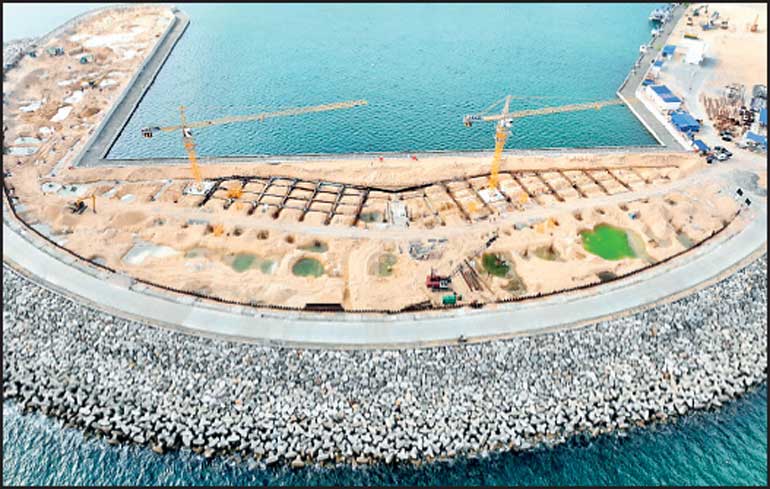
Construction work in progress at
several sites in Port City Colombo
By Tyron Devotta
This is no longer a speculative vision; it is the emerging economic reality of Port City Colombo. CHEC Port City Colombo Deputy Managing Director Thulci Aluwihare has said Sri Lanka may finally be on the cusp of unlocking a new category of foreign investment—one that is fundamentally different from anything the country has seen before.
From November 2025 to March, Port City Colombo secured approximately $ 900 million in investments, an almost unprecedented surge for a project that had seen gradual traction in its early years amid broader macroeconomic challenges. The timing is not accidental.
After a prolonged period marked by the Easter Sunday attacks, the global shock of the COVID-19 pandemic, and Sri Lanka’s economic collapse, the project remained largely in a holding pattern.
International marketing efforts began to gain momentum from late 2025 onwards, as conditions began to stabilise.
“The macro story had to align first,” Aluwihare explained. “You cannot market a country when the fundamentals are unstable. Now, we are seeing recovery, policy alignment, and growing confidence, and we are finally seeing the results.”
From real estate to a ring-fenced financial ecosystem
Port City Colombo’s most significant transformation has been conceptual rather than physical. Originally envisioned as a waterfront real estate development, it has evolved into a fully ring-fenced services export Special Economic Zone (SEZ), enabled by the Colombo Port City Economic Commission Act.
The shift is critical. Sri Lanka’s economy is already driven by services, accounting for nearly 60% of GDP; yet, until recently, it lacked a modern legal framework dedicated to exporting services.
Port City Colombo fills that gap. Within its boundaries, a streamlined regulatory environment operates—one designed not merely to offer tax incentives but to systematically eliminate the structural risks that have historically deterred foreign investors.
At the core of this model is a decisive break from the country’s traditional investment framework. Investors in Port City Colombo operate entirely in foreign currency. Capital is brought in, returns are generated, and profits are repatriated, all in US dollars. This effectively removes exchange rate risk, long considered one of Sri Lanka’s most persistent deterrents to foreign direct investment (FDI).
“In Port City Colombo, the Sri Lankan rupee is not the operating currency,” noted Aluwihare. “So investors are naturally hedged. That is a fundamental shift.”
Beyond currency stability, the zone offers 100% foreign ownership, unrestricted hiring of foreign talent, and long-term residency visas ranging from five to 10said years. These are not incremental policy tweaks; they are structural guarantees.
Port City Colombo’s legal and regulatory architecture has drawn from some of the world’s most successful financial zones, including the Dubai International Financial Centre, Abu Dhabi Global Market, Labuan International Business and Financial Centre, and Singapore.
But Aluwihare is careful to position Colombo not as a direct competitor. “We are not trying to compete with Dubai or Singapore,” he says. “We are positioning ourselves to complement them, particularly from a cost and regional access perspective.”
With operating costs estimated at a fraction of those in established financial hubs, Colombo’s proposition lies in being an accessible, neutral, scalable alternative, especially for companies looking to tap into South Asia’s growth.
A rapid scaling hybrid model
The strategic logic extends beyond Sri Lanka. With India expected to sustain strong economic expansion over the next decade, Port City Colombo is positioning itself as a satellite financial and services hub to support that growth.
The pitch is simple: a business-friendly environment anchored in Sri Lanka, but serving the wider South Asian region. At the same time, the project integrates lifestyle elements into its economic proposition, which Aluwihare describes as a “work-live-play-learn” ecosystem.
From beachfront access and recreational infrastructure to schools, healthcare, and entertainment zones, the aim is to create not just a business district, but a globally competitive urban environment.
Perhaps the most striking development lies in how quickly investors can now enter the ecosystem. Companies can establish operations remotely, without physically entering Sri Lanka. For businesses, particularly those based in the Gulf region, licences can be issued within seven days, and visas facilitated within five.
Until Port City Colombo’s physical infrastructure is fully completed, these businesses are already operating out of Colombo’s existing commercial spaces, of which over 1 million square feet is now occupied by Port City-linked entities. This hybrid model–virtual entry with physical expansion–has enabled rapid scaling.
A new FDI story for Sri Lanka
Of the nearly 200 companies registered so far, around half are in IT and IT-enabled services. A further 30% fall within financial services, professional services, and trading. This composition is deliberate.
While primary investors will eventually build the physical city, it is the secondary layer, service-based businesses, that will generate immediate foreign exchange and economic activity.
“No developer will come unless there is business activity,” Aluwihare said. “First, you attract the companies. Then the infrastructure follows.”
The renewed momentum also coincides with shifting global dynamics. Ongoing instability in parts of the Middle East has prompted some investors to reassess traditional safe havens such as Dubai.
Port City Colombo is positioning itself as an alternative, or a complementary location for diversification and risk mitigation. In some cases, it is being pitched as a disaster recovery base for companies operating in the Gulf.
For decades, Sri Lanka has struggled to attract sustained FDI, often failing to cross even the $ 1 billion mark annually. Port City Colombo aims to change that narrative. With an estimated $ 15 billion required for full development, and a projected annual GDP contribution of over $ 13 billion, the scale of ambition is unprecedented.
If realised, it would effectively reshape the country’s economic structure.
The emerging narrative
Yet, for all its promise, the project’s success will ultimately depend on one factor: credibility.
“Investors are watching governance very closely,” Aluwihare said. “There is a growing belief that Sri Lanka is making a genuine effort to address longstanding issues, particularly around transparency and corruption.”
That perception, he suggests, is as important as any fiscal incentive. Because in the end, capital does not simply chase returns, it seeks trust. What is unfolding in Port City Colombo is not just an infrastructure story. It is an attempt to redefine Sri Lanka’s place in the global economic system.
From a traditional exporter of goods and labour, to a services-driven, globally connected financial and business hub, the numbers now suggest that, after years of delay, that transition may finally be underway for Sri Lanka.
And if the current trajectory holds, Colombo may soon find itself competing, not just regionally, but on a far larger stage.




