Friday Aug 07, 2026
Friday Aug 07, 2026
Wednesday, 17 September 2025 00:02 - - {{hitsCtrl.values.hits}}
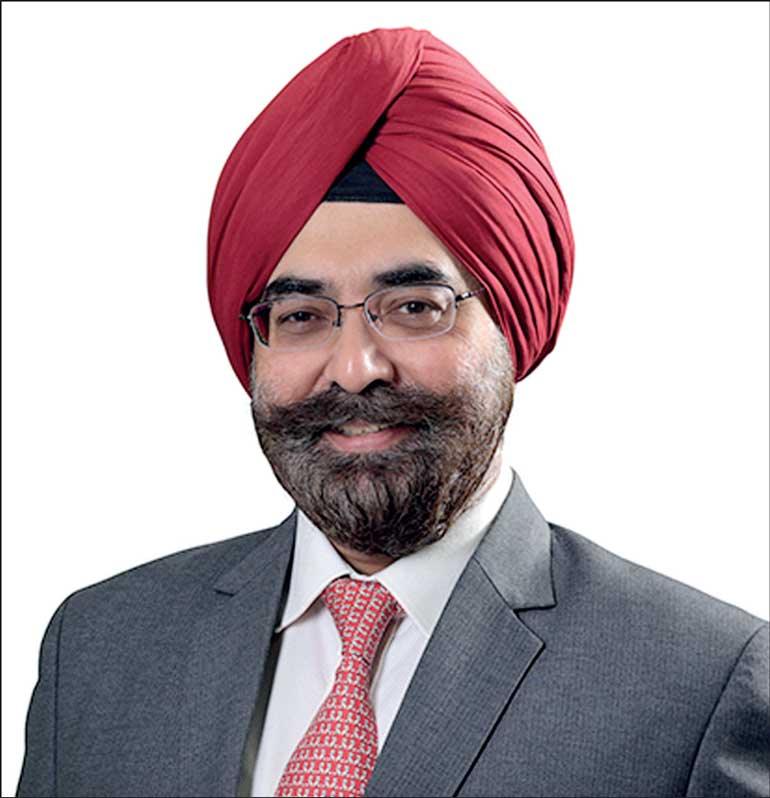
CEO – India and South Asia P.D. Singh
Q: Sri Lanka has faced a period of significant economic and social challenges but is now beginning to show early indicators of recovery. From your perspective, how do you see this bounce back unfolding?
A: Sri Lanka is showing encouraging signs of recovery, the external sector has shown commendable progress:
These trends in the external sector have contributed significantly to improving the balance of payments, rebuilding reserves, and stabilising the currency.
Sri Lanka has made remarkable strides in stabilising its economy, undertaking one of the largest fiscal adjustments in its history—equal to nearly 8% of GDP. This has been exceptionally significant by both historical and international standards. Furthermore, total revenue collected exceeded the half-yearly estimate by 3%.
Q: Sri Lanka is going through an important phase of economic recovery and reform. Against this backdrop, what do you think the future looks like for a bank such as Standard Chartered Sri Lanka, with its international footprint, legacy presence, and ongoing strategic realignment?
A: We believe the future holds significant opportunity for a bank like Standard Chartered Sri Lanka. With our international footprint, over 130-year legacy in the country, and ongoing strategic realignment, we are uniquely positioned to play a catalytic role in supporting Sri Lanka’s reintegration into global markets.
By leveraging Standard Chartered’s unmatched global network, we offer our corporate clients access to international markets and global capital. As per the group strategy we will continue to focus on building our cross-border capabilities.
As a country emerging to the next level of growth engaging with international partners for reform, Sri Lanka requires trusted financial partners with global capabilities and deep local knowledge. Standard Chartered has been a longstanding market leader in servicing financial institutions (banks) and Government of Sri Lanka—acting as lead manager, bookrunner, and rating advisor on several of its international bond issuances. We are committed to continuing this support, helping Sri Lanka access global capital markets with confidence. With our global reach and capital market expertise, we aim to be a steadfast partner to the government and the broader economy during this important phase of transition and growth. This is also in line with the group strategy of accelerating FI market share to 60%, focussing on E&A and new inbound markets.
At Standard Chartered, we empower local corporates to expand internationally by leveraging our global network. Our international presence across 54 markets gives corporates in Sri Lanka the much-needed global reach.
Q: Moving out of retail banking marks a significant strategic shift. How will this impact banks future business?
A: The divestment is in line with Standard Chartered’s global strategy, aimed at achieving operational efficiencies, reducing complexity, and driving scale. This transition represents a pivotal moment for Standard Chartered Sri Lanka as we refocus our efforts on our core strengths. Our priority throughout this process has been to ensure a seamless transition for our employees and clients, who are at the heart of everything we do. While exiting the retail segment, Standard Chartered remains committed to Sri Lanka and will continue to maintain a strong presence and focus on its Corporate and Investment Banking business in the country. The Bank remains a core part of Standard Chartered Group’s strategic footprint in Asia.
We are committed to expanding our Financial Markets (FM) franchise in Sri Lanka by leveraging on our global expertise in emerging market economies. Our goal is to add value to our clients as they drive the country’s economic growth in alignment with IMF-led economic reforms with the main focus on two key areas, i.e. – Digitisation and structured solutions. While our digitisation initiatives are already underway, we are also investing in strengthening our local capabilities to offer comprehensive derivatives-based structured solutions that will provide our clients in Sri Lanka with enhanced options to manage their exposure and optimise the balance sheet.
Standard Chartered’s transaction banking aims to power businesses of the real economy with world-class cash management, trade finance and working capital solutions across some of the world’s most dynamic regions. Transaction banking aims to pivot around four key pillars to deliver a larger share of growth from both the multimarket corporate clients and financial institutions segments. Plans to leverage on the bank’s uniquely connected network to drive cross sell and broaden the multimarket segment will be complimented by investments in enhancing the banks, FX, cash management, trade and working capital capabilities towards a nimbler and globally scabble digital model. While being a clear front runner in the correspondent banking business, the strategy also aims to double down on this segment while penetrating the high growth emerging new economy FI sector to accelerate its cross-border revenues.
In short, while our footprint is evolving, our commitment to Sri Lanka remains steadfast. We aim to build on our legacy by offering even greater value to the country’s corporate and institutional ecosystem—supporting growth, investment, and international integration.
Q: As India positions itself as a fast-growing global economy and Sri Lanka seeks to accelerate its recovery and growth, what specific avenues of collaboration – whether in manufacturing,
services, renewable energy, or regional supply chains – can be pursued to strengthen bilateral opportunities?
A: India and Sri Lanka share a long-standing partnership rooted in geographic proximity, cultural ties, and economic interdependence. As India continues its trajectory as one of the fastest-growing major economies, and Sri Lanka accelerates its post-crisis recovery, there is significant untapped potential for deepening bilateral collaboration across multiple sectors.
1. Strengthening trade and economic integration:
India remains Sri Lanka’s largest trading partner, with bilateral trade exceeding $ 5 billion annually. Strengthening trade linkages through improved logistics and customs cooperation can further integrate supply chains, especially in textiles, pharmaceuticals, electronics, and processed foods.
Sri Lanka is at a strategic inflection point. With 26% of imports directed from India and south-south trade having a significant improvement in global trade, the country is geographically and economically well-positioned to become a regional trade and investment hub. This is an opportune moment to fully leverage the connectivity to regional markets and drive meaningful capital inflows into key sectors. To further enhance trade, the country can look at revising the trade treaty to attract more trade.
2.Manufacturing and industrial collaboration:
Sri Lanka offers a strategic location with access to major shipping lanes, making it an ideal partner for regional manufacturing hubs and value chain integration. Indian firms can explore joint ventures in apparel, automotive components, and electronics assembly, leveraging Sri Lanka’s skilled workforce and preferential trade access to markets like the EU and US under the GSP+. Sri Lanka has an opportunity to support India in trade and to enhance the growth of India’s presence globally.
3.Renewable energy and sustainability:
India and Sri Lanka are both committed to sustainable development and have signed various MoUs for cooperation in the renewable energy sector, particularly solar, wind, and grid interconnectivity. With Sri Lanka investing in wind and hybrid energy systems specially in the North and North-west regions there is increasing potential for cross border energy export to India with the geographic advantage.
4.Services and technology collaboration:
There is significant potential for growth in IT, education, fintech, and healthcare services. There is scope for capacity-building partnerships, BPO operations, and digital infrastructure collaboration, particularly in areas like digital payments and e-governance. Already Indian tech companies have setup offices Sri Lanka and Sri Lanka can act as an extension to the tech corridors in India.
Educational ties and student exchange programs can also support knowledge-based economic growth and foster people-to-people connectivity.
5.Foreign Direct Investment (FDI):
India is among the top five sources of FDI into Sri Lanka, with leading Indian companies investing in petroleum, retail, telecom, hospitality, and manufacturing sectors. Sri Lanka’s economic recovery and reforms aimed at improving the investment climate could further attract Indian investors looking to expand regionally.
New opportunities exist in ports, logistics, renewable energy, tourism infrastructure, and technology services, particularly through Public-Private Partnerships (PPPs).
Q: Sri Lanka is actively seeing to boost foreign direct investment as part of its growth story. With its global footprint and long-standing presence here, how can Standard Chartered help the country build a stronger and more resilient FDI pipeline that goes beyond short-term inflows?
A: Standard Chartered Sri Lanka has played a significant role bringing FDIs to the country. Globally, we are present across 54 markets. At Standard Chartered, we are uniquely positioned to support the country’s ambition of building a stronger and more resilient FDI by leveraging our network throughout the globe. Our role extends beyond facilitating short-term capital flows, we are focused on supporting sustainable, long-term investment.
In practical terms, we work closely with both the public and private sectors to connect strategic investors to priority sectors such as infrastructure, renewable energy, manufacturing, and digital services. We also advise on structuring investments in ways that maximise impact while aligning with Sri Lanka’s evolving policy landscape.
Consistency and credibility are key to investor confidence, and we are encouraged by the government’s direction in implementing reforms. We remain committed to being a trusted partner to Sri Lanka in this next phase of growth — helping not just to attract capital, but to embed it in productive, value-creating opportunities that benefit the broader economy.
Q: What do you believe will be most critical enablers and potential stumbling blocks in ensuring long-term stability and growth?
A: Sustaining the momentum in growth relies on determined policy action, continued investment, and vigilance against external headwinds. To translate this early recovery into sustained progress, Sri Lanka must focus on the following enablers:
1.Infrastructure to boost tourism – Bandaranaike international Airport (BIA) terminal expansion project is important and development of the roads, highways, and domestic airlines.
2.Bilateral trade treaties – Diversifying into new markets helps reduce dependency risks. Proactive efforts, such as reducing tariff barriers with major partners—can unlock growth. India and ASEAN partners remain strategic.
3.Strengthened PPP frameworks – Leveraging private capital via transparent Public–Private Partnerships can help address infrastructure deficits—without overstretching public finances. Ease of doing business reforms.
4.Digitisation and innovation – Accelerating digital adoption—in finance, trade facilitation, and government services—can lift productivity and enable better governance. Digital banking and fintech platforms are already gaining traction.
Commendable work has been done by the Central Bank and the Government in steering the macroeconomic recovery. Their proactive policy framework has laid a foundation for stability. That said, deeper financial inclusion and digitisation, particularly at the lower end of the economic spectrum, remain key. Encouraging broader use of digital payment methods — such as credit and debit cards — can improve the velocity of money and enhance formal financial participation. Despite of two million credit cards and approximately 19 million debit cards in circulation, there is still significant room to grow usage, especially in rural and informal sectors. Supporting this transition through fintech partnerships, financial literacy, and ecosystem digitisation will be a core focus for the country.
Success, in this new chapter, will be measured not just by profitability, but by our impact — in helping build a more resilient, inclusive, and future-ready Sri Lanka. Whether it’s through financing sustainable infrastructure, championing trade and investment flows or advising on rating and public debt management, Standard Chartered is committed to being a long-term partner in Sri Lanka’s growth story.
In essence, we are here for good — and here to help Sri Lanka not just recover but re-emerge stronger and more connected on the global stage.




