Thursday Nov 26, 2026
Thursday, 26 November 2026 04:41 - - {{hitsCtrl.values.hits}}

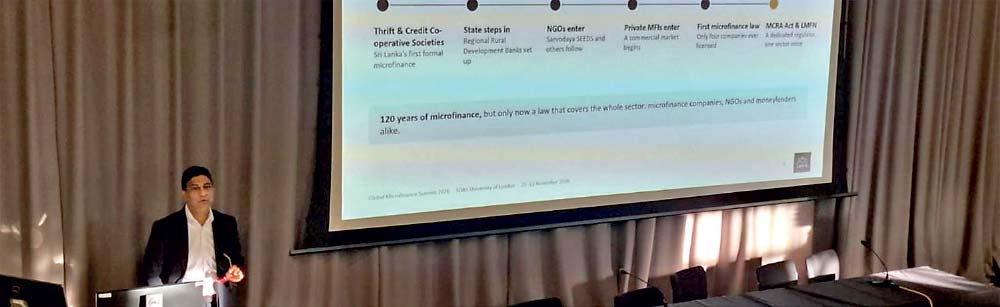
Lanka Microfinance Network Chairman Danushka Udugama speaking at the Summit
By Imran Nafeer
Sri Lanka’s microfinance sector has entered a new era, and it is ready to welcome international investors, partners and expertise. That was the message delivered by Lanka Microfinance Network (LMFN) Chairman Danushka Udugama at the Global Microfinance Summit 2026, held at SOAS University of London on 21 and 22 November.
The Summit was organised by the Global Alliance for Financial Inclusion (GAFI) and the Financial Inclusion Forum UK (FIF-UK). It brought together microfinance networks, regulators, investors and development partners from South Asia, Africa, the Middle East and beyond. Presenting under the title “Crisis, Cyclone, Comeback: Sri Lanka’s New Microfinance Law and the Opportunity It Opens,” Udugama gave an international audience a clear picture of a country and a sector that have come through difficult years stronger and better organised.
A 120-year story reaches a turning point
Udugama reminded delegates that microfinance in Sri Lanka is more than 120 years old, tracing its roots to the first Thrift and Credit Co-operative Societies in 1906. Over the decades, State development banks, NGOs and private microfinance companies built a sector that reaches deep into rural communities.
What was missing, he said, was a single modern law covering the whole sector. That changed in March 2026, when Parliament passed the Microfinance and Credit Regulatory Authority Act, No. 9 of 2026. For the first time, one dedicated authority will license and supervise microfinance institutions and moneylenders, with consumer protection as one of its core objectives and clear standards for responsible lending.
“For responsible institutions, this is good news,” Udugama said. “It levels the playing field, it protects clients, and it builds the trust that investors need.”
An economy back on its feet
Udugama described how Sri Lankan microfinance institutions stood by their clients through the pandemic, the economic crisis and Cyclone Ditwah, and how the country has since turned the corner. The economy grew by 5% in 2025, and the Central Bank expects growth of 4 - 5% this year. In July 2026 the World Bank restored Sri Lanka’s upper-middle-income status, and in September Fitch Ratings upgraded the country’s credit rating. Income per head reached a record of more than $ 5,000 in 2025, and bank lending to the private sector is growing strongly again.
A sector that speaks with one voice
A key part of the comeback, he said, is that the sector has organised itself. The Lanka Microfinance Network was formalised in May 2026, with more than 120 participants at its inaugural meeting, a nine-member board and representatives from all nine provinces. LMFN held its first Leaders’ Forum in September and has since joined GAFI, connecting Sri Lankan microfinance to a global community of peer networks.
LMFN brings microfinance companies, NGOs, community lenders and support organisations under one roof. It is working alongside the new regulator to turn the law into practice, while building capacity and ethical standards across the sector.
Women at the heart of the opportunity
Udugama highlighted the strong business case for investing in Sri Lankan microfinance, particularly in women. Women-owned enterprises hold almost half of small business loans by number and consistently repay better than other borrowers, he noted, yet they still receive a smaller share of the money lent. Closing that gap, he said, is both good impact and good business.
He set out LMFN’s vision for the sector in 2036: every lender licensed and trusted; lending that is digital and linked to the credit bureau; products that are ready for climate events, with insurance and savings built in; services that go beyond credit; and microfinance institutions connected to capital markets through gender and Orange bonds. Sri Lanka’s first domestic Orange Bond, which channels capital to women, is targeted for December 2026.
A $ 100 million proposal
Udugama pointed out that, until now, most international lenders and investors have reached Sri Lanka through its banks and finance companies rather than through dedicated microfinance institutions. With the new law, a licensed and investable microfinance sector is now opening.
To make that opportunity real, LMFN proposed a $ 100 million fund to be channelled through the network to microfinance institutions of every size. Larger licensed institutions would receive funding to scale up lending to women and rural enterprises, mid-size lenders would receive growth capital and technical support to meet licensing standards, and the smallest community lenders and co-operatives would receive small, patient funding that reaches village level.
“LMFN is Sri Lanka’s largest and most inclusive microfinance network,” Udugama said. “We can be the one door through which your capital reaches the whole sector, from the largest institution to the smallest village lender.”
An invitation to the world
He also called on investors, sector leaders, technical partners and international organisations to play their part, from debt and equity for licensed institutions, to digital systems, climate insurance and support for the new regulator.
He closed with an invitation to the Summit delegates. “Sri Lanka today has a modern law, a growing economy and a sector that speaks with one voice,” he said. “Come to Sri Lanka. See it for yourselves. Meet our member institutions, and build the next decade of responsible microfinance with us.”