Wednesday Nov 18, 2026
Wednesday Nov 18, 2026
Monday, 16 November 2026 04:39 - - {{hitsCtrl.values.hits}}
By Wealth Trust Securities
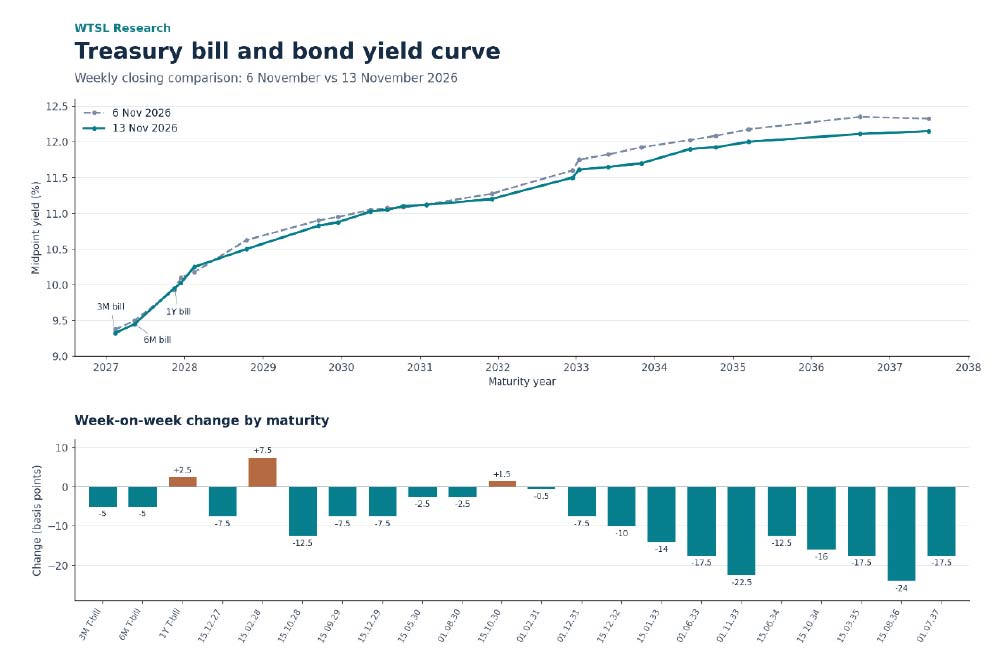
 The secondary Bond market extended its rally during the week ending 13 November, with yields declining sharply across the curve as the positive momentum from the preceding week carried through. Following a modest increase at the start of the week, sustained buying interest quickly regained control, driving a steep re-pricing across key maturities. The move was underpinned by improving sentiment surrounding the Middle East conflict, as renewed diplomatic momentum strengthened expectations of de-escalation and eased concerns over further supply disruptions.
This was reflected in energy markets, with Brent crude falling towards $ 90 per barrel earlier in the week. The sharp decline helped temper near-term inflationary and external sector risks, providing a supportive backdrop for the domestic Bond market. Against this backdrop, sustained buying interest gathered momentum, driving yields sharply lower across key maturities and reinforcing the broader rally.
However, towards the close of the week, some uncertainty began to set in as hopes of an immediate diplomatic resolution were dampened. Oil prices rebounded towards $ 95–96 per barrel. In addition, profit-taking pressure following the recent extended rally was compounded by a sharp increase in global bond yields. The US 10-year Treasury yield climbed above the 5% level to around 5.13%. Regional bond markets also came under pressure, with India’s benchmark 10-year yield also rising sharply, adding to the cautious tone. These developments prompted a modest reversal in domestic yields.
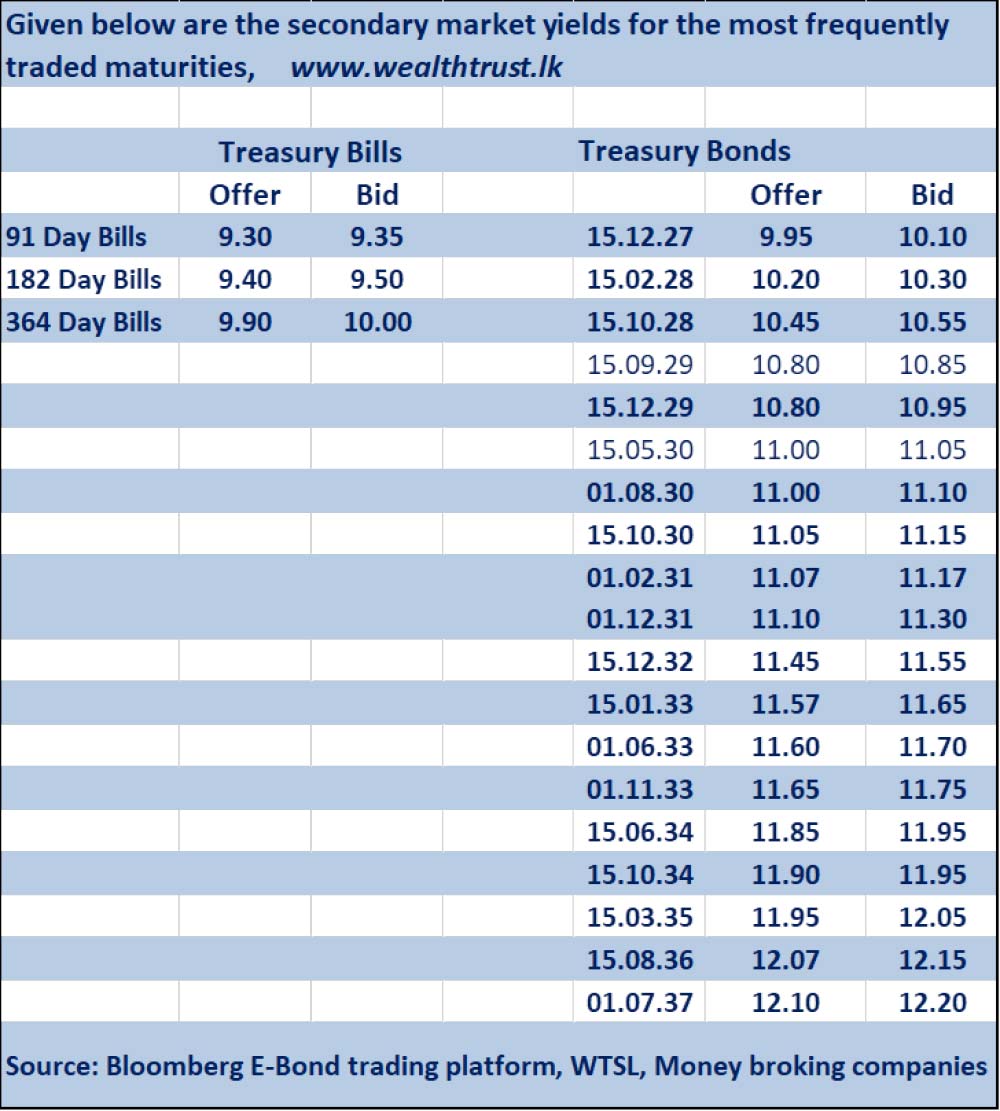
Despite this, the late-week uptick remained minor relative to the scale of the preceding rally, with renewed buying interest emerging at the higher levels. As a result, secondary market two-way quotes closed sharply lower week-on-week across the yield curve-more pronounced on the belly to longer end of the yield curve. Market activity and transaction volumes remained healthy to elevated, throughout the week.
In terms of the trade summary, the 15.02.28 and 01.05.28 traded lower at the rates of 10.20% and 10.30%-10.25% respectively. The 15.09.29 traded from an intraweek high of 10.90% to a low of 10.70%, while the 15.12.29 at 10.75% during the week.
The 2030 tenors initially saw a modest upward move in yields before reversing sharply lower as buying interest strengthened through the week. The 01.03.30 rose to an intraweek high of 11.10% before rallying down to a low of 10.90%, while the 15.05.30 traded at 11.05%. The 01.08.30 traded up to an intraweek high of 11.15% before declining to a low of 10.95%. Similarly, the 15.10.30 initially traded up to 11.15% before rallying down to an intraweek low of 11%.
The rally extended into the 2031 segment. The 01.02.31 traded down from an intraweek high of 11.10% to touch a low of 11%, while the 01.12.31 saw a more pronounced decline from an intraweek high of 11.32% to a low of 11.10%.
Further along the curve, the 15.12.32 rallied from an intraweek high of 11.68% to a low of 11.45%, while the 15.01.33 traded at a low of 11.53% as against an intraweek high of 11.60%. The 01.06.33 traded down from an intraweek high of 11.90% to a low of 11.65%, while the 01.11.33 declined from 11.95% to an intraweek low of 11.75%.
The belly of the curve also recorded notable declines in yields. The 15.06.34 traded down from an intraweek high of 11.92% to a low of 11.83%, while the 15.10.34 rallied strongly from an intraweek high of 12.10% to a low of 11.85%.
On the longer end, the 15.08.36 saw one of the sharpest moves of the week, with yields declining from an intraweek high of 12.40% to hit a low of 12%.
At the weekly Treasury Bill auction conducted last Wednesday, weighted average yields were seen holding broadly steady for the sixth straight week. The yield on the 182-day tenor posted a decline of one basis point- the first such decline on any tenor observed at the auction in nine weeks. The yield on the 91-day and 364-day tenors were seen remaining unchanged week on week at the rates of 9.35% and 9.95% respectively.
The Public Debt Management Office (PDMO) raised Rs. 79.06 billion or 87.85% (an increase in the acceptance rate from 73.22% observed the previous week) in total out of the Rs. 90 billion offered in total. The 91-day tenor recorded acceptance above its respective target allocation, while the 182-day and 364-day recorded acceptances below their respective offered amounts.
Total bids received amounted to 1.86 times the overall offer.
In addition, a further Rs. 6.50 billion was raised at phase II of the auction process. Accordingly, the aggregate accepted amount of the issuance was Rs. 85.56 billion.
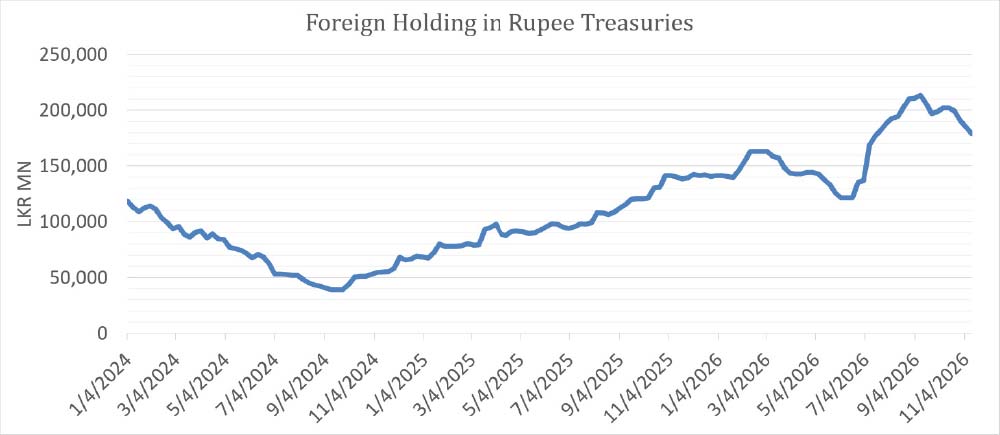
Meanwhile, the foreign holdings of rupee-denominated government securities recorded a net outflow for the fourth straight week, registering a decrease amounting to 2.90% or Rs. 5.45 billion for the week ended 12 November. Accordingly, the total foreign holdings of rupee treasuries decreased to Rs. 179.42 billion, falling to the lowest level in 17 weeks or since early July this year. The cumulative decline over the past four weeks amounts to Rs. 22.95 billion.
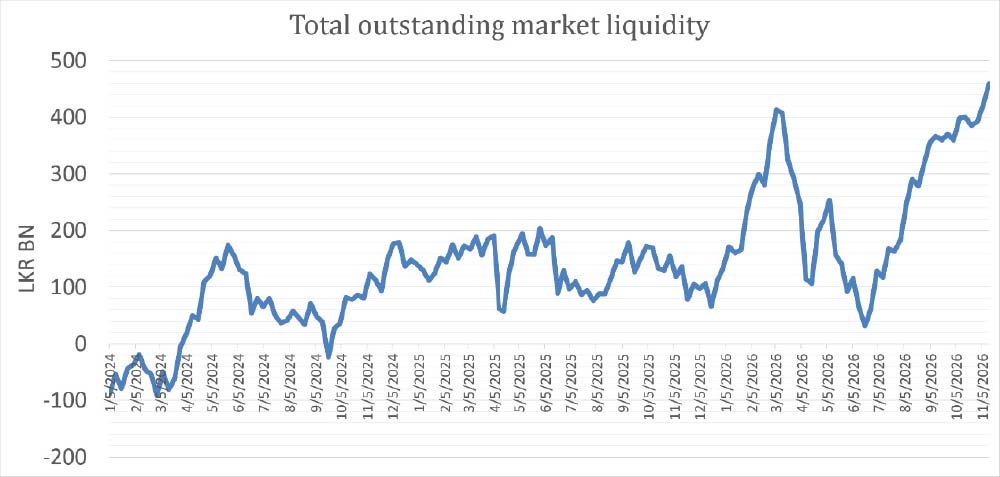
In the money market, the Surplus liquidity hit an all-time high of Rs 458.89 billion for the week ending 13 November 2026, as against its previous week’s closing level of Rs. 422.29 billion.
The weighted average rates on Call Money and Repo were at 9.02% and 9.14% respectively at the end of the week.
Furthermore, the Rupee or the USD/LKR rate was seen closing the week broadly steady, at Rs. 332.55/332.65 unchanged as against its previous week’s closing. This was subsequent to trading within an intraweek high of Rs. 332.32 and a low of Rs. 332.75.
The average daily USD/LKR traded volume over the first four trading days of the week stood at $ 87.30 million.
(References: Public Debt Management Office - Ministry of Finance, Central Bank of Sri Lanka, Bloomberg E-Bond Trading Platform, Money Broking Companies)