Saturday Oct 17, 2026
Saturday Oct 17, 2026
Tuesday, 24 March 2026 01:12 - - {{hitsCtrl.values.hits}}

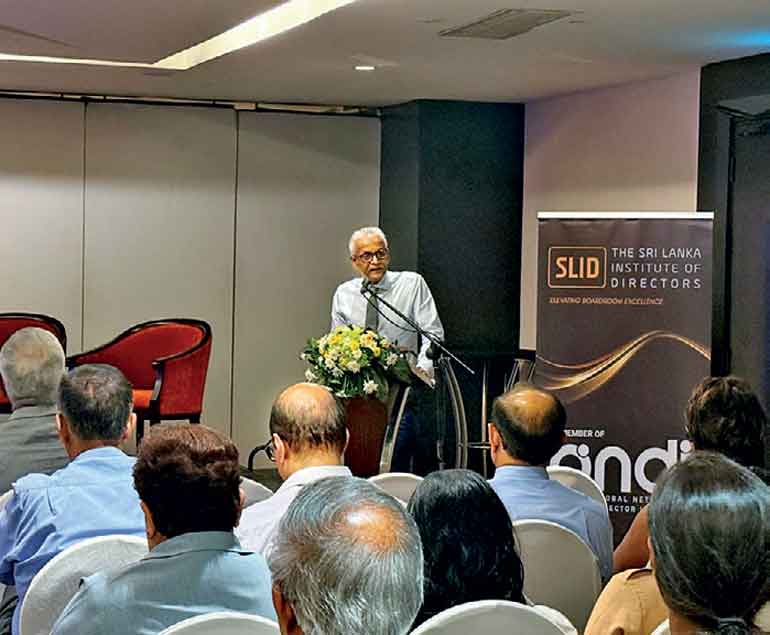
The 32nd session of the SLID-KPMG Audit Committee Forum was successfully held on 9 March 2026 at the Ivy Room, Cinnamon Grand Colombo. The forum attracted over 50 professionals, the majority being company directors, including representatives from audit committees, as well as senior leaders in ESG compliance field.
The Board – especially the audit committee – must now oversee ESG just as it does financial reporting. New global standards (e.g. SLFRS S1/S2) create a “shared language” for governance, strategy and risk disclosures. This session challenges conventional thinking and explores how audit committees are redefining their mandate as sustainability moves from the periphery to the core of corporate governance and value creating business models.
The Forum noted that companies are under pressure to provide transparent and high-quality information on their sustainability efforts with the implementation of SLFRS S1 and S2 in Sri Lanka. The Audit committees are responsible for monitoring compliance with such new climate and ESG disclosure requirements, as part of their role to achieve good financial reporting.
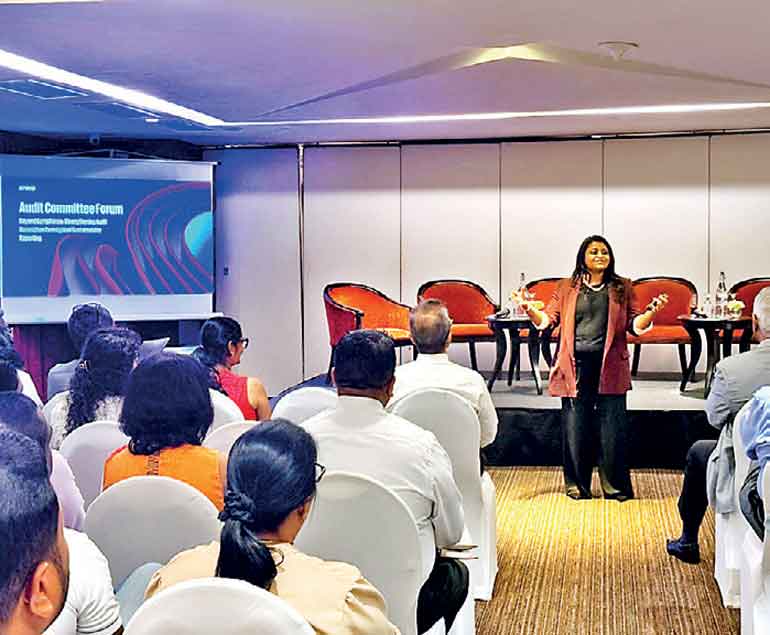
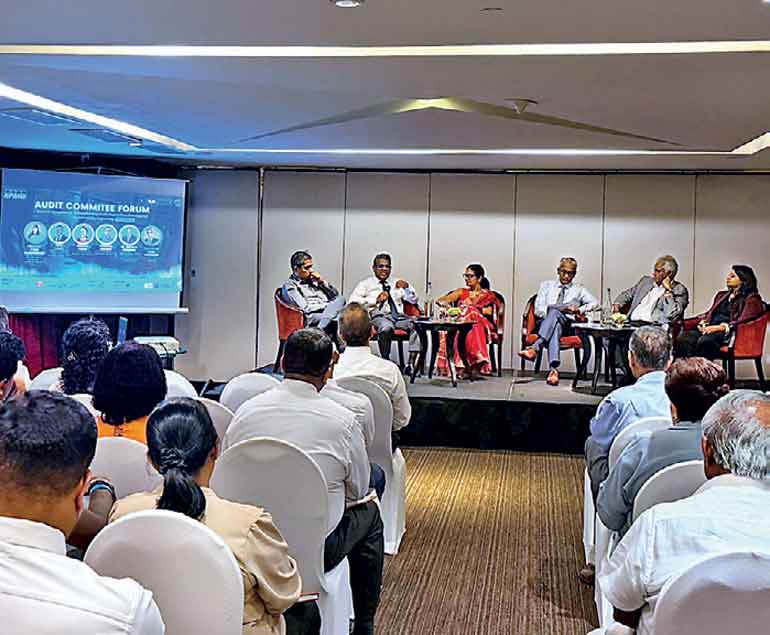
To raise awareness and help audit committee members KPMG structured this program with a presentation by KPMG Partner ESG services Pyumi Sumanasekera followed by a panel discussion addressing the following 4 pillars with practical insights from the respective panellists from established companies in the country.
1. Integrating Sustainability into Governance – Strengthening the Audit Committee’s role in embedding sustainability into strategy, risk oversight, and decision making - Aitken Spence PLC Executive Director and Head of Plantations and Sustainability Rohan Fernando.
2. Building Robust Systems and Accountability – Focusing on the data governance, controls, and ownership for credible, audit ready ESG information - MAS Holdings Head of Sustainable Business Amanthi Perera.
3. Driving Clarity and Implementation – Practical insights on prioritising actions to support long term value creation – Lion Brewery PLC Chief Sustainability Officer Eshantha Salgado.
4. Understanding sustainable financing strategies - how financial services organisations are looking at businesses and supporting/catalysing the transition – DFCC PLC Senior Vice President- Head of Treasury and Investment Banking Prins Perera.
The panel discussion was moderated by SLID Audit Committee Forum Chairman and KPMG Sri Lanka and Maldives Chief Operating Officer Chairman Suren Rajakarier.
Pyumi commenced with her presentation, using the analogy of preparing a delicious dish with the appropriate ingredients by a chef. She said, Organisations that embark on the journey of SLFRS S1 S2 need to keep in mind that this standard has come into effect for a reason. While the Boards are the head chefs of the dish you serve your investors and stakeholders. Financial impacts of climate and sustainability related risks and opportunities are real and it’s impacting our financial results. Being the quality of our main dish. Managing these risks and having strategies are merely not a disclosure but real risk management strategies that need to be embedded into the organisation to have tangible results. Merely scrambling to put efforts in place at the end of a year, may not harness the desired result! Like any other strategy, having the right system processes and controls makes sure rude awakenings are avoided. Whilst having the right 'salt' - culture, awareness and performance metrics are what enhance the flavors resulting in a mouthwatering dish! The dish being a sustainable business that sees financial results plus longevity.
On the matter of Integrating Sustainability into Governance Rohan Fernando made the point that for a diversified conglomerate such as Atken Spence, effective ESG oversight is not optional—it is central to investor confidence, access to capital, customer trust, and long term value creation across sectors. He elaborated how the role of the board and audit committee is challenged to provide leadership to fulfil the changing landscape with the future focused disclosures. He followed by clarifying the importance of a strong corporate governance structure to achieve this goal and said the sustainability initiatives are led by board members. The discussion also led to how Sustainability Related Risks and Opportunities are considered in investment and divestment decisions, with practical examples of divestment and investment decisions in thermal power and waste to energy projects within the Group. Even way back in the early 90s ASP invested in Kandalama Hotels which used sustainable building methods and design.
Rohan also noted that ASP is the only conglomerate in Sri Lanka that has had its near-term emissions targets validated by SBTi. He appreciated the importance of the role of the Board in this process of aligning corporate strategy with climate science.
In relation to Building Robust Systems and Accountability focusing on data governance, controls, and ownership for credible, audit ready ESG information, Amanthi highlighted that for an organisation of MAS Holdings’ scale and complexity, credible ESG reporting cannot rely on narrative or intent alone—it must be underpinned by enterprise wide data governance, disciplined controls, and clear accountability.
She elaborated that ESG data only becomes credible when controls are designed up front—not added later to satisfy assurance. In practice, this means standardising definitions across sites, embedding automated validation checks at the point of data capture, and supporting clear audit trails from factory level source data through to group level reporting.
At MAS there’s clear line of sight from factory level and operational data through to group level disclosures, particularly as EU regulations demand greater transparency, consistency, and auditability. Compliance is considered at architecture level and not because of reporting. The systems used to measure and escalate ESG indicators are automated with minimal manual intervention. The findings and performance measures are linked to individual KPIs to ensure responsibility and accountability. Finally, third party audits are conducted to further fortify data and support assurance against global standards. Also move from periodic validation to continuous controls monitoring to make assurance seamless and more predictable.
The discussion focussing on Driving Clarity and Implementation, Eshantha provided specific practical insights on actions taken by his company at a very significant cost that ensured a sustainable business despite disasters and unexpected events.
Beyond setting targets, the company has undertaken scenario analysis and forward looking assessments to understand how climate, resource constraints, and regulatory shifts could affect its operations and value chain. He explained how such insights from this analysis are translated into concrete priorities, investments, and day to day decisions.
He highlighted how boards can close the gap between what they intend to do and the real action with real life examples about investments in cost effective wastewater treatment, use of technology, furnace fuel reduction and flood protection to significant assets.
The Form also discussed sustainable financing strategies looking at businesses and supporting/ catalysing the transition. Prins Perera commented based DFCC’s pioneering green. blue bond and GSS+ bond issuance in Sri Lanka, about practical lessons that emerged around market appetite, pricing, credibility, and investor expectations for such sustainable financing options. He also raised concerns around SMEs difficulties to transition to a compliant state demanded by the investors in EU and other advanced economies providing preferential sustainable capital through these bond issues.
In practical terms, he alluded to using a checklist for governance checks, eligibility criteria, and performance metrics to help ensure that financing supports genuine progress, rather than transition washing.
Conclusion
In summary, the takeaways were summarised by the moderator Suren Rajakarier as:
nSustainability expectations intensify across global markets, ESG is increasingly scrutinised with the same rigour as financial performance.
nCompliance process for SLFRS S1andS2 needs to start incredibly early at the strategy setting stage and not as a financial reporting item at the end of a reporting period. Also, audit-ready ESG data starts with architecture, not reporting.
nSustainability commitments increasingly translate into measurable targets and external scrutiny, and the question is no longer whether ESG data matters, but whether the organisation can stand behind it with confidence.
nThe importance of translating scenario insights into a small number of clear milestones and KPIs that management and the board could realistically track and act on
nAudit committees have a crucial oversight role to play in ensuring that ESG and implementation of S1 and S2 standards are addressed not merely as financial reporting issues, but as strategic boardroom priorities central to safeguarding organisational reputation, trust, and long-term value.
The 32nd Audit Committee Forum underscored the growing importance of ESG in corporate governance. The practical examples shared at the session, combined with the diverse expertise of the panel, provided participants with actionable insights to take back to their respective boards and organisations. This Forum was organised by Sri Lanka Institute of Directors with KPMG Sri Lanka as the Knowledge Partner, with the ultimate purpose of sharing best practices, and to elevate the standard of corporate governance in the Sri Lankan business community.