Thursday Jul 16, 2026
Thursday Jul 16, 2026
Thursday, 22 January 2026 03:54 - - {{hitsCtrl.values.hits}}
 Ensuring that digitalisation delivered genuine economic value, rather than superficial efficiency gains, would be critical. When institutions were resilient, innovative and strategically aligned, Dr. Amarasekara argued, they were better positioned to support national progress and sustainable growth
The inaugural National Banking and Finance Conference, held to mark the 60th anniversary of the Institute of Bankers of Sri Lanka (IBSL), opened with a clear message to the financial sector: growth, resilience and competitiveness will increasingly depend on how effectively banks internalise digital transformation while maintaining financial discipline in a constrained macroeconomic environment.
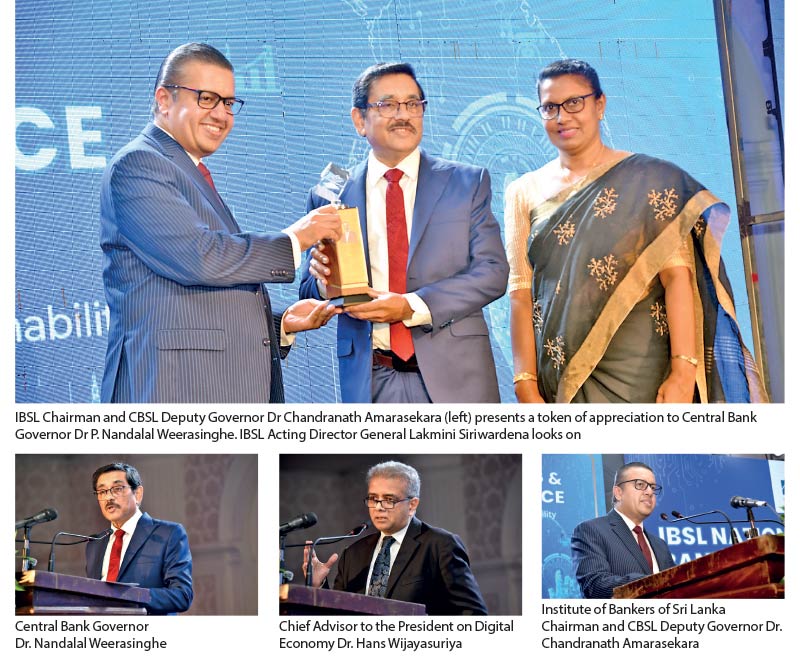
Opening proceedings, Institute of Bankers of Sri Lanka Chairman and Central Bank Deputy Governor Dr. Chandranath Amarasekara described the event as more than a commemorative milestone, positioning it instead as a reset for the sector’s strategic thinking.
“Today is more than the start of a conference. It signals a new chapter in the intellectual, professional and strategic evolution of Sri Lanka’s financial ecosystem.”
The conference, centred on digital transformation and financial sustainability, was framed as a deliberate effort to align industry thinking with the realities of a post-crisis economy. Expectations of banks and financial institutions had risen sharply as Sri Lanka emerged from one of the most difficult periods in its economic history, Dr. Amarasekara observed.
“In this shock-prone world, we are called upon not just to support recovery but to shape it, to drive innovation, accelerate digital transformation, strengthen confidence, and ensure that the path ahead is both sustainable and inclusive.”
Digital transformation is more than technology. It demands a shift in culture, mindset and competence. Leadership would be decisive. Investment in digital skills, Dr. Weerasinghe explained, had to extend beyond IT teams to the entire organisation. Sustainability, meanwhile, had moved decisively into the financial mainstream
At the same time, Dr. Amarasekara cautioned against allowing technological momentum to erode prudence. Financial sustainability, he stressed, continued to rest on disciplined balance-sheet management, robust risk frameworks and prudent lending practices, even as institutions adapted to rapid technological change.
“In such a fast-moving ecosystem, relying on experience alone or even sound intuition is no longer enough. We must sharpen our strategy and strengthen foresight.”
IBSL, Dr. Amarasekara noted, was responding by deepening its focus on capacity-building, research and professional standards. Research, in this context, was no longer an academic exercise but an operational necessity, strengthening the ability of institutions to anticipate risks, adopt data-driven strategies and project the transparency that underpins investor confidence.
Ensuring that digitalisation delivered genuine economic value, rather than superficial efficiency gains, would be critical. When institutions were resilient, innovative and strategically aligned, Dr. Amarasekara argued, they were better positioned to support national progress and sustainable growth.
Delivering the Chief Guest address, Central Bank Governor Dr. Nandalal Weerasinghe traced the pace of change in financial services over the past decade and its implications for banking strategy.
“Even a decade ago, customers had to travel miles, stand in lines and submit loads of paperwork just to open an account or obtain a loan. The idea of mobile banking, real-time analytics or AI-assisted financial services would have sounded like science fiction.”
The shift since then, Dr. Weerasinghe noted, had been structural rather than cosmetic. Customer expectations had reset permanently.
“People now expect banking to be instant, personalised, secure and available anywhere, anytime. This requires us to think differently about products, processes and the very business model of financial institutions.”
Digital transformation, Dr. Weerasinghe stressed, could not be reduced to technology deployment alone.
“Digital transformation is more than technology. It demands a shift in culture, mindset and competence. Leadership would be decisive.”
Investment in digital skills, he added, had to extend beyond IT teams to the entire organisation. Sustainability, meanwhile, had moved decisively into the financial mainstream.
“Climate risks are financial risks that we have already experienced,” Dr. Weerasinghe noted, pointing out that environmental factors were now influencing asset values, equity performance and long-term stability.
Environmental, social and governance considerations therefore needed to be integrated into core decision-making, alongside support for investments in renewable energy, climate-resilient infrastructure and inclusive development.
For Dr. Weerasinghe, digital capability and sustainability were deeply intertwined. Digital tools enabled more accurate climate-risk modelling, improved transparency in green financing and wider financial inclusion through mobile platforms and digital identities.
The super ROI is there to be captured, Dr. Wijayasuriya explained, but it requires digital transformation pursued with discipline, foresight and a strong focus on resilience and trust
“Digital transformation cannot be treated as another IT project. It is a financial strategy and a critical driver of long-term financial sustainability in a connected global economy.”
Complacency, he warned, carried the risk of institutional obsolescence. At the same time, digitalisation brought new vulnerabilities.
“Digital transformation necessitates investment in a robust cyber-defence posture, which protects banks’ most valuable assets, namely their data and reputation.”
Financial sustainability, Dr. Weerasinghe added, could no longer be assessed purely through balance-sheet metrics, as ESG performance and digital capability increasingly shaped long-term institutional value.
In the keynote address, Chief Advisor to the President on Digital Economy Dr. Hans Wijayasuriya placed digital transformation within the broader challenge of achieving growth under fiscal constraint.
“As we emerge from an economic crisis, we aspire to achieve growth while remaining committed to financial sustainability and resilience.”
The central question, Dr. Wijayasuriya argued, was whether growth could be achieved without exhausting scarce capital.
“The question is whether we can achieve a super return on investment. Can we achieve leapfrog growth while not spending our last rupee.”
Digital transformation, Dr. Wijayasuriya contended, offered that possibility, though it demanded difficult organisational and behavioural change. International experience, including India’s, demonstrated that aggressive digital adoption could lift growth beyond expected baselines without equivalent increases in capital investment.
As digital tools penetrated deeper into economic processes, productivity gains and scale effects created growth “bounces” that would otherwise require far greater investment.
He explained that the Government’s digital economy blueprint was built around horizontal digital public infrastructure, including digital identity, national data exchange and advanced payment platforms, opened through APIs to enable innovation by banks, fintechs and developers.
“A dollar invested in a digital platform can generate five, ten or even twenty times value through inclusion, network effects and innovation.”
Technology adoption, however, had become increasingly binary, particularly with artificial intelligence.
“If you adopt and use it better than others, you progress. If not, your competitiveness depletes very rapidly.”
Dr. Wijayasuriya also warned that the same technologies were being exploited by the scam economy, making regulatory technology, fraud prevention, privacy protection and trust as important as innovation itself.
“The super ROI is there to be captured, but it requires digital transformation pursued with discipline, foresight and a strong focus on resilience and trust.”
The conference framed digital transformation not as a discretionary upgrade cycle, but as a structural determinant of profitability, resilience and national competitiveness, as Sri Lanka’s banking and financial sector navigates a narrow path between recovery, growth and long-term sustainability.
- Pix by Shehan Gunasekara