Friday Oct 16, 2026
Friday Oct 16, 2026
Monday, 17 August 2026 04:27 - - {{hitsCtrl.values.hits}}
By Wealth Trust Securities
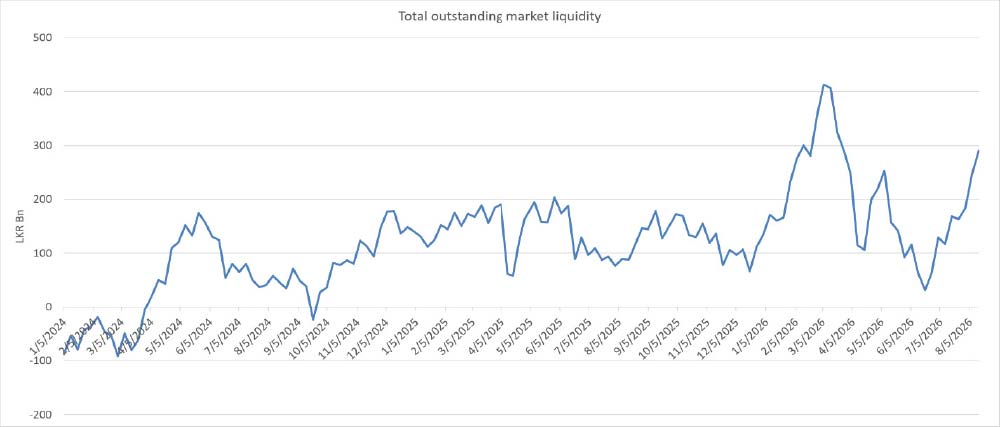
 Money market liquidity strengthened considerably last week, with the outstanding system liquidity surplus rising to Rs. 290.69 billion from Rs. 246.81 billion a week earlier, reaching its highest level since March. The sizeable build-up in excess liquidity continued to exert downward pressure on short-term money market rates. Accordingly, the weighted average Call Money and Repo rates declined to 8.80% and 8.84%, respectively, from 8.93% and 8.97% in the preceding week.
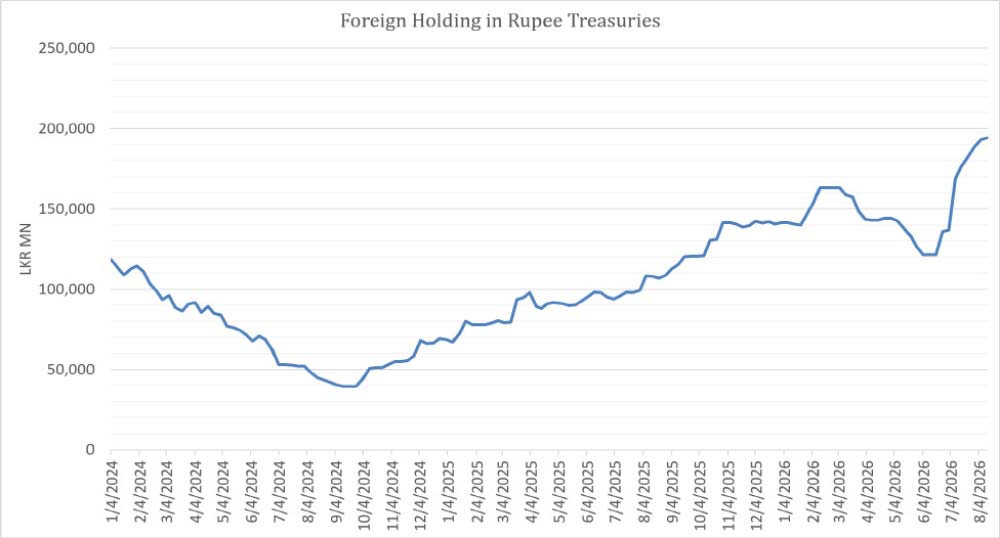
Meanwhile, foreign investor appetite for rupee-denominated Government securities remained robust, with the market recording a net inflow of Rs. 1.35 billion during the week ended 13 August. This marked the tenth consecutive week of net foreign inflows, lifting total foreign holdings of rupee Treasuries to Rs. 194.21 billion, their highest level since June 2023.
Against this backdrop, the secondary Bond market rallied strongly last week, with sustained and aggressive buying interest driving yields to fresh lows. Trading activity and transaction volumes remained robust.
Elevated system liquidity and declining money market rates remained key drivers, as surplus liquidity encouraged investors to deploy funds into longer-dated government securities. In addition, the limited supply of Treasury Bonds during August further strengthened the favourable demand-supply dynamic, with the limited supply of new issuances in the near-term encouraging market participants to compete for available paper in the secondary market.
The appreciation of the Sri Lankan rupee also supported sentiment by easing concerns over currency-related risks for investors in rupee-denominated assets. Moreover, the broader decline in Treasury Bill yields, both in the secondary market and at auction, reinforced expectations of lower interest rates across the yield curve.
During the week, Sri Lanka’s Central Bank Governor commented on the policy outlook in a Reuters interview. He indicated that, under current conditions, the Central Bank did not see a need for further policy rate hikes this year, while noting that the bank would remain vigilant. These comments boosted expectations of a supportive interest-rate environment (Reuters, 11 August 2026).
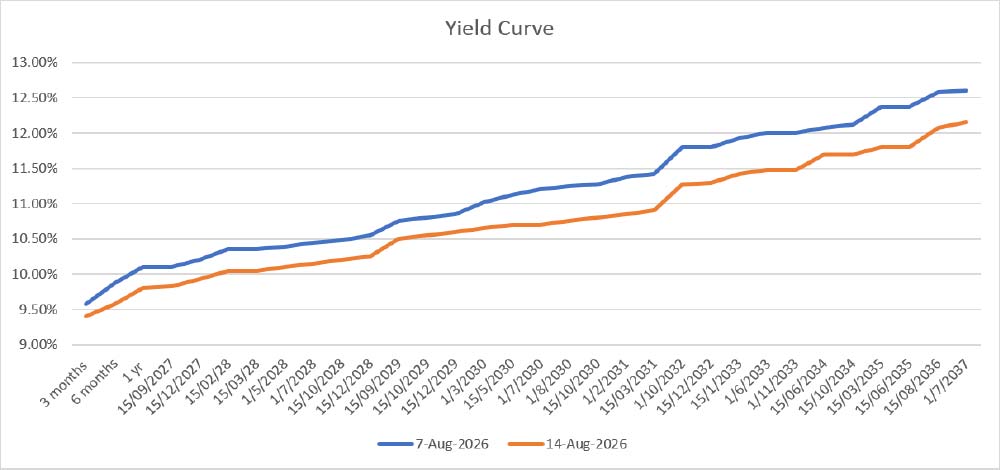
Consequently, secondary market bond yields closed notably lower on a week-on-week basis.
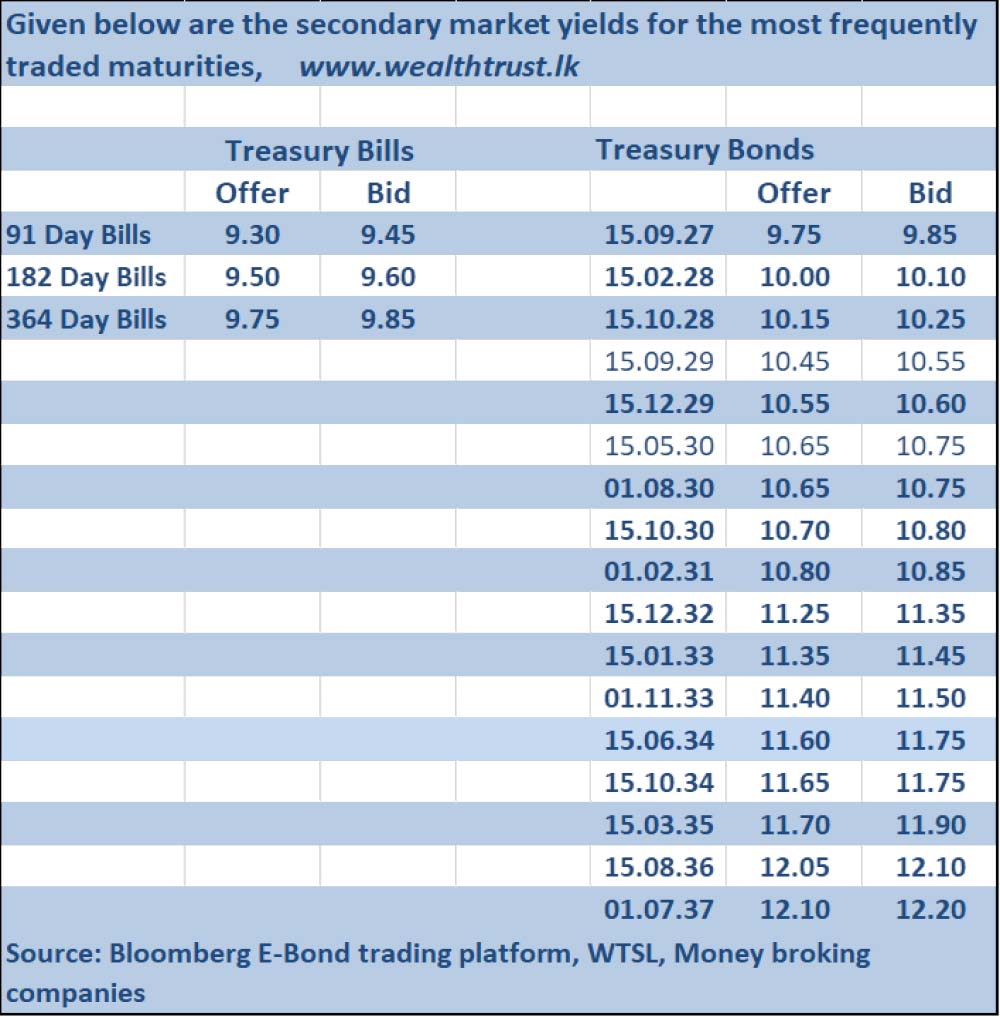
In terms of the secondary bond market trade summary the 15.09.27 traded at the yield of 10.00%. The 15.02.28 and 15.03.28 traded down the intraweek ranges of 10.20%-10.10%, while the 15.10.28 declined from an intraweek high of 10.30% to a low of 10.20%. The 15.12.28 traded at 10.51%. The 15.12.29 traded down from an intraweek high of 10.90% to a low of 10.60%.
The 2030 tenors rallied strongly during the week, with the 01.03.30 falling from an intraweek high of 11.00% to a low of 10.75%. The 01.08.30 and 15.10.30 saw steep declines, trading down the intraweek ranges of 11.20%-10.70% and 11.25%-10.80% respectively.
The 01.02.31 also rallied strongly, trading down from an intraweek high of 11.40% to a low of 10.85%. The 01.10.32 traded down the range of 11.60%-11.30%, while the 15.12.32 traded down from an intraweek high of 11.40% to a low of 11.30%.
The 15.01.33 traded down from an intraweek high of 11.95% to a low of 11.44%, while the 01.11.33 traded down the range of 11.80%-11.60%. The 15.10.34 saw a notable decline, falling from an intraweek high of 12.10% to a low of 11.67%.
On the longer end, the 15.08.36 and 01.07.37 rallied strongly, trading down the intraweek ranges of 12.55%-12.10% and 12.60%-12.15% respectively.
The weekly Treasury Bill auction held last Wednesday, saw a significant downward shift, with weighted average yields falling for a fifth straight week —last week’s decline being the steepest yet, as rates dropped across all three tenors.
The 91-day Bill led the retreat, shedding 33 basis points to settle at 9.44%. The 182-day paper followed suit, easing 21 basis points to 9.78% and the 364-day tenor with an 18-basis-point drop to 10.01%.
Demand remained robust as the Public Debt Department fully raised the entire Rs. 140 billion on offer, with each tenor meeting its target allotment. Investor appetite was robust: total bids came in at 2.76 times the amount offered, underscoring ample market liquidity chasing short-term government paper.
Demand extended into the second phase with the full Rs. 14 billion offered being taken up against a total market subscription of a staggering Rs. 142.45 billion. Accordingly, the aggregate accepted amount stood at Rs. 154 billion.
Forex market
In the forex market, the USD/LKR rate on spot contracts closed the week with the rupee appreciating to Rs. 332.80/332.90 as against its previous week’s closing of Rs. 335.37/335.42. Intraweek the rupee strengthened to a high of Rs. 332.90 and a low of Rs. 335.30.
The average daily USD/LKR traded volume over the first four trading days of the week stood at $ 121.78 million.
(References: Public Debt Management Office - Ministry of Finance, Central Bank of Sri Lanka, Bloomberg E-Bond Trading Platform, Money Broking Companies)




