Monday Sep 07, 2026
Monday Sep 07, 2026
Monday, 7 September 2026 04:41 - - {{hitsCtrl.values.hits}}
By Wealth Trust Securities
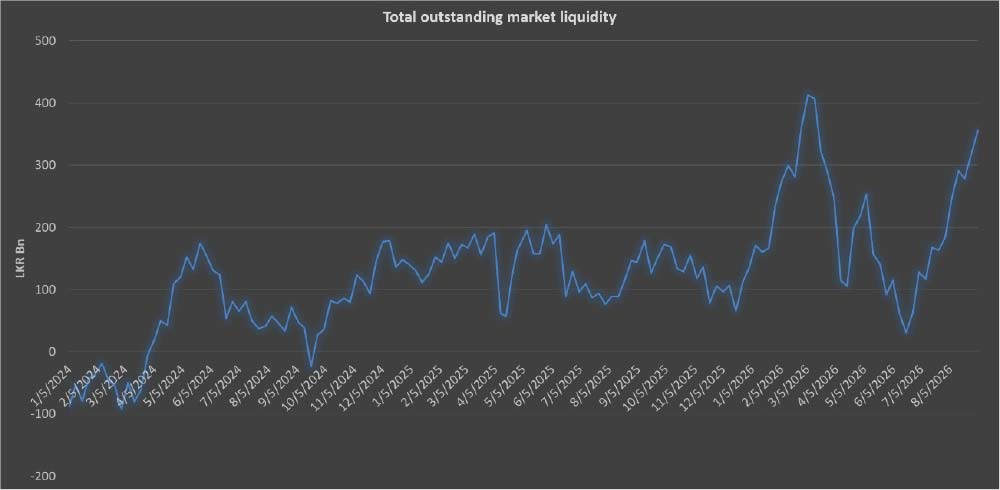
 The money market liquidity witnessed another week-on-week sharp increase, exceeding Rs. 350 billion, its highest level in 24 weeks or since March this year.
The jump in liquidity to Rs. 355.30 billion was against its previous week’s total outstanding figure of Rs. 318.15 billion.
The weighted average Call Money and Repo rates stood at 8.86% and 8.92%, respectively.
The secondary Bond market experienced a week of volatility, with yields see-sawing as early buying momentum gave way to selling pressure. The market initially carried forward the positive sentiment from the preceding week, with buying interest driving yields lower across selected tenors amid robust activity and sizeable block transactions.
However, the trend reversed as profit-taking temptation emerged following the recent extended bond market rally. Sentiment was further weighed down by renewed geopolitical tensions in the Middle East, which pushed global oil prices higher, alongside a broader rise in global government bond yields.
While the bullish outcome at the Treasury Bill auction and renewed buying interest at elevated levels periodically triggered recoveries, these proved insufficient to fully reverse the upward pressure on yields, week on week. Selling interest was particularly evident across the 2030 to 2034 segment of the yield curve towards the latter part of the week.
Ultimately, yields closed higher, as profit-taking and external headwinds outweighed the buying interest that had supported the market earlier in the week. Overall activity and transaction volumes were seen at healthy levels.
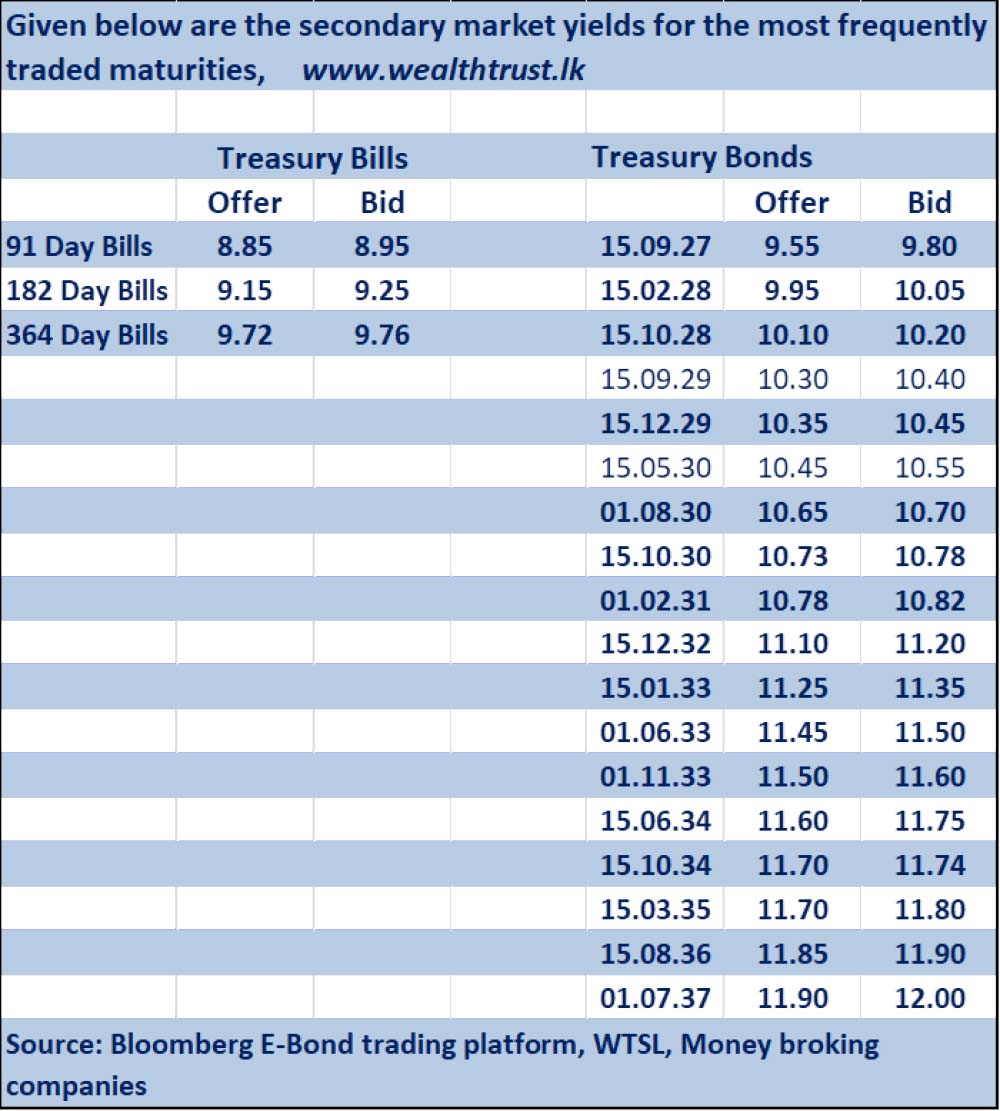
The 15.02.28 and 15.03.28 traded at the rates of 10.00% each, while the 01.05.28 traded within an intraweek range of 10.05% to 10.07%. The 15.12.28 traded at 10.10% to 10.14%, while the 15.12.29 saw its yield edge up from an intraweek low of 10.30% to a high of 10.35%.
The 2030 tenors saw a notable reversal during the week. The 01.08.30 and 15.10.30 maturities rose from intraweek lows of 10.40% and 10.45% respectively to highs of 10.75% each. The 01.02.31 similarly traded up from an intraweek low of 10.60% to a high of 10.85%.
Further along the curve, the 15.12.32 traded up from an intraweek low of 10.95% to a high of 11.10%. In the 2033 duration bucket, the 15.01.33 rose from an intraweek low of 11.10% to a high of 11.30%, while the 01.06.33 and 01.11.33 traded up from intraweek lows of 11.30% each to highs of 11.55% and 11.58% respectively. The 15.10.34 traded up from an intraweek low of 11.45% to a high of 11.75%.
On the longer end, the 15.08.36 traded up from an intraweek low of 11.75% to a high of 11.87%, while the 01.07.37 rose from a low of 11.82% to an intraweek high of 11.95%.
To recap, at last Wednesday’s weekly Treasury Bill auction, weighted average yields extended their decline for an eighth consecutive week, as robust demand continued to drive yields lower across all three tenors.
The sharpest decline was recorded on the 182-day bill, which fell 17 basis points to 9.27%, while the 91-day yield declined by 10 basis points to 8.96%. Meanwhile, the 364-day yield eased by 8 basis points to 9.81%.
The Public Debt Management Office (PDMO) successfully raised the full Rs. 80 billion offered, with each tenor meeting its respective targeted allocation. Demand remained strong, with total bids received amounting to 2.54 times the offer.
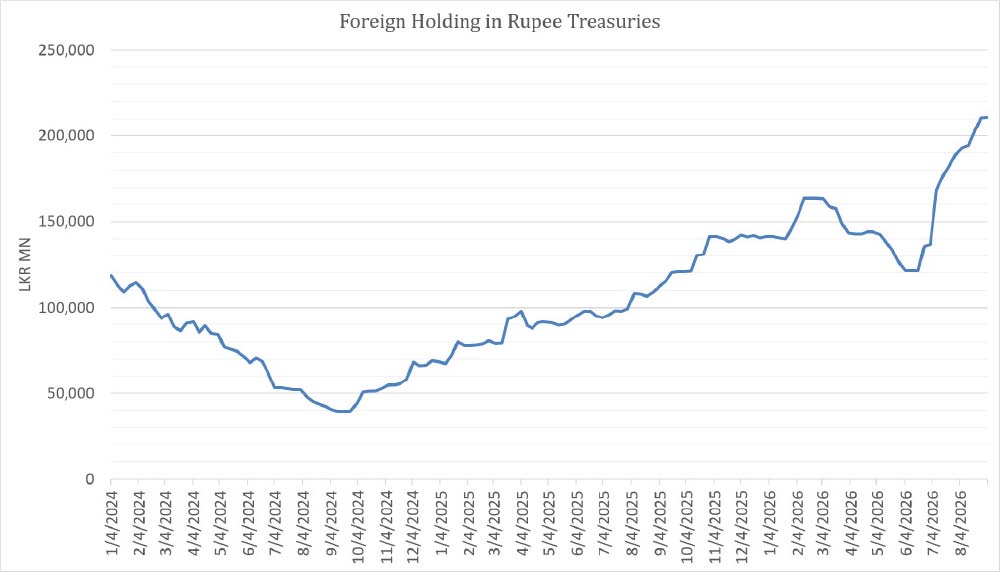
Meanwhile, the foreign holdings of rupee-denominated government securities edged up by Rs 90 million during the week ended 3 September, its lowest increase in 10 weeks. The total foreign holdings of rupee treasuries stands at Rs. 210.65 billion.
Furthermore, the Rupee or the USD/LKR rate was seen depreciating marginally, to close the week ending 4 September at Rs 328.22/328.30 as against its previous week’s closing of Rs. 327.98/328.04. Intraweek the Rupee strengthened to a high of Rs. 327.75 from a low of Rs. 328.40.
The average daily USD/LKR traded volume over the first four trading days of the week stood at $ 57.81 million.
(References: Public Debt Management Office - Ministry of Finance, Central Bank of Sri Lanka, Bloomberg E-Bond Trading Platform, Money Broking Companies)



