Tuesday Jul 28, 2026
Tuesday Jul 28, 2026
Tuesday, 27 January 2026 02:49 - - {{hitsCtrl.values.hits}}
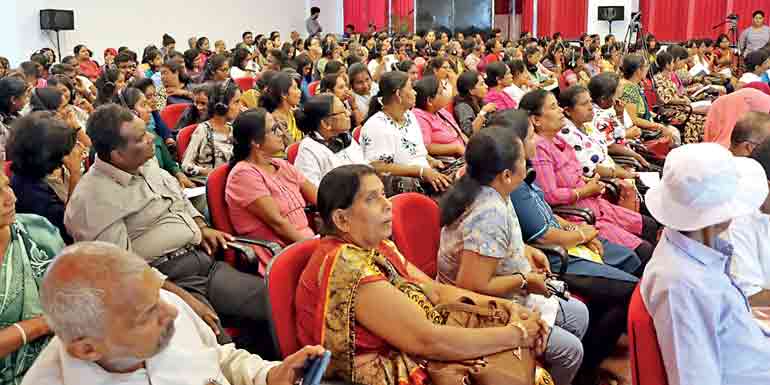
The National Collective of Community Savings and Credit Services Providers organised the conference “Microfinance and Credit Regulatory Authority Bill: Neither Here, Nor There” on 21 January at the Olympus Auditorium, Bandaranaike Centre for International Studies (BCIS), BMICH.
It was to foreground the community savings and credit services as an alternative credit practice to moneylending and microfinance.
While underscoring the uniqueness of community credit practices, grounded in collective rights, solidarity, mutual aid, the non-hierarchical nature of organising and long years of practice, community credit providers opposed the Asian Development Bank (ADB)-Treasury-CBSL attempt to subsume the community credit model under moneylending and microfinance in the proposed Microfinance and Credit Regulatory Authority Bill. Over 200 community credit practitioners from more than 50 community organisations from Mannar, Kilinochchi, Jaffna, Mullaitivu, Batticaloa, Anuradhapura, Polonnaruwa, Badulla, Rathnapura, and Hambanthota had gathered at the conference.
M. K. Jayathissa, a farmer leader from Hingurakgoda, Polonnaruwa, explained the microfinance crisis as resulting from the microfinancialisation of rural credit and the targeting of low-income women. He recalled his role in the farmers’ struggle against debt during the 1990s. Jayathissa linked the microfinance crisis among women and the farmers’ debt crisis to a wider crisis in food production.
Ekabaddha Praja Sanwardhana Kantha Maha Sangamaya Chairperson Weligepola Renuka Bhadrakanthi, shared her three decades of experience as a community practitioner. She showed how the community credit framework helped women build assets and wealth through small savings. Unlike market-based initiatives such as microfinance and moneylending, community-controlled credit systems empowered women both with agency and material capabilities. Renuka also noted the regional diversity in organisational frameworks and credit purposes. She stressed the need for vigilance and action now, as globalisation and neoliberalism drive economic reforms aimed at capturing community wealth and making people dependent on the market.
Rajeswary Sritharan from Yuhashakthi, Mullaitivu, brought in experiences from war-torn societies. Yuhashakthi and Mahashakthi networks, operating in the Northern and Eastern provinces and comprising more than 10,000 women members, were created during the civil war to support women’s ability to control the household economy. These two networks have proven resilience against war-related dispossession and loss while also strengthening women. Rajeswary contended that self-help community credit groups are informal and unregulated, revealing that societies are governed by a collective ethos, community audits, and democratic decision-making, ensuring transparency and accountability. She pointed out that community groups do not have a history of bringing their members before the police or courts when they fail to service their debts, unlike microfinance companies. She also raised the significance of community groups such as Yuhashakthi and Mahashakthi as first responders in times of crisis, even as recently as with Ditwah, intervening and assisting affected communities much before the government could.

Suneth Aruna Kumara, representing Vimukthi Gami Gowi Kantha Samithiya, Hingurakgoda, Polonnaruwa and also speaking on behalf of the microfinance-affected women, highlighted the creative space that collective forms of association have opened up for microfinance victims. “People who were hiding, afraid of debt collectors, are trying to rebuild their lives autonomously,” he said. In this journey, women are rethinking the meaning of credit, whether it is possible to create credit mechanisms that do not rely on interest income, and imaginative ways of decommodifying community relations. Suneth emphasised that women’s initiatives are emerging from their lived experiences as debtors, exploited by predatory interest rates and violent recovery practices. As a victim himself, Suneth criticised the proposed regulatory Bill for failing to adequately safeguard microfinance and credit consumers by providing legally binding safeguards. According to Suneth, the proposed Bill does not guarantee that the microfinance crisis will not recur.
Another highlight of the conference was the sharing of experiences by Malaihaya women, presented by Letchumanan Kamaleswary from the Centre for Equality and Justice. Kamaleswary described debt as ever-present in the Malaiyaha community. It forced migration from South India and kept people captive as plantation labour for over 200 years. Although the plantation management restricts all community associations within the plantations, microfinance companies can enter and operate freely. Debt is so severe that most Malaiyaha women work past their retirement age.
Pubudu Manohara, from the Rural Development Foundation in Hambanthota, traced the history of community credit projects to various state poverty alleviation programs since 1977. These projects, affiliated with governments and supported by international groups such as the World Bank and UNDP, have survived many national and local crises. Over time, however, both the Government and international organisations like the ADB have become wary of people’s ability to save. “They are afraid of our ability to create community funds,” he said.
The discussion emphasised that mobilising community groups and local political leaders is essential to oppose the Bill in its current form. Concerns arose about the negative impact of heavy regulations on community organisations and women’s resilience. “Domestic violence is rooted in economic violence. The destruction of community organisations will have a direct effect on local development and local economic activities. That will also burden the Government,” said a Yuhashakthi representative from Mullathivu.
Community organisers urged the Government to consult directly with them when developing regulations, emphasising that new rules should protect and strengthen community-based initiatives rather than respond to external pressures. They argued that the ADB, having promoted commercialisation of microfinance and contributed to the resulting crisis, lacks the legal and ethical standing to advocate for regulatory frameworks. Instead of receiving directives from the International Financial Institutions (IFIs), the Government should converse with the grassroots communities, devising homegrown developmental solutions to regenerate local economies, empower the most vulnerable and build community wealth, the community organisers stressed.




