Friday Oct 16, 2026
Friday Oct 16, 2026
Monday, 19 January 2026 04:50 - - {{hitsCtrl.values.hits}}

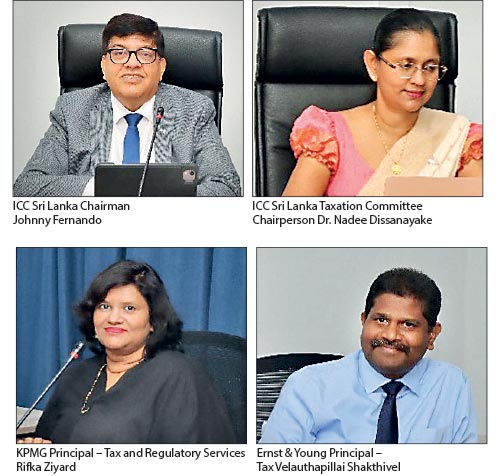 The Taxation Committee of the International Chamber of Commerce Sri Lanka (ICCSL) recently conducted a timely in-house seminar on the New VAT Tax Invoice Format and Its Implementation Requirements, bringing together policymakers, tax professionals, and members of the business community to examine readiness for the changes scheduled to take effect from 1 April 2026.
The seminar was convened with a clear objective: to assess the preparedness of businesses for the new VAT invoice regime, identify practical gaps and ambiguities, and develop constructive proposals for the Inland Revenue Department (IRD) to ensure the smooth, effective, and business-friendly implementation of the new system.
Delivering the keynote address, ICC Sri Lanka Chairman Johnny Fernando, underscored the urgency and relevance of the discussion. He emphasised that the VAT invoice reform is not a routine administrative adjustment, but a structural shift that directly impacts how businesses document transactions, claim input tax credits, and maintain compliance. He noted that clarity, predictability, and adequate transition time are essential to protect both revenue objectives and economic activity.
The seminar was moderated by ICC Sri Lanka Taxation Committee Chairperson Dr. Nadee Dissanayake, who framed the discussion around a central concern: turning policy into practice without creating unintended economic friction. She highlighted that invoice design, while technical in nature, has far-reaching consequences for business confidence, system costs, and ease of doing business in Sri Lanka.
The event featured two distinguished resource persons who brought complementary perspectives to the discussion.
KPMG Principal – Tax & Regulatory Services Rifka Ziyard, presented the policy and structural rationale behind the new VAT invoice format. Her presentation traced the evolution from the pre-2026 invoice framework to the proposed structure, explaining why change was considered necessary. She highlighted revenue assurance objectives, the need for greater traceability, alignment with digital compliance trends, and efforts to curb fictitious invoicing and abuse of input tax credits. Ms. Ziyard also explained the newly introduced mandatory fields, enhanced identification requirements, and stronger legal enforceability built into the new format.
Ernst & Young Principal – Tax Velauthapillai Shakthivel shifted the focus from design to practical implementation realities. Drawing on field experience, he outlined key challenges businesses are already encountering or anticipating, including system and software readiness, transitional confusion, sector-specific issues, and the disproportionate burden on SMEs and micro businesses. He also highlighted common risks such as invoice rejection, denial of input tax credits due to minor errors, timing mismatches, and rising compliance costs.
A major theme emerging from the discussions was the need for clarity and certainty before full-scale implementation. Participants expressed concern that several areas of the new invoice format remain unclear or open to interpretation. They cautioned that proceeding with implementation on 1 April 2026 without resolving these issues could lead to negative economic consequences, disrupt business operations, and discourage entrepreneurship and investment.
The business community strongly emphasised that invoice complexity directly affects daily business transactions, particularly in high-volume and service-oriented sectors. If unresolved ambiguities persist, businesses may face increased compliance risks, higher costs, and operational inefficiencies, ultimately affecting the broader economy.
Participants proposed that the IRD consider allowing adequate lead time for companies to adjust systems, train staff, and conduct awareness programmes. They also stressed the importance of finalising and communicating a reviewed, practical, and unambiguous invoice format before businesses incur significant costs on system development and compliance infrastructure.
The seminar further highlighted the need for a balanced transition approach, where initial implementation prioritises education and guidance over strict enforcement. Participants called for practical guidance notes, illustrative examples, and consistent interpretation by officers to distinguish genuine errors from high-risk non-compliance.
The event was attended by several senior ICC Sri Lanka office bearers, including Vice Chairman Hemakumara Gunasekara and Past Chairman Shanil Fernando, alongside members of the business and professional community.
Concluding the seminar, ICC Sri Lanka reaffirmed its commitment to acting as a bridge between the private sector and policymakers. The insights gathered during the session will be consolidated into formal proposals to the Inland Revenue Department, with the aim of strengthening the VAT invoice framework while safeguarding ease of doing business and economic stability.
The seminar marked an important step toward collaborative, informed, and practical tax reform ensuring that compliance systems support growth rather than hinder it.




