Tuesday Jun 16, 2026
Tuesday Jun 16, 2026
Wednesday, 28 January 2026 00:02 - - {{hitsCtrl.values.hits}}
 Sri Lanka’s recovery is moving into a more demanding phase, where macroeconomic stability has been largely restored but growth is expected to slow and debt dynamics are again coming into focus.
At the First Capital Investor Symposium last week, this shift was laid out in the firm’s Investment Strategy: January 2026 – Sri Lanka outlook, which projected GDP growth easing to 3–4% in 2026 and 2027, down from an estimated 4–5% in 2025, amid weaker consumer spending, limited reform momentum and the lingering economic impact of Cyclone Ditwah (please see https://www.ft.lk/top-story/2026-slow-growth-outlook-raises-debt-concerns-First-Capital/26-787291)
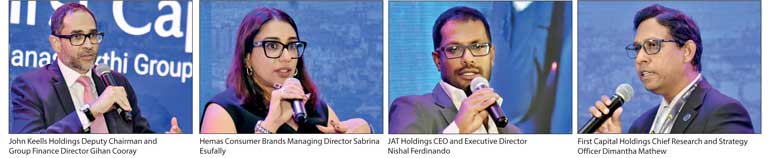
Against that backdrop, a panel discussion featuring John Keells Holdings PLC Deputy Chairman and Group Finance Director Gihan Cooray, Hemas Consumer Brands Managing Director Sabrina Esufally, JAT Holdings PLC CEO and Executive Director Nishal Ferdinando and First Capital Holdings PLC Chief Research and Strategy Officer Dimantha Mathew shifted the focus from macro diagnosis to corporate response. Rather than debating whether recovery is real, the discussion centred on how growth will be generated in an economy facing tighter financial conditions, slower domestic demand growth and limited fiscal space.
For John Keells Holdings, Hemas and JAT Holdings, the challenge is not simply to defend margins or wait for demand to return. It is to create demand through long-cycle investments, reshape consumption patterns, expand infrastructure capacity already nearing utilisation and operate directly inside larger, more competitive markets abroad. The panel’s remarks offered a view into how some of the country’s most capital-intensive and strategically exposed companies are positioning themselves for this next phase.
Consumers trade back to quality, but growth shifts to demographic-led categories
For Hemas Holdings PLC, stabilisation has translated into a measurable shift in consumer behaviour, but not into a return to scale-led growth. Managing Director of Hemas Consumer Brands Sabrina Esufally said the recovery is visible in volumes and brand choice.
“So I think at a macro level, we’re seeing the impact of stability and recovery on the consumer basket. This is translating not just into growing consumer confidence, but we see the growth of volume. And more importantly, we see consumers actually starting to choose brands, starting to select based on quality,” she said.
She described the crisis period as one in which consumers were forced into substitution.
“For a period, a year or two ago, we saw consumers trading off the brands that they’ve grown up with into cheap alternatives that were not giving them the same standard of quality. That was a scary time for a brand that’s in the consumer business,” Esufally said.
 However, she stressed that population size remains a binding constraint.
“We are confident that growth is not going to come from blindly scaling highly penetrated categories. We are limited by our population size and we are likely to be continually limited over the next few years,” she said.
Growth, she explained, will come from shifts in demographics rather than penetration.
“We see more women going to work, and that’s resulting in a whole bunch of categories coming up that require more convenient, on-the-go solutions,” she said.
Younger consumers are also reshaping channel strategy.
“Gen Zs are demanding brands that feel personal, that sell to them in channels that they frequent. And this won’t be the traditional channel,” Esufally said.
Urbanisation is altering household structure and consumption.
“Families are becoming smaller and more nuclear. This is changing consumption patterns and the shape of the basket,” she said.
On impact, Esufally rejected separating commercial activity from social outcomes.
“I’m not really a fan of framing impact as CSR, because that’s often the first thing that gets cut when a company is in trouble,” she said. “Companies have to demonstrate that they’re solving a real customer problem at a price point customers can afford.”
Creating demand ecosystems across tourism, logistics and electric mobility
For John Keells Holdings PLC, the stabilisation phase coincides with the operationalisation of two of the Group’s largest investments: City of Dreams Sri Lanka and Phase One of the West Container Terminal at the Port of Colombo.
Deputy Chairman and Group Finance Director Gihan Cooray framed tourism growth as a structural challenge rather than a cyclical rebound.
“If you look at tourism in Sri Lanka, it’s more of a transition,” he said. “It’s an expression of where we see that demand and growth coming from.”
He pointed to Colombo’s relatively low share of tourist visitation.
“We probably get maybe 25–30% of overall tourists visiting Colombo. Whereas if you look at other regional markets, that number is much higher,” Cooray said, citing Bangkok, where city visitation is more than double Colombo’s share.
City of Dreams Sri Lanka, which opened in August as South Asia’s first fully integrated resort developed with Melco Resorts & Entertainment, was intended to address that gap.
“The vision was to see how we drive more visitation into the city and also grow the pipe,” he said. “Not just getting a person who is already coming into Sri Lanka to visit the city, but also bringing in people who may not have had Sri Lanka on the map.”
Early traction has come through large-scale corporate events.
“We’ve already had two Indian corporates last year with around 1,000 delegates coming. We have another large conference coming up in May with about 4,000 people coming in over a period of about 12 days,” Cooray said.
In logistics, he cited utilisation at the Western Container Terminal.
“Phase One has about 1.6 million TEU capacity, and at the rate it’s going now, we’re pretty much at 90% utilisation, even though we started operations only in April,” he said. Phase Two will add a further 1.6 million TEUs by the end of the year.
Cooray said the opportunity extends beyond transshipment.
 “We can look at more value-added logistics, not just transshipment, which creates a stickier ecosystem,” he said.
On electric mobility, Cooray referred to the rapid growth of the EV segment, noting that, based on his remarks, BYD accounts for about 10% of that segment. He described adoption as both an infrastructure and behavioural challenge.
“One of the biggest concerns is range anxiety and the charging ecosystem,” he said. “Sri Lanka is a small place, but it’s still a mindset issue.”
JKH’s approach has been to leverage existing assets.
“We try to leverage the network that we have with our supermarket outlets, hotels and so on,” he said, referring to the Keells supermarket chain and hotel portfolio. “That helps address confidence concerns, particularly for longer drives.”He addressed concerns about grid-based charging.
“Even if you are charging through thermal power, if you look at the efficiency of EVs versus a combustion engine, it is still cheaper from a vehicle owner’s perspective and even from an emissions perspective,” Cooray said.
From rebuilding at home to expanding in developed markets
For JAT Holdings PLC, the post-Ditwah period presents both demand and execution challenges. CEO and Executive Director Nishal Ferdinando quantified the scale of rebuilding required.
“The estimated infrastructure damage is about $ 4.1 billion,” he said. “Out of this, around 80% is residential, industrial and main infrastructure, with about 20% in agriculture.”
He added that this represents roughly 0.48% of the country’s total capital stock in buildings and infrastructure.
“This surge gives an opportunity for us to build back better, not just build for the sake of building,” Ferdinando said. “Resilient designs and more durable materials are something we have to focus on.”
He also outlined timing differences in demand.
“If you take Colombo and Kandy, the damage profile is different. Paint demand in Colombo may spike in another two months, while the Central Province may see that spike closer to six months,” he said.
Inventory and labour readiness, he warned, will determine outcomes.
“If we fall short, we will have to air freight or use alternative materials, and that delays projects,” Ferdinando said, adding that labour shortages would impose a significant opportunity cost.
Beyond domestic rebuilding, Ferdinando detailed JAT’s international strategy.
“There is a difference between operating in emerging markets and developed markets,” he said, referring to Bangladesh and the Maldives compared with New Zealand and Australia. “We are not exporting from Sri Lanka. We are manufacturing and operating in those economies,” he said.
He pointed to JAT’s experience competing locally against multinational firms.
“For the last 15 years, we’ve been competing with global players that are number three, four or seven in the world, and we’ve maintained our market share,” Ferdinando said.
Capital constraints, he said, require focus.
“When someone else has 1,200 R&D specialists working on 1,000 products, we focus on maybe 20 products and do them world-class,” he said, noting that technology and AI can shorten product development cycles.
Growth, debt and risk converge
From a market perspective, First Capital Holdings PLC Chief Research and Strategy Officer Dimantha Mathew cautioned that stabilisation brings new constraints.
“If growth slows to around 3–4%, you are not generating sufficient GDP growth to push down debt-to-GDP levels,” he said.
He noted that Sri Lanka is unlikely to repeat last year’s trade surplus, reducing the buffer for reserve accumulation and debt repayment.
“At some point, risk starts getting priced into the economy, and that is reflected in interest rates,” Mathew said.
He also highlighted export concentration.
“A large part of our exports go to developed markets rather than high-growth markets,” he said, pointing to apparel and tea exposure to emerging external risks and tensions.
Growth by design
With First Capital projecting slower GDP growth, a narrowing external buffer, rising interest rates and renewed pressure on debt sustainability, the environment for growth is becoming more demanding.
Within that context, the panel discussion focused on how individual companies are responding within their own areas of operation. The discussion did not suggest a broad-based rebound. Instead, it highlighted how growth, where it emerges, is likely to be driven by specific investments, targeted demand creation and execution within clearly defined business segments.
- Pix by Upul Abayasekara




