Thursday Nov 12, 2026
Thursday Nov 12, 2026
Monday, 9 November 2026 05:01 - - {{hitsCtrl.values.hits}}

 Fintrex Finance PLC hosted its inaugural Investor Forum 2026, an exclusive gathering for the investor community, on 9 October at the Mahogany Ballroom, Cinnamon Grand Colombo, bringing together leading experts in financial markets, public policy, digital payments and cybersecurity to address a challenge confronting every investor: protecting wealth from scams, deepfakes and financial fraud.
Held under the theme ‘Trust in the Digital Age – Protecting Wealth from Scams, Deepfakes and Financial Fraud’, the forum drew an audience of high net worth depositors and individuals, corporate clients, regulatory officials and industry peers. It came as the very technologies making finance faster and more accessible are being turned against customers by increasingly sophisticated fraudsters.
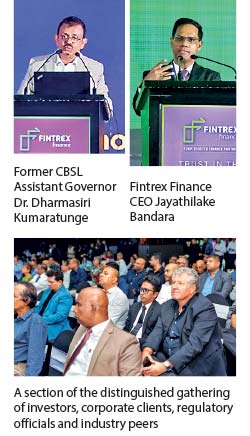
Delivering the welcome address, Fintrex Finance Chief Executive Officer Jayathilake Bandara described the forum as a pioneering initiative in Sri Lanka’s licensed finance industry, reflecting the company’s commitment to responsible innovation, financial awareness and a more accessible, technology-driven and customer-centric financial services model. Trust, he emphasised, is the foundation of financial progress; innovation makes it possible, and responsibility makes it sustainable.
The keynote address was delivered by Central Bank of Sri Lanka former Assistant Governor Dr. Dharmasiri Kumaratunge, who is also a former Director of its Payments and Settlements Department and former Secretary to the Ministry of Technology. Drawing on more than three decades spanning central banking, national payment infrastructure and digital transformation, he examined how trust can be safeguarded as financial services become increasingly digital – including the emergence of AI agents able to shop and pay on a customer’s behalf, raising new questions about who that agent is and how everyone in the chain is paid.
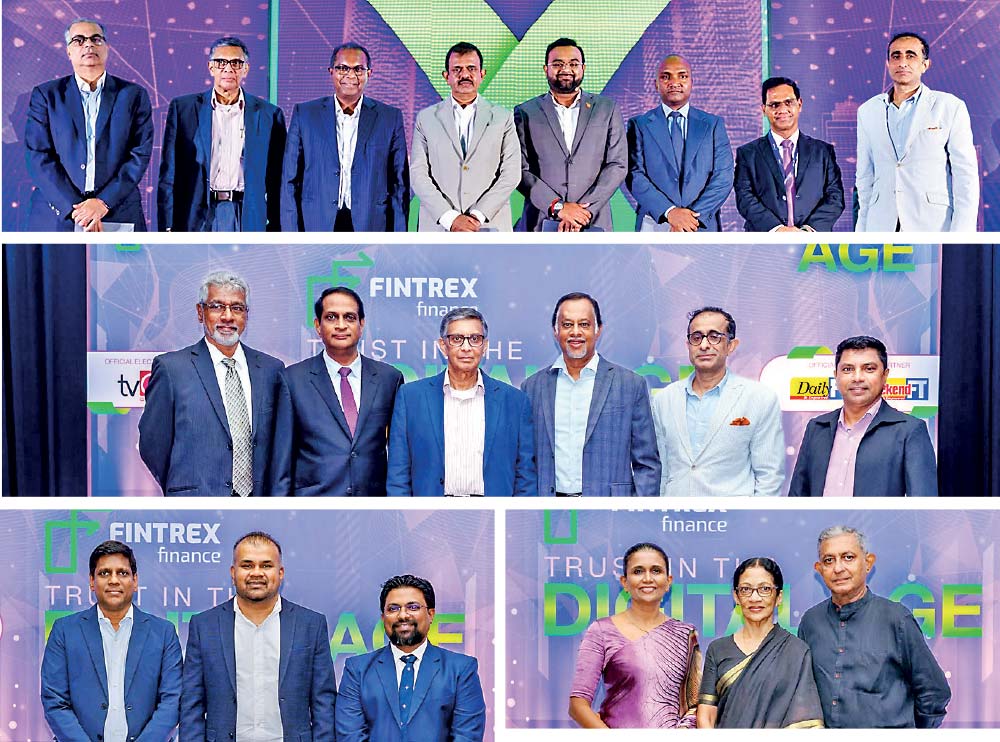
Dr. Kumaratunge also joined the panel discussion, moderated by cybersecurity, digital trust and AI governance expert Asela Waidyalankara. The panel brought together JB Securities Ltd., CEO and Advocata Institute Chair Murtaza Jafferjee, offering the investor and capital market perspective; LankaPay Ltd., CEO Channa De Silva, on digital payments and transaction security; and TechCERT CEO Eng. Kushan Sharma, on cybersecurity.
Old scams, new platforms
Opening the discussion, Waidyalankara noted that the first known financial fraud dates back to around 300 BC, when a Greek merchant attempted to manipulate a marine insurance arrangement. The intent has not changed, he observed; only the platforms have. Today, fraud arrives with ‘social proof’ – polished videos and endorsements from familiar faces – in an age when people can no longer trust their eyes and ears.
The ‘money brain’ and the psychology of fraud
Jafferjee, drawing on more than three decades in financial services, said scams exploit predictable behavioural blind spots rather than a lack of intelligence, referring to Warren Buffett’s idea of a ‘money brain’ that is quite distinct from intellectual capacity.
He pointed to the fear of missing out, misplaced trust in celebrity endorsements – which, in the age of AI, may never have been given – and confirmation bias. Schemes promising distant returns, such as timber plantations, are especially persuasive because the outcome is hard to verify. “There is absolutely nothing wrong with timber as an asset class. The problem is, are the trees there?” he said.
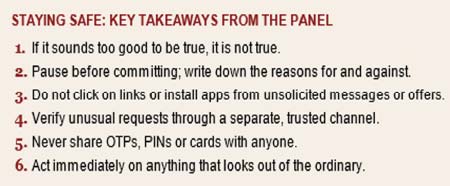
“In the age of one-minute attention and instant creation, it is one click away, and that is exactly what scamsters are exploiting,” he said. His advice: cultivate a healthy level of scepticism; avoid impulsive decisions, since “the mere passage of a weekend itself is sufficient”; and write down why you should, and why you should not, make an investment. “That will solve 80% of the problem,” he said.
If it is too good to be true, it is not true
De Silva offered a rule of thumb every investor can apply. “If somebody is promising you a 45% return, they need to make 55% on their own before they can give you 45%. Who gives a 55% return on any investment?”
In his view, the public has not lost trust in digital payments; for those already online, the danger lies in manipulation. He recounted how an engineer on his own team, lured by a Rs. 3,000 discount on a lawnmower that required downloading an app, unknowingly installed malware that monitored every action on his phone. A month later, his account was emptied minutes after his salary was credited.
“It is not my grandmother in Timbuktu who gets caught. It is a software engineer working for me in Colombo,” he said, urging people to be vigilant, think twice before acting, and not to click on links.
Seamless, not stifling, security
Cautioning against controls so heavy that customers retreat to branches or cash, De Silva said: “What we need to provide is seamless security, not stifling security where people don’t want to go digital,” he said.
He highlighted LankaPay’s mobile number verification, which works with telecom operators to confirm that the number on the device initiating a transaction matches the number registered with the bank – a measure that has brought OTP-sharing fraud down to near zero. Work is now under way with telcos to counter SIM-swap fraud.
Dr. Kumaratunge recalled that a 2019 Central Bank circular mandating mobile numbers for account opening initially met industry resistance, yet laid the foundation for today’s OTP safeguards. “We have to start somewhere,” he said.
Verify, don’t analyse
Sharma noted that deepfakes are often the opening move of a cyberattack, citing a fake video of the Central Bank Governor endorsing investments and the widely reported case in which an employee of engineering firm Arup transferred $ 25 million after a video call with deepfaked senior managers.
Investors, he said, need not become experts at detecting deepfakes, now virtually indistinguishable from reality; instead, anything anomalous should be verified through an independent, established channel. “We don’t need to be the masters of analysing deepfake videos, but we need to follow the established channels for verification,” he said.
Offering reassurance, he noted that banks and licensed finance companies operate under the Central Bank’s cybersecurity framework and are regularly assessed across people, process and technology. “I have trust in the banking and financial sector. The only thing is, whenever you see an anomaly, you need to act on it immediately,” he said.
One system, one environment
Rather than leaving customers caught between regulators, banks, law enforcement and global platforms, Dr. Kumaratunge called for close coordination, recalling earlier proposals for a common national fraud management system and a shared Security Operations Centre linking banks, finance companies, payment providers, insurers and Government entities. “It is better to have one system, one environment. Then it is easy to monitor, regulate and develop,” he said.
Awareness: The first line of defence
The panel agreed that awareness remains the most powerful safeguard, with De Silva urging basic checks. “If you get a WhatsApp message from your chairman asking you to put money into an account, ask: would the chairman ask for money? Has he done that in the last 10 years? If not, shouldn’t you check?”
Is digital still worth it?
Responding to an audience question, Jafferjee answered with an emphatic yes, citing precise, instantaneous and fully traceable payments. Cash outside the banking system, he added, is an idle resource; bringing it back improves liquidity and can help lower interest rates. “Going back to cash is not a good idea, because you are wasting a resource that can be utilised.”
On authentication, Sharma pointed to biometrics and newer standards such as FIDO, while De Silva advocated risk-based authentication matched to transaction value. “Seamless security is the name of the game,” he said.
 A technology-driven future built on trust
The forum reflects Fintrex Finance’s broader vision of shaping a more technology-driven future for financial services. Under Chairman Ajit Gunewardene and CEO Jayathilake Bandara, the company is moving beyond the branch-intensive model towards an agile, digitally enabled and customer-centric approach to financing.
As a licensed finance company regulated by the Central Bank of Sri Lanka, Fintrex Finance PLC recognises that the future of finance demands more than digital convenience; it requires strong governance and the protection of customer confidence. Through initiatives such as the Investor Forum, the company reaffirms its commitment to trust, transparency and responsible innovation, and to a more informed and financially resilient investment community.
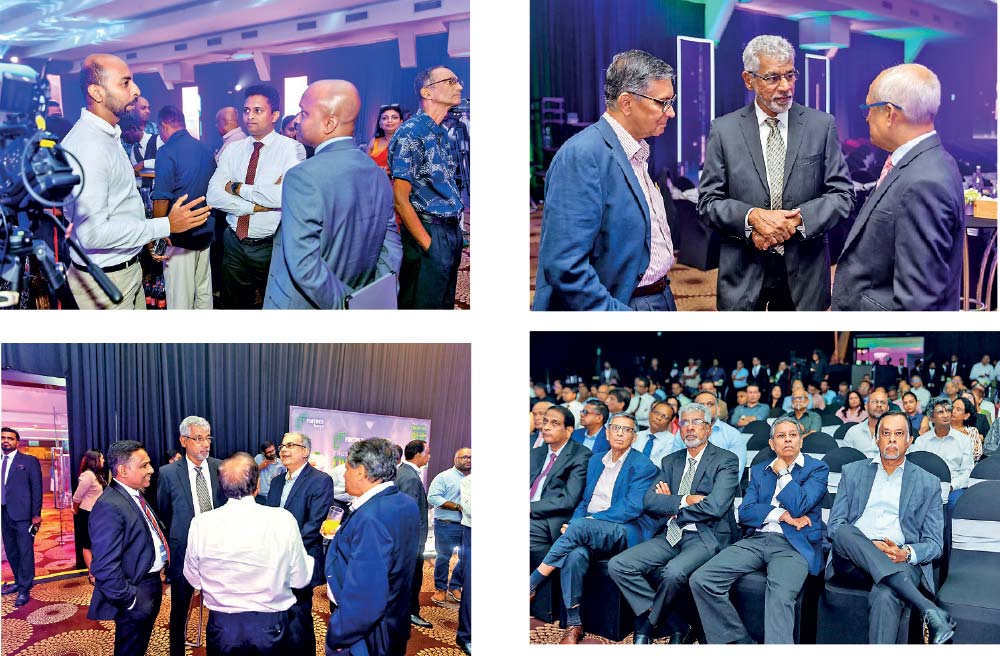
The formal proceedings were followed by a networking session, giving guests the opportunity to continue the conversation with the speakers and the Fintrex Finance leadership team.