Tuesday Aug 04, 2026
Tuesday Aug 04, 2026
Monday, 26 January 2026 04:47 - - {{hitsCtrl.values.hits}}
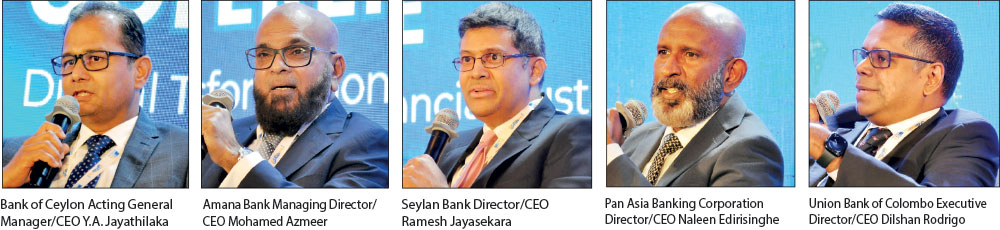
Sri Lanka’s banking sector is entering a more demanding phase of transition, as institutions built on trust, regulation and extensive physical networks confront rising digital expectations, tighter supervisory scrutiny and growing cyber risk. At the Institute of Bankers of Sri Lanka’s inaugural National Banking and Finance Conference themed “Digital Transformation and Financial Stability” last week, chief executives from a cross-section of State-owned, private, Islamic and mid-tier banks offered a grounded assessment of how they are pursuing digital transformation while preserving financial stability.
The CEO Forum, the conference highlight, followed broader discussions on technology, talent and regulation, but shifted the focus decisively towards execution. Bank of Ceylon Acting General Manager/CEO Y.A. Jayathilaka, Amana Bank Managing Director/CEO Mohamed Azmeer, Seylan Bank Director/CEO Ramesh Jayasekara, Pan Asia Banking Corporation Director/CEO Naleen Edirisinghe and Union Bank of Colombo Executive Director/CEO Dilshan Rodrigo spoke less about aspiration and more about constraints: cost, culture, governance and the limits imposed by legacy systems.
Rather than portraying digitalisation as an endpoint, the discussion reflected a shared view that transformation is continuous, capital-intensive and inseparable from leadership and organisational discipline.
A journey, not an event
For Bank of Ceylon, digitalisation has unfolded as a long-running structural shift rather than a discrete technology upgrade. Jayathilaka framed the process as one that reshapes systems, procedures and customer experience over time.
“Digital transformation is, by its name itself, a transformation journey. When it’s a journey, we can’t do it overnight,” he said, pointing to the cumulative nature of change over the past decade.
At branch level, the shift is now visible in routine banking. Account opening has moved online, paper forms have been removed and digital signatures have become standard. Jayathilaka noted that adoption is no longer confined to major cities.
“Use of debit cards, credit cards and automated transaction channels has expanded across the country, including rural areas,” he said.
However, higher digital penetration has not reduced demand for physical banking. Despite digital transactions now accounting for close to 90% of activity, Bank of Ceylon continues to expand both its branch network and workforce.
“We won’t be able to reduce it over a period. We have to respond to customer demand and customer requirements,” Jayathilaka said.
The scale of parallel operations remains significant. “For every transaction done at a counter, around four are carried out through online channels,” he said. Monthly online transaction volumes rose from around Rs. 250 billion to over Rs. 350 billion by December, even as cash usage and counter transactions also increased.
Maintaining this dual infrastructure requires substantial capital. “When we upgrade our switches, we are not talking in millions. We invest around Rs. 3–4 billion in a single server,” Jayathilaka said, adding that total IT infrastructure investment last year reached Rs. 12–15 billion.
Leadership, culture and challenges
Across the banking sector, Amana Bank CEO Mohamed Azmeer located the core challenges of digital transformation less in technology than in leadership and organisational culture.
“Very often, banks fail in digital transformation not because they lack technology,” he said. “They fail because leadership does not change decision-making, risk assessment and governance.”
While regulatory constraints are significant, Azmeer argued they can be managed through early engagement and alignment. Leadership mindset, however, determines whether transformation delivers value or stalls.
He described Amana’s operating model as one that links the real economy with the financial system through trade, investment and partnership relationships, with technology acting as an enabler.
“Technology plays a key role because we are able to connect all these relationships on a single platform,” Azmeer said.
Capability building has been central to execution. Azmeer pointed to early investment in leadership development, including overseas training for senior staff. He cautioned against treating technology as an objective in itself.
“AI is a technology, not an objective. Blockchain is a technology. We have to use them to reach our objectives,” he said.
Governance has moved in parallel. Amana has deployed chatbots in compliance functions and is testing AI-based tools in audit processes to ensure controls keep pace with faster digital operations. “If these areas are well protected, the business can move at the speed it needs to,” Azmeer said.
He also highlighted the role of education in building trust, citing early initiatives to explain Sharia banking through short digital content. “At that time, we had 25,000 customers. Today, we have over half a million.”
Inclusion, simplicity and the power of fewer clicks
Seylan Bank’s Ramesh Jayasekara framed digital transformation as an open-ended process, shaped as much by ecosystem coordination as by bank-led initiatives. “Even five years from now, we will still be talking about transformation,” he said.
Digital inclusion, he argued, depends on collaboration across telcos, fintechs, Government platforms and the digital ID framework. Seylan’s own experience reflects this. Digital penetration has risen from about 15% to around 45% over the past few years, supported by the introduction of Sinhala and Tamil language interfaces.
“A large share of customers transact primarily in local languages,” Jayasekara said, arguing that language accessibility is a core driver of adoption rather than a peripheral feature.
Simplicity has been the guiding design principle. Referring to a cash-backed loan product, Jayasekara said: “If a customer can access their own money in five clicks, adoption improves.”
“The fewer the steps, the easier the adoption,” he added, drawing parallels with consumer technology platforms such as Uber and PickMe.
He also stressed the importance of embedding risk and compliance early in product design. “They need to be involved from day one,” he said, linking this approach to cyber security and customer confidence.
Balancing innovation, regulation and efficiency
Pan Asia Banking Corporation CEO Naleen Edirisinghe of described digitalisation as a balance between customer experience, regulatory discipline and operational efficiency.
“Technology is a tool, not a goal,” he said, pointing to the Central Bank’s risk-resilient framework as a common constraint across banks.
Efficiency has been the most tangible outcome. Pan Asia’s digital on-boarding platform, Lime, reduced account-opening time from about 30 minutes to nine.
“Earlier, we opened about three accounts a day. Now it is around 15 to 16,” Edirisinghe said, highlighting the immediate productivity gains.
He also pointed to changing customer behaviour, including complaints logged digitally during early morning hours. “Customer behaviour is changing,” he said. Internally, Pan Asia has deployed platforms that provide a consolidated, real-time view of customer relationships. “One screen gives a full overview of the customer relationship,” Edirisinghe said.
Legacy systems and hard investment choices
For Union Bank CEO Rodrigo, legacy systems are the single largest constraint on seamless digital banking.
He outlined three strategic options: replacing core systems, upgrading existing platforms, or layering functionality through open APIs. Each carries material cost implications.
“For a large bank, this could be a $ 5 million investment. For a smaller bank, even $ 1 million could represent a year’s profit,” Rodrigo said.
Transformation, he argued, must be led by the business rather than technology teams. “In the past, technology drove projects. Now business has to take ownership,” he said, identifying customer journey mapping as the starting point.
Execution must occur without disrupting operations. “Digital transformation is like changing tyres on a vehicle moving at speed,” Rodrigo said. “The business cannot stop.”
Looking ahead, Rodrigo emphasised ecosystem development through vendors, open APIs and experimentation environments. “Banks do not need to build everything themselves,” he said.
Navigating transformation
The discussion made clear that technology alone will not deliver outcomes without leadership, organisational change, regulatory alignment and sustained investment. While strategies differ by scale and business model, the constraints posed by legacy systems, cyber risk and evolving customer expectations remain shared, shaping how Sri Lanka’s banking sector navigates its next phase of transformation.
- Pix by Lasantha Kumara




